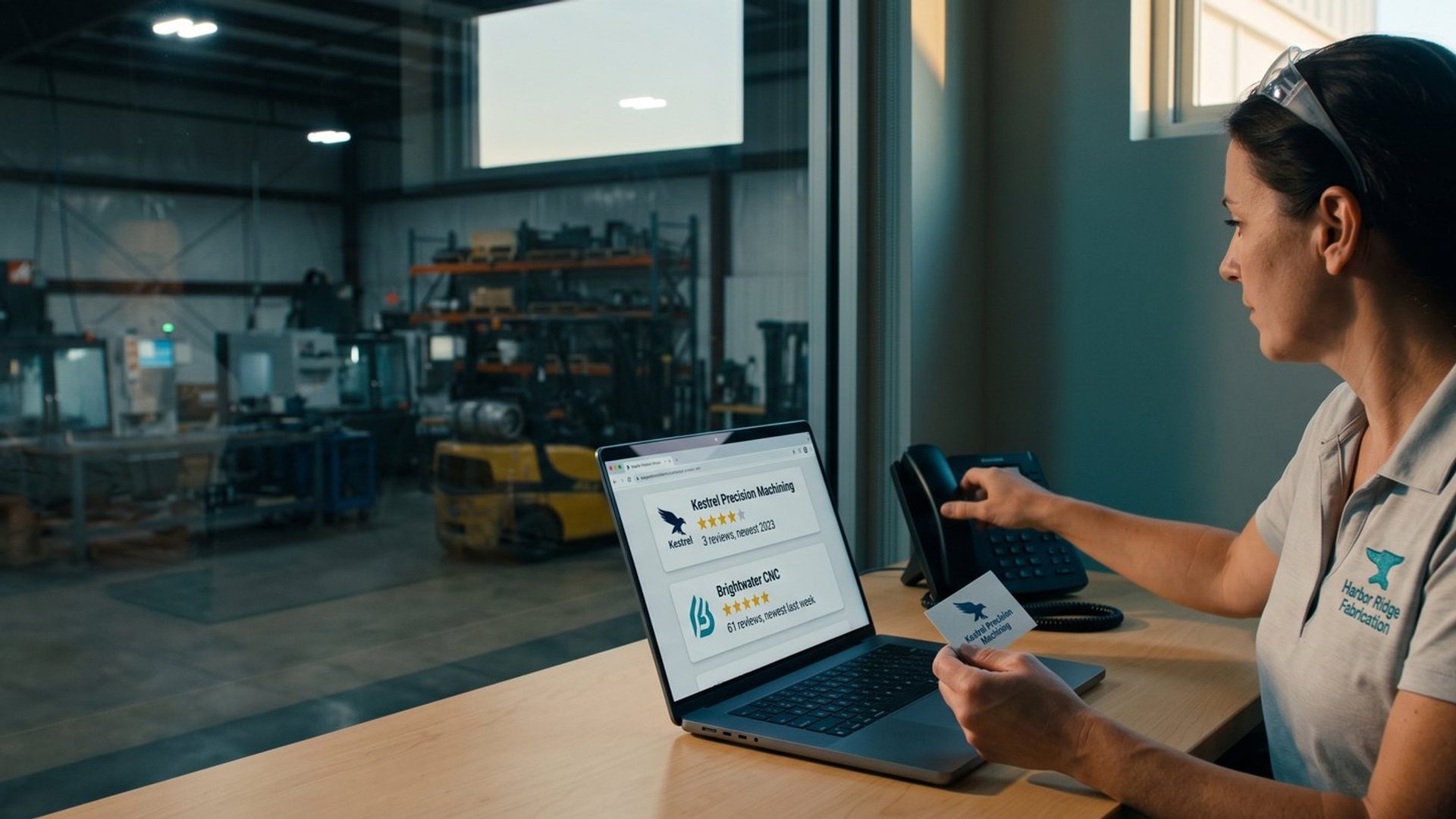
A plant manager in Ohio needs a new partner to machine aluminum housings. A colleague at a trade show gives her your name and says you did good work for his company. That is about as warm as a lead gets. She thanks him, goes back to her office, and types your company name into Google.
What she finds next decides whether she ever calls you.
If you machine parts, she probably lands on Thomasnet. If you run an IT services firm or an agency, it is Clutch. If you sell software, it is G2 or Capterra. She sees your listing. It has three reviews, the newest from 2023, and a description someone wrote when the company had half the staff it has now. One row down is a competitor with 60 reviews, four of them from last month, each naming a project like hers.
She calls the competitor. Your colleague's recommendation got you looked at. The review site decided you were not worth the call.
So here is the short answer, before the long one. B2B buyers check a review site before they call you, even when somebody they trust sent them. Those sites also sell advertising, and the advertising is easy to buy. But paying to put a thin profile at the top of a list just shows more buyers your weakest side. Get the profile and the reviews right first. Then decide whether the ads are worth it, and for a lot of small firms the honest answer is no.
A Referral Gets You Looked At. The Review Site Decides If You Get the Call.
Owners tend to think of review sites as a way strangers find you. That is half the job. The other half is checking, and it happens on deals you thought were already warm.
Katie Hollar, who runs marketing at Clutch, described this on the Duct Tape Marketing podcast. A lot of the people reading provider profiles on Clutch already have a name in hand from someone in their network. They come to the profile to check: has this firm done work in my industry, at my size, for a problem like mine? A referral tells a buyer you exist. A review tells her you have done this before for someone like her.
The research side is shifting too. G2, which runs the biggest software review site, surveyed more than a thousand software buyers for its 2026 buyer behavior report. G2 says 82% of them had asked an AI chatbot for software recommendations in the past two years, and that buyers now lean on review sites and chatbots more than anything else when they build a shortlist. G2 sells reviews, so read that with the obvious grain of salt. But the direction matches what we see, and the two feed each other: the chatbots lean heavily on what review sites say about you. We wrote about that side of it in Your Buyer Asks AI About You Before They Ask You.
The part that matters for a small firm is this. Nobody tells you when you lose a deal this way. There is no form fill, no call, no "we went another direction" email. The buyer looked, left, and called someone else. You never knew you were in the running.
Your Buyer Picks the Review Site. You Don't.
There are dozens of B2B review and directory sites, and each one will tell you it is the one that matters. It isn't. The site that matters is the one your buyers actually open, and that depends almost entirely on what you sell.
If you sell software, the sites are G2 and Capterra. Capterra is really three sites: the same vendor account and the same advertising also run on GetApp and Software Advice. As of February 2026 all four belong to one company: G2 bought Capterra, GetApp and Software Advice from Gartner. That makes the software side simpler than it used to be, and it also means one company now controls most of the shelf your product sits on.
If you sell a service, meaning an agency, an IT firm, a development shop, an accounting or consulting practice, the main site is Clutch. Clutch says it covers more than 1,500 service categories, from web development to bookkeeping.
If you make or supply physical goods for other businesses, it is Thomasnet, which has been the industrial buyer's directory for a long time, along with a handful of smaller industrial directories. We covered how engineers shop for suppliers in LinkedIn Ads for Manufacturers: Your Buyer Is an Engineer, Not a Marketer. Thomasnet is part of that same research trip.
Don't guess which one is yours. Two checks take an afternoon:
- Search like your buyer. Type the exact phrases a buyer would use, like "CNC machining aluminum Ohio" or "Salesforce consultant for manufacturers," into Google. Write down which directory pages show up on page one. Those are the sites your buyers land on without trying.
- Ask your last ten clients. One question at the end of a check-in call: "When you were choosing someone, did you look us up anywhere?" You will hear the same one or two names over and over. That is your list.
Most small firms end up with one site that matters a lot and one that matters a little. That is a manageable amount of work. Ten profiles that nobody maintains are worse than one profile that is complete.
An Unclaimed Listing Still Speaks for You. It's Just Wrong.
Here is something many owners don't realize: you probably already have a listing on at least one of these sites. Directories build profiles from public data whether you sign up or not. Thomasnet offers every supplier a free basic listing, and G2, Capterra and Clutch all let you claim a profile at no cost. If a listing already exists and you never claimed it, it is sitting there with whatever someone else filled in, and buyers are reading it.
Claiming is free on every site in the diagram above, and it is the single best hour you can spend here. Once it is yours:
- Pick your categories with care. Each category is its own page and its own competition. A machine shop listed only under "Machining Services" misses the buyer browsing "Aluminum Machining." A web firm listed under everything looks like it specializes in nothing. Hollar made the same point from Clutch's side: the providers that do best there are specific about who they serve, and the "we do it all" firms struggle.
- Write the description for the buyer comparing you, not for your own homepage. Say who you work with, what size of job you take, and what you are better at than the firm one row down. If the site lets you write a different description for each category, as Capterra does, use it.
- Fill in everything. Photos of the shop floor, real project examples, certifications, team size, minimum project size, locations served. Every empty field is a question the buyer has to call someone else to answer.
- Tag every link back to your site. Add tracking parameters to each link on the profile so a visit from Clutch or Thomasnet shows up in your analytics as Clutch or Thomasnet, not as "referral." You will need that number later, when someone asks you to pay.
- Answer every review, including the bad ones. Clutch does not remove negative reviews at a provider's request. A calm, specific reply to a fair complaint reads better to the next buyer than a wall of five stars, because it shows how you behave when something goes wrong.
Pius Binder, who founded a review-management company for software firms, put the timing plainly on the saas group podcast: claim the profiles and get a few real reviews before you need them, not after a deal goes cold. Starting when you are already losing deals is starting late.
A Happy Client Can Still Write a Review That Never Gets Published
The general habit of asking for reviews, meaning you ask at the moment the job goes well, make it one link, and spread them across the places your buyers read, is covered in the AI search post. What that post doesn't cover is that each B2B site has its own process. A client who is happy to help can still fail to produce a review if nobody tells them how the site works.
G2 checks every reviewer before the review goes live. Reviewers sign in with LinkedIn or an email address, answer questions about how they use the product, and a human moderator screens for employees and competitors. A reviewer who uploads a screenshot of the product in use, with their name or company visible, earns a "verified current user" label. When you ask a customer for a G2 review, tell them to sign in with LinkedIn or their work email and have a screenshot ready. That one sentence saves a lot of rejected reviews.
Clutch collects reviews two ways. For larger projects, usually more than $25,000, a Clutch analyst calls your client for a 15- to 20-minute interview, then writes it up and publishes it. For everything else, the client fills in an online form after signing in with LinkedIn or a company email. Either way the result is long. Hollar said the average Clutch review runs close to 500 words and covers the scope, the timeline, the budget and the outcome.
That changes who you ask. The happiest client is not always the best reviewer for Clutch. The best one is a client who will take a 15-minute call, can speak to the budget and the result, and is in the industry you want more work from. One detailed review from a manufacturer you did a $40,000 project for is worth more to the next manufacturer than five short ones from anybody.
Thomasnet works differently. It is mainly a supplier directory, so most of the persuading happens in your capability details rather than in written reviews: tolerances, materials, certifications, part photos. Fill those in like the buyer is an engineer checking your specs, because she is.
Paid Placement Buys Position. It Doesn't Buy Trust.
Every one of these sites is free for buyers, and the vendors pay for it. That is the business model. Claim a profile and expect a sales call before long. Before you take it, know what each site actually sells.
Capterra sells clicks. You pick a category and bid a price per click, and the higher your bid, the higher your listing sits in that category. You are not bidding on keywords the way you would in Google Ads; you are bidding on the category page itself. A paid listing gets buttons that send the buyer straight to your website, while a free listing keeps them on Capterra. One bid runs across Capterra, GetApp and Software Advice. The cost climbs in crowded categories. One B2B ad agency founder who spent more than $1 million on Capterra ads in a single year watched his cost per click rise 72% over that year as more competitors bid on the same categories.
Clutch sells sponsorship. Clutch's own help pages say its directory pages are sorted by sponsorship first and Clutch rank second, while its "Leaders" rankings are sorted by Clutch rank alone. In plain terms, paying moves you up the browse pages. It does not move you up the rankings that are built from your reviews.
Thomasnet sells yearly programs. The basic listing is free. Paid programs are priced by how crowded your category is, and are usually sold as annual contracts. WebFX, an agency that sells search marketing to manufacturers, estimates the average at $7,000 to $10,000 a year, and $25,000 to $50,000 in competitive categories. Treat those as rough guides from a firm with a stake in the answer. The number that matters is the quote your rep gives you.
Notice what all three have in common. You are paying to be seen first. What the buyer sees when she gets there is still your profile, your reviews and your description. Put a profile with three old reviews first in its category and you have paid to show more buyers exactly why they shouldn't call you.
Three Questions Tell You If a Review Site Ad Will Pay for Itself
When your profile is complete and the reviews are coming in, paid placement can be worth testing. Before you sign anything, answer three questions.
1. Does that page show up on Google for what your buyers search? A lot of directory traffic comes from Google, not from people browsing the directory. John Locke, an SEO consultant who works with manufacturers, gives the cleanest test we have heard: before you pay for any Thomasnet category, Google the term yourself. If Thomasnet's category page is on page one, a paid spot on that page is a second way to appear for that search. If it is on page three, almost nobody will ever see what you paid for. The same check works for Clutch and Capterra category pages.
2. Does your profile already hold up against the listings beside it? Open the category page and look at the firms around the spot you would buy. Compare review count, how recent the reviews are, and how detailed they are. If you come out clearly behind, buying the top spot just puts that comparison in front of more people. Spend the next quarter on reviews instead.
3. Can you track the category to revenue? Capterra's dashboard reports clicks and conversions. Thomasnet has its own analytics tool. Neither knows whether a lead became a customer. That same agency founder's advice from his own spending was to give every category its own tracking link and follow it into your CRM: which category produced the lead, the opportunity, and the signed deal. If $1,000 in one category turned into $10,000 in closed business, you know what a click there is worth to you. If you can't trace it, you are trusting the seller to grade its own homework.
If you get three yeses, start small:
- Bid for second or third place, not first. In that founder's Capterra accounts the first spot often cost far more than the second or third for only a little more visibility. In an example he walked through, dropping from first to third cut the cost per click by about 60%, and the listing still sat near the top of the page.
- Buy the fewest categories you can. Thomasnet reps will offer a bundle. Locke's advice is to take the minimum for one year, see what it actually produces, and only then decide on year two.
- Think about your margin. If one new client is worth $50,000 a year, a $10,000 listing needs one win to pay off. If you sell low-margin parts by the thousand, it may never pay back however many leads it sends.
- Send your best categories to a matching landing page. A buyer who clicked through from "aluminum machining" should land on a page about aluminum machining, not your homepage. We go into why in Your Buyer Is Already Comparing You. The Only Question Is Where.
Most Small Firms Should Keep the Free Profile and Spend the Money Elsewhere
Here is the number to keep in mind when the sales rep calls. WebFX described a manufacturing client that received 478 requests for information over its first year of working with them. One came from Thomasnet. That is one company's experience, from an agency that sells the alternative, but it is a useful reminder: a directory is one place buyers check, not the place they all start.
So for most small B2B firms, the order looks like this. Find the one or two sites your buyers actually open. Claim the profile and fill in every field. Spend a few months building a steady flow of detailed, real reviews from the clients you want more of. Answer the three questions. Then, if the page ranks, your profile holds up, and you can trace the money, test a small paid placement for a defined period and judge it on closed business, not clicks.
The free profile does most of the work, because the free profile is what a buyer is checking. Paid placement only changes how many buyers see it. Get the thing they see right first.
We spend our days helping small and mid-sized B2B companies get found and get chosen, and that includes working out which of these sites are worth your money and which ones only need an afternoon. If you would rather hand that off, that is what we do. If you would rather claim your profiles yourself this week, start with the Google search in question one. You will learn a lot from what shows up.