It usually starts with a handful of inquiries from overseas. A firm in Leeds fills out your form. A prospect in London asks whether you work with UK companies. You do, or you could, so you open your LinkedIn campaign, type "United Kingdom" into the location box next to "United States," and leave the budget where it was. One hundred dollars a day.
It feels like a free second market. Same ads, same audience, same spend, twice the territory.
It is not free. You did not add a second budget. You took the one you had and gave LinkedIn permission to spend it in two places, on its own terms, without telling it which of the two actually pays your bills. This piece is about what happens next, how to tell whether it is already happening in your account, and how to enter a second market properly when it genuinely deserves your money.
Adding the UK Doesn't Add a Dollar. It Splits the $100 You Already Had.
A location setting is a fence, not a fund. When a campaign covers two countries, every dollar of its daily budget is now available to either one, and the split between them is decided impression by impression in LinkedIn's auction. You do not choose it. You do not see it in the campaign totals. LinkedIn does not ask whether the United States is the market that has produced every customer you have ever signed.
Katia González, who co-founded the LinkedIn agency GetUpLead after years as a CMO, puts this near the top of the setup mistakes she finds when she audits accounts. Interviewed on Impactable's LinkedIn AdWise podcast, she describes advertisers who want to reach the United States and Australia, or the United States and the UK, putting both in one campaign and "burning your budget in one country and then there's nothing left" for the other. The host, Justin Rowe, had made the same mistake in his own account. The United States was his number one market and the UK was number two, and because they shared a campaign, the UK was getting the money. His explanation is the arithmetic of a small budget: at twenty, fifty or a hundred dollars a day, the budget is "not going to be in play for 24 hours."
There is a clock behind that, and it runs on London time, roughly. LinkedIn runs its schedules on UTC, and Rowe reports that its day turns over at about 8 p.m. Eastern (7 p.m. after daylight saving time ends), so on a small budget a lot of the money goes out before he is awake. London's working day starts five hours before New York's. We covered the mechanics of that clock, and the custom schedule LinkedIn offers to control it, in the piece on LinkedIn budgets that spend all weekend. For this decision you only need the consequence: in a campaign that spans the Atlantic, the market that wakes up first gets first call on the money.
One more detail makes the split looser than most people assume. LinkedIn treats a daily budget as an average, not a cap. Its own help page says actual spend "might be up to 100% higher than the daily budget amount on a given day," held in check only by a ceiling of seven times the daily budget across a Monday-to-Sunday week. None of that looseness is shared out by country on your behalf.
A Blended LinkedIn Report Hides the Country That Isn't Working
Here is why nobody notices. The numbers get better.
Clicks on LinkedIn are not priced the same everywhere. Tamarind's B2B House, a B2B marketing site that publishes LinkedIn benchmarks, puts the average cost per click at about $9.90 in the United States and about $7.00 in the UK. Treat those as one agency's benchmark rather than a price list; your own costs will depend on your audience and your bids. But the gap is wide, and the United States sits at the top of that benchmark's list.
Now put that inside one campaign. The following is a hypothetical, built to show the shape of the problem rather than to predict your account.
You spend an average of $100 a day, which comes to about $3,040 over a month. Spent entirely in the United States at $9.90 a click, that buys roughly 307 clicks, every one of them in the market where you have customers.
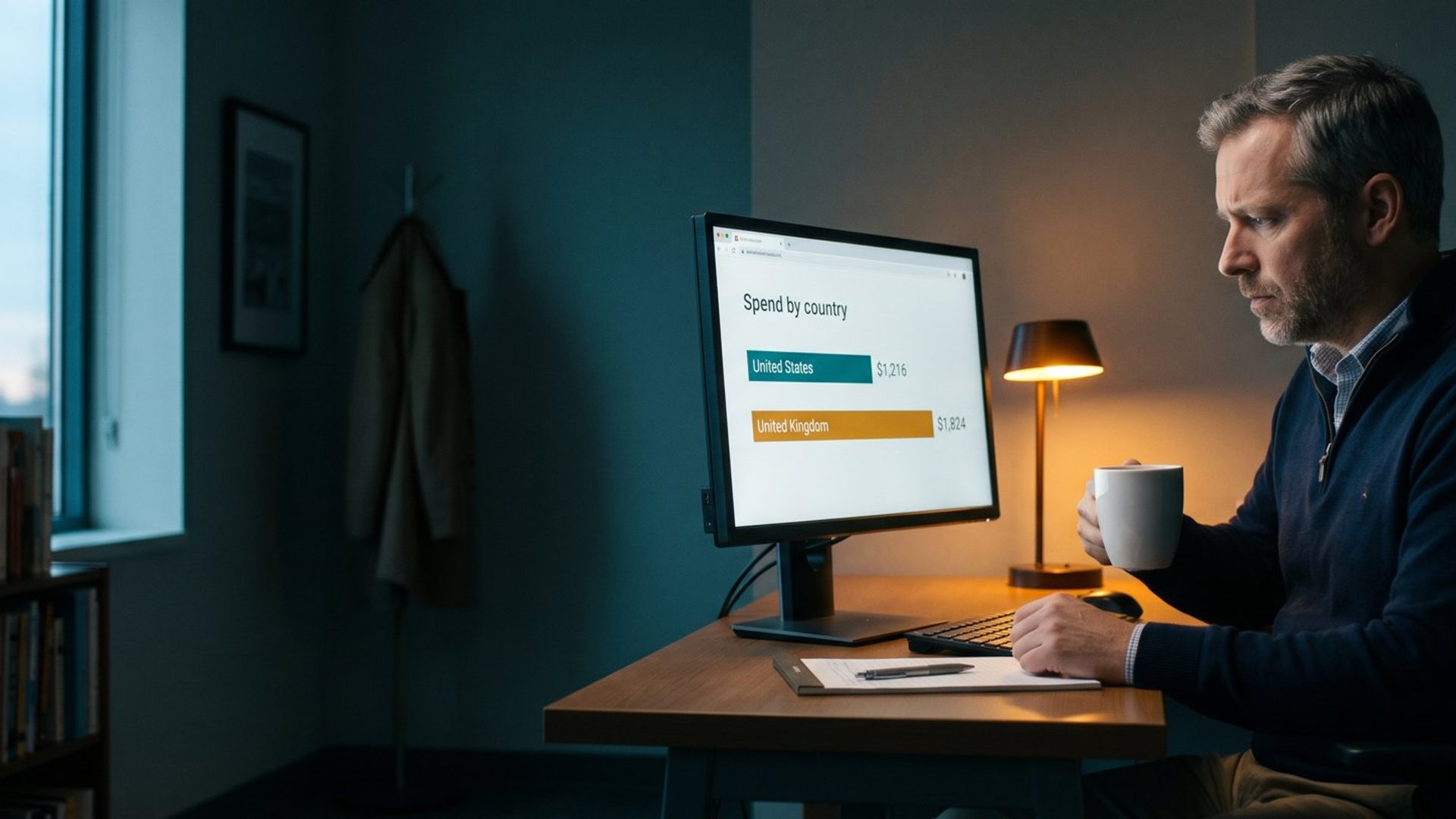
Add the UK and suppose 60% of the spend drifts there, because its day opens first and its clicks are cheaper. That is $1,824 at $7.00, about 260 UK clicks, and $1,216 at $9.90, about 123 US clicks. The campaign now reports 383 clicks at a blended $7.93 each.
Read the dashboard and you would call that an improvement: 25% more clicks, each one 20% cheaper. Read it by country and your home market just lost three clicks in every five. If the UK leads are real, maybe that trade is worth it. If they are curious, unqualified or impossible to serve, you have quietly swapped your best market for a cheaper-looking chart.
The blended number is not lying. It is answering a question you did not ask. "What does a click cost across this campaign?" and "Is each market paying for itself?" are different questions, and only the second one decides whether the UK deserves a share of your money.
Canada Can Share Your US Campaign. London and Sydney Can't.
None of this means every multi-region campaign is a mistake. Plenty of markets share a campaign perfectly well. Three questions decide it.
Do their working days overlap? Toronto runs on the same clock as New York and Vancouver on the same clock as Los Angeles. A New York to Los Angeles spread is three hours, which means the two coasts share most of a working day. London is five hours ahead of New York and eight ahead of Los Angeles, so its working day is nearly over before California's starts. Sydney's working day begins around the time New York is heading home. The further apart the working days, the more the market that wakes first gets first call on your budget.
Do their clicks cost about the same? When two markets are priced alike, the auction has no strong reason to favor one. When one is a good deal cheaper, the cheaper one pulls spend toward it, and the gap shows up as the kind of flattering blended number described above.
Can you sell the same thing the same way? The same offer, the same proof, the same pricing, and a sales team that can take a call during the buyer's working hours. A UK prospect who books a discovery call and gets offered a slot at 10 p.m. their time has learned something about you.
Run the pairs through that and the answer is usually obvious. The United States and Canada pass on all three for most businesses. The two US coasts pass, which is why Yoel Israel of WadiDigital, who runs LinkedIn for B2B clients, says the furthest he usually goes on a modest budget is splitting the east coast from the west. The United States and the UK fail the first two. The United States and Australia fail all three.
If your geography passes, one campaign is the right structure. Keep the location wide and set it to permanent location, as we covered in the LinkedIn setup piece, so you reach people who live and work there rather than whoever passed through on a trip. And if your problem runs the other way, a market that is one metro rather than two countries, that is a different setup, which we covered in the piece on LinkedIn for a single-city market.
$100 a Day Split Between the US and the UK Loses Both
When the markets fail the test, the instinct is to split them into two campaigns, one per country. On a small budget that usually makes things worse.
Israel's position is blunt. He works with budgets around $5,000 a month and says that at that level he will not segment much deeper than "all of US or all of North America," and that he does "not recommend segmenting by country" unless the budget is huge. He would rather spend his splits testing new targeting than dividing a modest budget by geography.
He has a point, and it is the same point we made in the piece on running four campaigns with a budget for one. Two campaigns at $50 a day are not twice as informative as one at $100. They are two campaigns each starved of the volume it needs to tell you anything. At $9.90 a click, $50 a day buys about five US clicks. You can wait a very long time for five clicks a day to produce a pattern you can act on.
So the honest answer for most small firms is the unglamorous one: pick the market that pays you and win it first. That usually means taking the UK back out of the campaign, not because the UK is a bad market, but because $100 a day cannot buy a real answer in two of them at once. Keeping geography wide inside one country, which we argued for in the piece on LinkedIn audience size, is a different thing from stretching a budget across an ocean.
Note what both practitioners agree on, even though their advice points opposite ways. González says never let two markets fight over one budget. Israel says never cut a small budget into pieces too small to learn from. Both are right, and together they rule out the setup most accounts actually have: two countries sharing one small budget.
If the UK Is Worth Entering, It Gets Its Own Campaign and Its Own Budget
Sometimes the second market is real. You can tell it apart from wishful thinking by evidence you already have.
It is already sending you business. Not one inquiry, but a steady trickle of UK leads, or UK customers who found you some other way and stayed. Pull your CRM and count them before you spend a dollar chasing more.
You can serve it. Someone can take a sales call in UK business hours. You can deliver the work, ship the product or support the customer from where you are. Your pricing makes sense in their currency and you are prepared to quote it.
You can afford it without starving home. The UK budget is new money, or money you have deliberately moved away from something weaker. It is never a slice quietly taken out of the US.
If all three are true, González is right: the UK gets its own campaign, with its own budget, its own location setting and its own ads. Own ads matters more than people expect. A UK buyer reading a case study about a company in Ohio is reading proof that you can help businesses somewhere else. If you have even one UK client willing to be named, that story belongs in the UK ad.
A separate campaign also fixes the report. Each country now carries its own cost per click, cost per lead and, once the deals come in, its own cost per customer. You stop asking the blended number a question it cannot answer.
A UK Test With No End Date Isn't a Test. It's a Slow Leak.
The last mistake is the quietest one. You launch the UK campaign "to see how it goes," and nine months later it is still running, still costing a few hundred dollars a week, and nobody has decided whether it works.
Build the test so that it has to end.
Give it an end date and a lifetime budget. LinkedIn's lifetime budget is a total for a fixed run: its help page says total spend "will never exceed the lifetime budget." There is a trade-off worth knowing. LinkedIn says a campaign on a set schedule "automatically stops" at its end date, and getting it running again means going back in and editing it. For an always-on campaign that is a nuisance. For a test, it is exactly what you want: a hard stop that forces a decision.
Decide the pass mark before launch. Write down the number that would make the UK worth keeping. The cleanest is cost per qualified lead against your home market, adjusted for what a UK customer is worth to you. If UK deals are smaller or slower, the UK has to deliver leads cheaper to earn its place. We walked through how to judge whether a lead cost is expensive in the piece on LinkedIn lead costs, and the same reasoning applies here, one country at a time.
Spend enough to get an answer. A test that buys a handful of clicks proves nothing in either direction. Size the lifetime budget to produce enough leads to compare, and accept that a small budget may mean a longer test, not a smaller one.
When the end date arrives, the campaign stops on its own and you make one of three calls: keep the UK and give it a standing budget, run a second test with a change you can name, or leave it and put the money back into the market that pays.
Your LinkedIn Demographics Report Already Shows Which Country Got the Budget
If your account already mixes countries, you do not have to guess how the money split. LinkedIn has been recording it.
Open the campaign in Campaign Manager and go to Demographics, the report we walked through in the piece on seeing exactly who clicked. Switch the view to country or region. Israel points to the same place: from the demographics drop-down, change the breakdown from job function to location and the geographic split appears.
Three things to look for:
Where the impressions and clicks actually went. Compare the share each country took with the share you would have chosen. If the UK took most of the delivery in a campaign you think of as a US campaign, you have found your answer.
Countries you never meant to reach. Dekker, who teaches B2B advertising on his channel Dekker the Marketer, audited his own campaigns this way and found impressions landing well outside the North American market he was aiming for. If a country appears that you cannot sell to, exclude it.
What each country turned into. LinkedIn can tell you where the clicks went. Only your CRM can tell you where the customers came from. Tag leads by country, line them up against the spend, and you have the per-market numbers the blended report was hiding.
That one report is often enough to settle the question. Either the second market is earning its share, in which case it deserves a campaign of its own, or it is spending the money your home market needed, in which case the fix takes thirty seconds and one deleted location.
A second market can be a real way to grow. It just has to be entered on purpose, with its own money and a date when you decide. If you would rather have someone else set up the split, size the test and read the per-country results with you, that is the kind of work we do every day in LinkedIn ads management. And if you would rather run it yourself, start with the Demographics report this week. It takes five minutes and it will tell you which country your budget has been working for.