You can buy advertising inside ChatGPT. Not soon, not in a closed beta you have to know somebody to join. Today, from a self-serve dashboard, with a credit card, for a minimum of twenty-five dollars a day.
That is worth stating plainly, because most of what has been written about this is guesswork. Search for it and you will find social posts, screenshots and blog roundups citing each other, all confidently describing a product they have not opened. Meanwhile OpenAI publishes the whole thing: the policies, the bidding models, the audience minimums, the crawler requirements, the billing mechanics.
So this is that documentation, read end to end, translated for somebody who has a business to run and a budget that has to work.
What Is Actually Live
The test began in the United States on February 9, 2026. It ran as an invite-only pilot through the spring, then in May OpenAI opened a beta self-serve Ads Manager alongside CPC bidding and proper measurement tools.
On August 31 they published the scoreboard: one billion dollars in annualized revenue run rate, in under two hundred days, tens of thousands of advertisers, and availability in more than forty countries. Self-serve is live in the United States, the United Kingdom, Canada, Australia, most of Europe, India, Japan and a long list besides.
It is still labeled beta, and OpenAI is direct about what that means: "ChatGPT Ads is currently in beta and in the early stages of scaling." Expect the product you learn this month to be a slightly different product next month.
A Billion Weekly Users Is Not Your Audience
Here is the first number to stop repeating. ChatGPT has more than a billion weekly users. Almost none of the coverage mentions how few of them are eligible to see an ad.
Ads appear only on the Free and Go plans. Plus, Pro, Business, Enterprise and Edu accounts see nothing. So every paying subscriber, which is disproportionately the professional and higher-income user, is out.
Then it narrows again:
- No ads to accounts identified as under 18, using age prediction rather than just a stated birthday.
- No ads in Temporary Chats.
- No ads in the ChatGPT Atlas browser during the test.
- No ads near personal health, mental health, or political conversations. Not restricted. Not eligible.
- And free users can switch to an Ads-Free mode that trades ads for lower message limits.
That last one deserves a moment. The people most annoyed by advertising can remove themselves, which means the reachable audience is self-selected toward people who looked at the trade and accepted ads in exchange for more usage. Whether that makes them better or worse prospects, nobody yet knows. But it is not the undifferentiated billion.
There Are No Keywords. There Are Context Hints.
This is the part that will break your instincts if you have run search ads.
There is no keyword list. At the ad-group level you write context hints: plain descriptive phrases about what you offer, who it helps, and when it is useful. OpenAI's own example is that instead of "running shoes" you write "cushioned everyday running shoes for beginners training for their first 5K."
Then read what they say those hints are not:
In OpenAI's words, context hints "are not exact-match controls, audience targeting rules, or instructions to show your ad only for specific conversations," and "do not guarantee that your ad will appear for particular words, topics, audiences, or situations."
You are not buying a query. You are describing your product to a matching system and letting it decide when the description fits somebody's conversation. The signals it weighs include the context and intent of the live conversation, your landing page, your title and copy, your hints, and, where the user has personalization on, wider signals from their ChatGPT history.
For anyone who has spent years building negative keyword lists to control exactly where money goes, that is a genuine loss of control, and it is the honest reason to start small.
The Targeting Is Better Than You Would Guess, With One Wall
Given all that, the targeting is more conventional than expected.
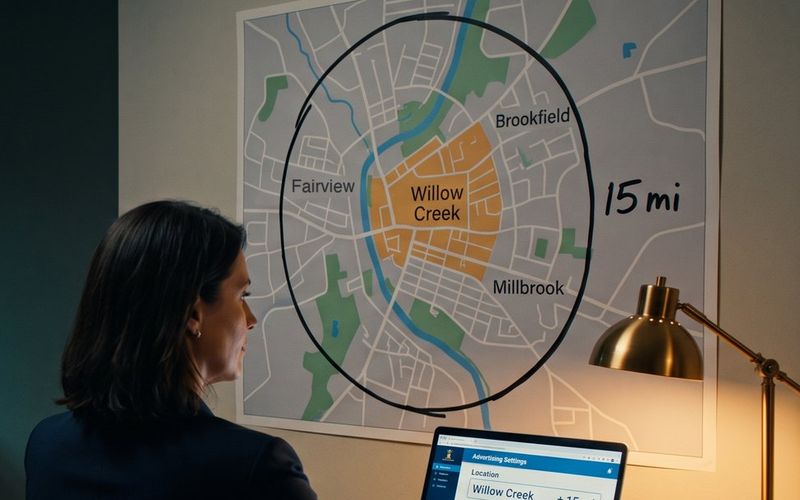
Geography works properly. You can target by country, and in the United States by state, DMA, and ZIP code. OpenAI publishes the full location catalog as a downloadable CSV. A local business can genuinely fence its service area, which is the single most important control for anyone selling within a drive.
Platform targeting lets you pick iOS app, Android app, or web.
Then the wall. Custom audiences, built from your customer emails or phone numbers, look like the obvious play for a small business. They are not, yet:
Inclusion targeting and audience bid adjustments require at least 25,000 matched users. OpenAI recommends at least 100,000. Lists under 25,000 can only be used for exclusion.
Read that against your actual customer list. Most local businesses and plenty of ecommerce brands have a few thousand customers, not twenty-five thousand. So for the overwhelming majority of small businesses, custom audiences are usable for one thing only: excluding people you do not want to pay to reach again. That is not nothing, but it is the opposite of what most people will assume when they see the feature.
The Default Bid Strategy Decides for You
New ad groups now default to a strategy called Maximize results, which sets and adjusts your bids automatically to get as many results as it can from your budget.
OpenAI is refreshingly blunt about the catch:
Their documentation states it "prioritizes result volume and does not guarantee delivery against a specific CPA, CPC, ROAS, or other cost-efficiency target at this time."
If you have read anything we have written about Smart Bidding or Performance Max, that sentence will feel familiar. Automated bidding optimizes toward the outcome you named, at whatever price the auction demands, and the guardrail is your budget rather than your efficiency target.
The alternative is Manual: Max bid, where you set a ceiling at the ad-group level. For CPC campaigns OpenAI suggests starting between three and five dollars a click. Underneath it all is a relevance-weighted second-price auction, so a more relevant ad can win against a higher bid.
Three objectives exist: CPM for reach, CPC for clicks, and oCPC, which optimizes toward a conversion event. Note carefully what oCPC does not change: you are still billed per valid click, not per conversion.
One trap worth knowing before you build anything: you cannot change a campaign's objective after you create it. Wrong objective means a new campaign.
Your Landing Page Has to Let a Robot In
This one will quietly stop a real percentage of small businesses, and almost nobody is talking about it.
Before an ad can run, OpenAI crawls the landing page to review it against policy and to understand when the ad is relevant. You must allow `OAI-AdsBot`, and they recommend allowing `OAI-SearchBot` too. If the crawler cannot reach your page, the ad cannot be reviewed, and an ad that cannot be reviewed cannot serve.
Three layers commonly block it, and most owners do not know any of them are on:
- robots.txt telling crawlers to stay out.
- Bot mitigation at Cloudflare, Akamai or similar, which frequently returns a 403 to anything that looks automated. The good news: `OAI-AdsBot` is officially verified and allowlisted by Cloudflare.
- CAPTCHAs and JavaScript challenges at the application layer.
OpenAI also warns off app-store links, deep links and anything behind a login as destinations, because there is not enough crawlable content to review.
What You Can Measure, and the Two Numbers That Will Confuse You
Measurement is more mature than you would expect this early.
There is an OpenAI Pixel and a Conversions API, and OpenAI recommends running both with a shared event ID so conversions deduplicate. Clicks carry a reference parameter called `oppref` appended to your landing page URL, which the pixel stores in a first-party cookie. Your UTMs survive the click, so your existing analytics keep working. There is automatic advanced matching, which hashes form data in the browser before it is sent, and modeled measurement that may estimate conversions it could not directly observe.
Reporting gives impressions, clicks, spend, CTR, average CPC, average CPM and conversions, in tables, charts and CSV exports.
Now the two numbers that will trip you up.
First: conversions take 24 to 48 hours to appear. If you check the morning after launch and see zero, that may be the reporting lag rather than the truth.
Second: view-through conversions are reported separately, on a fixed one-day window, and are deliberately excluded from the Conversions total. They do not affect CPA, bidding, or billing. If you go hunting for a bigger number and add the VTA column to your headline figure, you will be inflating your own results against a metric OpenAI has explicitly walled off. We have written before about how two dashboards can both be right while disagreeing; OpenAI has pre-emptively published its own version of that list, including the line that "a difference does not necessarily indicate an error."
Nobody Knows What Good Looks Like, Including OpenAI
This is the most useful sentence in the entire documentation, and it comes from OpenAI:
Hold every confident number you have seen against that. The CPMs, the CTRs, the "average ChatGPT Ads CPC" figures circulating in blog posts and LinkedIn threads are not benchmarks, because no benchmarks exist. They are one person's account, or invented.
OpenAI does publish two results of its own: an ecommerce advertiser reaching three times return on ad spend over twenty-eight days, and a technology partner reporting that more than eighty percent of ad-driven traffic was new customers. Those are selected anecdotes from a company announcing a milestone. They are not what you should expect.
The most honest public datapoint comes from an agency that spent its own money and published the result: roughly twelve hundred dollars, ninety-two clicks, zero conversions, an average cost per click around thirteen dollars. One account, one advertiser, a B2B offer, and already out of date, since it describes limitations that the documentation shows have since changed. Take it as a caution about expectations rather than a forecast.
Who Can Actually Advertise
The ad policies are narrower than the platform, and this is where most owners will find their answer.
Allowed today: household and consumer goods, local services, travel and entertainment, and digital products and education. If you are a home service business, a shop, or a course, you are in the permitted set.
Restricted, United States only, approved advertisers, case by case, with proof of licensure sometimes required: health services, financial services, and legal services. The health list is specific rather than general, naming things like dental, vision, hospitals and urgent care, medical testing, and minimally invasive cosmetic procedures. If your category is not named, do not assume you are covered.
Disallowed outright: gambling, alcohol and tobacco, recreational drugs including THC, adult content, political content, individual job and housing listings, and anything making wellness claims, which explicitly includes health coaching and detox programs.
And remember the placement rule sitting underneath all of it: even an approved advertiser in a sensitive category will not have ads placed near personal health, mental health or political conversations.
Is It Worth Twenty-Five Dollars a Day
Here is the honest read.
Try it if you are in a permitted category, you sell something people research conversationally before buying, and you can fund a real test rather than a gesture. The minimum is twenty-five dollars a day, but a genuine test needs enough clicks to tell you something, and at the costs early advertisers are reporting that likely means a few thousand dollars over a month, not a few hundred.
Wait if your customer list is your main advantage, because until you have twenty-five thousand matched users the audience tools mostly cannot help you. Wait too if your category is restricted and unapproved, or if you have no conversion tracking on your site today, because you will be buying clicks you cannot evaluate.
Understand what you are buying either way. This is not search. Nobody typed a query with commercial intent and got your ad in the results. Somebody was working through a decision and your ad appeared underneath the answer. That is closer to a very well-targeted display placement than to Google Search, and it should be judged, and budgeted, accordingly.
The interesting part is not the ad unit. It is that a growing number of buying decisions are now being worked out inside a conversation rather than a search box, and this is the first way to be present while that happens. Whether that turns out to be worth paying for is a question the data cannot answer yet, for anybody, including the people selling it.
What you can do is decide deliberately, on your own numbers, instead of on somebody's screenshot.