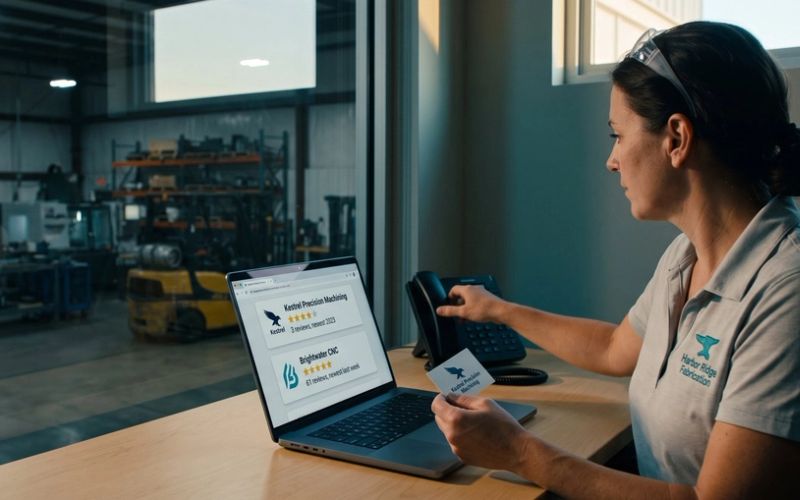
Ryan Maya runs a small fishing-gear company, and he filmed his first trade show booth so other owners could see what one really costs. The 10-by-10 space was $2,000. The association fee was $750. He rented a slatwall for about $1,500, paid for lights, flooring and the labor to put it all up, then added most of a week of hotel nights for himself and a staff member, plus flights and food. His estimate for the whole thing was "probably like $10,000," and he said on camera that he had no idea whether it would pay off.
That is the trade show most small B2B firms know. Two days on your feet, a bowl of candy, a stack of scanned badges, and maybe three conversations worth having. The badge list goes into a nurture sequence, the sequence gets ignored, and six months later nobody can say what the $10,000 bought.
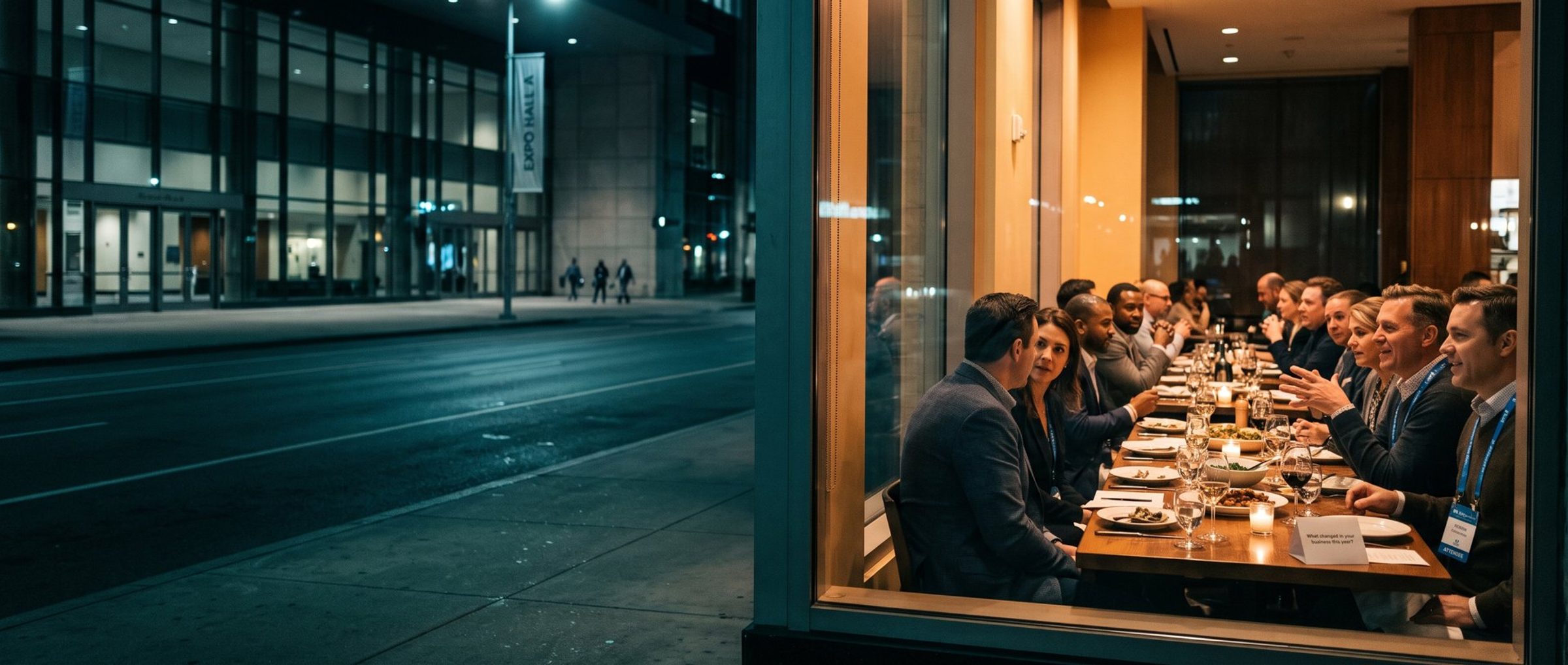
There is a cheaper version of the same trip that most small firms never try. You book a private room at a good restaurant near the show, invite twelve people, and spend three hours with them. The people who run these dinners for a living describe them very differently from booths. Nobody calls a dinner a lead machine. They call it the place where deals they already had started moving.
This piece is about how to plan one, fill it, run it and judge it, on a small firm's budget. It is B2B event marketing at the scale of one restaurant table, which is the scale most of our readers actually work at.
A Dinner Won't Create Pipeline. It Moves the Deals You Already Have.
Start with the honest version, because the people selling event software are surprisingly candid about it.
Jonathan Kazarian runs Accelevents, which sells event management software, so he has every reason to oversell events. On Insightly's Closing Time podcast, the host compared the roughly $50 per head of a casual networking outing to what she pays Google for a lead. He pushed back. Someone who books a demo off a paid lead is raising a hand. Someone who joins you for an evening is not. In his words, it builds brand awareness and puts people on your roadmap, "but it's not pipeline." The payoff, as he describes it, comes later: when that person finally starts shopping, sometimes most of a year on, they still remember the evening and who hosted it.
Zach Diamond, who runs revenue marketing at the AI company Cognition and hosts executive dinners in New York, London, Paris and a handful of other cities, says something that sounds like the opposite. His dinners show their biggest effect on deals. But listen to which deals. He describes the format as best for "pipeline maturation": senior buyers who are already in a sales conversation, seated beside a few existing customers, having a frank talk with peers. Those deals move faster afterward. For a cold audience, he says, an intimate dinner is the wrong tool.
Both of them are right, and putting the two together gives you the rule for a small firm. A dinner does not create pipeline cheaply. It moves the pipeline you already have. It turns a buyer who has gone quiet for two months into one who introduces you to her team.
That tells you who should host one. If you have open deals that have gone quiet, a handful of customers who like you, and enough of both in one city to fill a table, a dinner is one of the best uses of a few thousand dollars you have. If you have no contacts in a city at all, do not start with a dinner there. Diamond is blunt about this: with no relationships in a market, inviting cold strangers to dinner gets you people who came for the free food. Go to other people's events in that market first, meet people, and host once you have a list. Dave Gerhardt's guests at Exit Five, who have run event programs at Qualtrics and Iterable, describe the same order: early on you go to third-party shows because nobody knows who you are, and you host your own once your database can fill a room.
The Guest List Comes Off Your Deal Board, Not Your Address Book
Most dinners get planned the wrong way around. Someone picks a city and a restaurant, then asks sales to "invite some people." The guest list ends up being whoever answered.
Diamond plans his the other way. The first conversation is with sales leadership, and the question is what the dinner is for. His example: there are eight late-stage deals in one city, all in retail, and they need to close. So the dinner is built around a retail conversation, and success has a definition before a single invite goes out. Success is those eight people attending. If fifteen show up, the other seven are a bonus.
For a small B2B firm, that turns into a short exercise:
- Open your pipeline and list every deal that has gone quiet or slowed down.
- Group them by city. You are looking for one place with five to eight of them.
- Add the customers in that same city who would say good things about you unprompted.
- That list is the dinner. The city and the date come second.
If you cannot get to five open deals in one place, that is useful information too. It means the dinner is premature, and the money is better spent somewhere else this quarter.
This also fixes the oldest problem with events, which is that sales does not care about them. Diamond notes that if he tells reps to invite their contacts and nobody knows who those contacts should be, that is a sign the event should not happen. When the dinner is built around a rep's own stalled deals, it is not marketing's event anymore. It is a favor to the people whose quota depends on those deals.
Your Customer Sells You Better Over Dinner Than Your Best Rep Does
The most persuasive person at your table is not on your payroll.
Eric Siu, who runs the agency Single Grain and has been hosting dinners for more than a decade, splits his tables roughly in half: about half customers, half people he would like to work with. He told a story on Marketing School about one early ten-person dinner that produced three clients, all closed within a year. He did not pitch anyone at the table. The customers did the work, just by talking honestly about their own problems in front of peers who had the same ones.
Diamond describes the same effect from the other side. When a buyer who is still deciding sits next to someone at her level who already uses your product, she gets a level of trust no sales deck can produce. She hears how it actually went, including the parts that were hard.
Two rules make this work.
Seat people at the same level. Siu is firm on this one. Do not put an intern beside a founder beside a director. They will not talk about the same things, and everyone leaves feeling they wasted the evening. If your open deals are with operations directors, fill the table with operations directors.
Keep it small. Diamond aims for about fifteen and calls twelve the sweet spot. Once, partners brought extra guests and 29 people showed up. The room split into two tables with two facilitators and a presentation nobody could hear, and the format that makes these dinners work, one shared conversation, was gone. Siu aims for ten. Somewhere between ten and fifteen is the range. Past that you are hosting a party, which is a different event with a different job.
A Company That Sells to Your Buyer Will Pay Half the Dinner
The cheapest dinner is the one you do not pay for alone.
Kazarian's company hosted eleven events one year, and he said almost none of them were hosted solo. They co-host with two to four partners: companies that sell to the same buyer without competing, such as an integration partner or an agency that implements their software. For a dinner, they aim for 25 to 32 prospects. All in, he put the cost at around $8,000 depending on the city, split between the co-hosts, so each company's share is a couple of thousand dollars. Even with travel, he said, cost per guest lands around $300 to $450.
Those are his program's numbers, not a benchmark, and his tables run larger than the intimate dinners described above. But the logic carries straight down to a twelve-seat table. A partner brings three things: half the bill, half the invitations, and their customers' trust. On Exit Five, one of Gerhardt's guests, who runs events and partner marketing at Iterable, said the biggest mistake she sees is companies not using their partners for events at all. Kazarian explained why it works so well: when a guest's existing vendor recommends you, she arrives already inclined to believe you, because two companies willing to host a dinner together probably do work well together.
If you are not sure who that partner would be, we wrote a whole piece on finding them: Somebody Already Sells to Your Buyer. They Are Not Your Competitor. A co-hosted dinner is one of the easiest first projects to do with one.
The Night Before the Trade Show Beats a Booth on the Floor
You do not have to choose between a show and a dinner. The smartest version uses the show to fill the dinner.
When an industry conference comes to town, your buyers have already bought the plane ticket and the hotel. They are in one city, with evenings free, and many shows do not feed attendees dinner. One of Gerhardt's guests described the move directly: instead of spending heavily on a booth on the show floor, rent out a restaurant close by, because your buyers are all going to be in the area anyway.
The details decide whether it works.
Pick the show by how many of your buyers are there, not how big it is. Kazarian's company sells event software, so the big event-industry show is perfect for them. Dreamforce, Salesforce's giant conference, is not, even though it is far larger: by his estimate event professionals are less than 1% of its crowd. A regional trade association meeting where a third of the room is your buyer beats a national expo where your buyer is a rounding error.
Work around the show's own schedule. Nobody leaves a session in the middle of the day, especially at association events that award continuing education credit. Check which evenings the show already fills with its own receptions, and take a gap.
Make it easy to get to. This is the lesson in Kazarian's own numbers. At IMEX America in Las Vegas, his company hosted a networking night at a Topgolf. By his company's written recap, 227 people registered and 84 showed up, and they blamed part of the drop on the ride-share pickup at the convention hotel. Their fix for next year was shuttles. On the podcast he contrasted that with the roughly 90% turnout he says their seated dinners get. A small dinner a short walk from the show, with confirmed seats, is a very different commitment from an open invitation across town.
The same company also had a 10-by-10 booth at that show, and it booked 116 meetings, more than a competitor with a booth four times the size. The reason they gave was not the booth. It was the outbound they did beforehand, writing personally to the buyers they wanted to meet. That is the real lesson about booths. The booth is not what gets remembered. The scheduled conversation is, and a dinner is the most concentrated version of one you can buy.
If you also run LinkedIn ads, the show's published exhibitor and sponsor lists make an excellent target list for the two weeks before. We covered that in The LinkedIn Playbook You're Reading Was Written for Software Companies.
A Dinner for Twelve Fills Faster Than a Room for Fifty
The hardest part of an executive dinner is getting the right people to say yes. Every practitioner we listened to fills the room the same way: in waves, with names.
Wave one is the people who already like you. Diamond starts by confirming a few friendly guests with senior titles. Siu does the same: he gets five people in first, often without naming who else is coming, just the restaurant, the kind of people who will be there, and that he is covering the bill.
Wave two names wave one. Once those first yeses are in, every invitation after that says who is coming. Siu's wording is simple: it is a private dinner, it is invite only, here is who has confirmed so far, and there is a seat for you. People say yes to a room, not to a restaurant. Gerhardt's guests add one more lever for senior guests: give one of them a topic to lead at the table. An executive with a role shows up, and shows up prepared.
Invite more than you seat. Siu reaches out to fifteen or twenty people to land ten, and says he always fills it.
Send it four to six weeks out, and do not panic at week three. Diamond's pattern is that a few people say yes right away, most say nothing until about two weeks before, and then replies arrive in a rush. Every first-time host gets nervous in the quiet stretch and thinks about canceling. Don't.
Gerhardt passes along one more rule, which he credits to David Cancel, the former CEO of Drift: no empty seats. A room for 40 with 13 people in it is worse for your reputation than not hosting at all. Book a room for the number you will actually get, and let it feel full.
Nobody Drives Across Town for a Dinner Full of Small Talk
Ask anyone who has sat through a bad executive dinner what went wrong and you get the same answer. Diamond's description is the clearest: a long table, several courses, good food, and two hours of small talk with whoever happened to sit next to him, with no way to reach the one person at the far end he actually wanted to meet. He left asking himself whether the food was worth it.
A good dinner has structure, just not too much.
Give the table a question. Kazarian's team puts two printed questions at every plate, one personal and one about the industry, and everyone takes about thirty seconds on each. It warms up the room and stops people from being stuck with the two guests beside them. Siu's version is to go around the table: who you are, what you do, the biggest problem you are working on right now, and one thing that is working for you. Then the table helps each person with their problem.
Say out loud why everyone is there. Diamond opens with a short framing of what the evening is about, and he names the elephant in the room with a joke: this is not a sales event, sorry to my sales guy. Everyone knows you are hoping to sell them something. Saying so relaxes the room more than pretending otherwise.
The host runs the room. Someone else is the expert. Diamond's job at his own dinners is to watch the flow, nudge quiet conversations, and change the lights or music when they are off. A founder, a senior engineer or another senior person from his company is the one guests actually want to learn from. Owners of small firms often try to do both, and end up doing neither well. If you can, bring one colleague so you can host and they can speak, or the other way around.
Interview the restaurant before you book it. Is the private room really private, or is it a curtain? Can you control the lighting and the music? Will one server work with you on when courses arrive? A venue that has done this many times will answer before you finish asking. Diamond once had a presentation ruined by a restaurant's broken audio and a slanted projector, and every mistake like that became a new question on his checklist.
Hire a photographer, not a videographer. Kazarian's team pays a photographer around $300, split with their co-hosts. Guests post the photos on their own. A camera crew makes people guarded, and the honest conversation is the whole point.
The Dinner Ends at Ten. The Follow-Up Decides the Deal.
This is where most events go to die, and every practitioner said so in their own way. One of Gerhardt's guests compared it to bringing home a load of fresh groceries and leaving them on the counter until they spoil. You spent the money to get people in a room, and then the next step never happens.
Three things keep that from happening.
Make the follow-up about what they said. You were at the table. You know what each guest is struggling with. A generic "thanks for coming" email wastes that. The note to the operations director who talked about her vendor consolidation project should be about her vendor consolidation project, and should suggest the one next step that fits it.
Decide before the dinner who sends it. Diamond sends the follow-ups himself as host and copies the sales rep, though he notes a founder or senior executive may be the better sender for very senior guests. Either way, someone owns it by name. One of Gerhardt's guests called this her own biggest early mistake: assuming someone else, usually sales, would handle the follow-up, when reps have their eyes on the deals already in front of them.
Send it while the evening is still fresh. The next morning is ideal, and the same week is the limit. The goodwill from a good night fades on roughly the schedule you would expect.
If the dinner is part of a larger program, this is also the moment for the two halves of your team to meet properly. We wrote about what happens when they don't in Marketing Hands Over the Lead and Nobody Knows What Happens Next.
A Dinner Has One Thing to Prove: How Many Deals Moved
If you judge a dinner by cost per lead, it will lose every time, and that is the wrong test. Twelve guests at a few hundred dollars each looks expensive next to what you pay for a lead from search ads. But the search lead is a stranger who filled out a form. The dinner guest is a decision-maker on a deal you have already spent months on.
Gerhardt made the comparison from the other direction. He described a dinner with a group of marketing leaders in Austin that cost about $1,300 for two and a half hours face to face with people who mattered to his business, and said that amount would not even capture an email address on LinkedIn.
So measure the thing the dinner was built to do. You already wrote the list in step one: the five to eight deals the dinner was for.
- The morning after: which guests replied, and which asked for a next step?
- At 30 days: which of those deals moved forward a stage, and which are still where they were?
- At 90 days: what closed, and how does that compare with similar deals of yours where the buyer never came to dinner?
Diamond's favorite proof is not a dashboard. It is the email he gets the next day from a senior guest, copying the sales rep: thanks for the evening, I know we have been slow on this, let me introduce you to my three direct reports. As he put it, that is the email that paid for the dinner.
This is anecdotal measurement, and that is fine. A dozen guests will never produce statistically clean attribution. What it will produce is a short, specific list of deals you can check, which is more than a booth's badge scans ever gave you.
Where to Start
Pick one city where you have five or more open deals and a few happy customers. Find one company that sells to the same buyers and ask them to co-host. Book a private room for twelve, ideally on an evening when your industry's show is already in town. Invite your friendliest senior customers first, then name them in every invitation after that. Put a question at every plate. Send each guest a note the next morning that is about them. Then check the deals at 30 and 90 days.
None of that needs a big budget. It needs a clear list of deals and the patience to treat a dinner as part of the sale, not as lead generation.
We plan B2B marketing programs for small firms where the pieces work together. For an event like this, that usually means running LinkedIn ads to the guest list's companies in the weeks before, so your name is already familiar when the invitation arrives, and building the follow-up so it gets sent. If you have a city full of stalled deals and are wondering whether a dinner would move them, we're glad to talk it through.