Think about what it took to get that order. You paid for the ad, the click, maybe the second and third click when they left and came back. You paid the payment processor. You paid for the product, the label and the box. Then the order goes out with a packing slip, some tissue paper and, if they are lucky, a sticker with your logo on it.
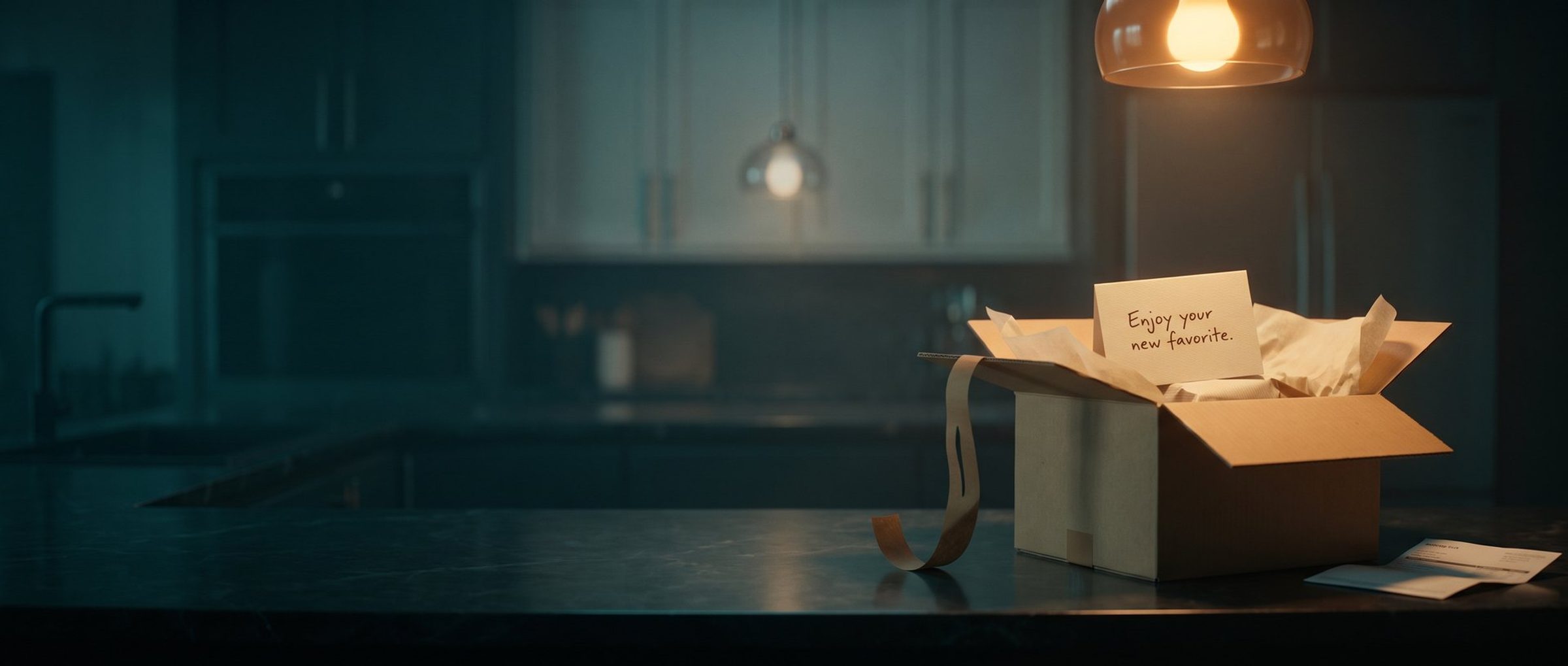
That box is the one piece of marketing in your whole business that is guaranteed to reach the person it was meant for. It cannot be filtered into a promotions tab. It cannot be scrolled past. Nobody bids against you for it. It lands on the doorstep of someone who has already paid you, and they open it themselves, on purpose, at the moment they are most curious about what you sell.
Most online stores send it out with nothing in it that gives that customer a reason to come back. This article is about what belongs in the box, why each piece is there, and how to tell whether any of it is actually working.
The Box Is the Only Message Nobody Skips
Every other way you talk to a customer after the sale competes for attention. Your email lands next to forty others. Your text arrives while they are driving. Your retargeting ad shows up between a friend's vacation photos and a video about a dog. Each of those channels costs money to send, and each of them can be ignored.
The box can't be ignored. People open it. Customers who never read your email open the box, and so do customers who unsubscribed from your texts. Even customers who bought from you only because the price was right open the box, and for those few seconds you have their full attention.
And it is cheap. As of October 2026, Vistaprint charges $21.99 for 100 standard 4x6 postcards, about 22 cents a card, and the price per card drops as you order more. Put that next to what the customer cost you. Say that first order cost you $30 in ads (swap in your own number). A printed card is less than 1% of what you already spent to get that customer. Even a nicer card, a sample and a handwritten line from the owner usually come to a dollar or two.
The money that matters is not the card, though. It is the second order. We have written before about why the first sale barely breaks even and the second one is the profit. The box is the first, cheapest and most-read place to start earning that second order, and most stores treat it as a shipping container.
A Box Has Four Jobs. A Coupon Does None of Them.
When store owners do put something in the box, it is usually a discount card. "Take 15% off your next order." It feels generous. It is also the least useful thing you can put there, because it does the one job the customer did not need done: it makes your product cheaper for someone who just showed they will pay full price. We have a whole piece on why a discount is not an offer, and the box is where that habit does some of its quietest damage.
A box that earns a second order is doing four jobs:
- Make the first use go right. A product that disappoints on day one is a refund request, a bad review or a customer who never comes back. Most first-day disappointment is not the product. It is setup, sizing, care or expectations.
- Start the clock on the second order. The customer has no idea when they will need you again. You do, or you can work it out.
- Ask for one thing. A review, a referral or a photo. One of them, chosen on purpose, not a card that asks for all of them at once.
- Show who is behind the store. Amazon can't do this one, and a small store can. A real person with a name, a reason they started and a way to reach them.
Every insert you print should map to one of those jobs. If it doesn't, it is costing you a few cents and some packing time to say nothing.
A Confusing First Day With Your Product Costs You the Second Order
Open your support inbox and read the last fifty emails. A good share of them are some version of "how does this work," "is this supposed to look like this" or "I think I got the wrong size." Each of those is a customer standing in their kitchen with your product in their hand, unsure. Some of them email you. Plenty of them don't. They just decide the product is not for them and quietly never come back, or they start a return.
That is the gap a start card fills. It is one page, and it answers the three or four questions your inbox gets every week, in the order the customer will hit them:
- What is in the box, so they know nothing is missing.
- The first thing to do, in plain steps. "Rinse before first use." "Let the candle burn until the whole top melts on the first light." "Wash cold, hang dry."
- What normal looks like. This is the one most stores skip, and it prevents the most returns. A leather bag that smells strong for a week. A serum that tingles. Boots that pinch for the first few wears. If you tell people what to expect, a normal experience stops looking like a defect.
- How to reach a human if something is wrong, before they reach for the refund button or a one-star review.
Here is how to write it. Pull your support emails and return reasons from the last three months, sort them by the question underneath, and answer the top three. That is the card. It changes as your inbox changes. We have written about how your support inbox works as a free conversion audit, and about how every return is a sale you already paid to get. The start card is where those two ideas meet the customer's kitchen counter.
Your Customer Does Not Know When They Will Run Out. The Box Can Tell Them.
If you sell anything that gets used up, you know roughly how long it lasts. A 12-ounce bag of coffee at two cups a day. A month of supplements. A bottle of shampoo. Your customer has never done that math and never will. They will notice they ran out on the morning they need it, and then they will buy whatever is closest, which is often not you.
So do the math for them and print it. "This bottle lasts most people about six weeks. Your reorder link is below." Add a QR code that goes straight to that product with their usual size selected. That is not a sales pitch. It is information they need, and it puts you first in line on the day they need you.
If your product does not run out (a jacket, a cutting board, a piece of jewelry), the second-order card does a different job. It shows the one thing that pairs with what they bought: the conditioner for the leather, the matching earrings, the oil for the board. One product, shown in use, with a reason it goes with the first one. Not a catalog. A store that puts twelve products on a card is asking the customer to shop. A store that puts one is making a recommendation.
The card and your post-purchase emails should tell the same story. If you already run a post-purchase email flow, time the reorder email to the date the card names, so the paper and the inbox back each other up. If you sell on subscription, this card is doing even more work. Subscription operators will tell you the riskiest days are the ones right after the first box lands, when the customer decides whether it was worth it. A clear card on what to expect in the first few weeks is cheaper than any save offer. There is more on that in our piece on why a subscription is a different business.
One Request on the Card Gets Answered. Five Get It Thrown Out.
The most common insert after the discount card is the everything card: leave a review, follow us on Instagram, tag us in a photo, refer a friend for $10, join our list. Five asks, each with its own QR code, competing for the same few seconds. The customer does none of them. The card goes in the recycling with the tissue paper.
Pick one ask per box, and pick it by what you need most right now:
- A review, if you are a newer store and strangers do not trust you yet. This is usually the right ask for first orders. We cover why reviews carry more weight than anything you say about yourself in a stranger won't believe your store.
- A referral, once a customer has ordered more than once and has shown they like you. Asking a first-time buyer to vouch for you before they have used the product is asking too early.
- A photo, if you sell something visual and need real customer images for your product pages and ads.
Time the review ask to when they will have an opinion. A card that says "tell us what you think" means nothing on the day the box arrives if the product takes two weeks to show results. Say so: "Give it two weeks, then tell us honestly how it went." Then send the review email on day fourteen, not day two.
There is one legal line to know here. The FTC's rule on consumer reviews, in force since late 2024 (16 CFR 465.4), makes it illegal for a business to offer an incentive in exchange for a review that expresses a particular sentiment, and that includes implying it. "Leave a review and get 10% off your next order" is fine. "Leave us a 5-star review and get 10% off" is not, and the rule covers wording that only hints the review has to be glowing, too. Keep the wording neutral: an honest review, whatever it says.
And if any of your orders ship through Amazon, the rules for what can go in the box are much tighter than they are on your own store. We cover what is allowed in you sell on Amazon, Amazon owns the customer.
A Fifth-Time Customer Is Still Getting a First-Time Box
Here is a test. Order from your own store twice, a month apart. Open both boxes side by side. If they are identical, your best customers are being treated exactly like strangers.
The box should change with the relationship. A simple version a small store can run by hand:
- First order: the start card, the founder note, and the review ask. Everything is about making the product work and showing who you are.
- Second order: a short thank-you that acknowledges they came back ("You came back. That means a lot to a store our size."), and the pairing card or the reorder card.
- Fifth order, or whatever counts as a regular for you: something they did not expect. A sample of a new product before it launches, a handwritten note, a small extra that costs you a few dollars. This is the box that gets photographed and posted, because it feels like recognition, not marketing.
You do not need software for this. Most store platforms can flag a first-time customer's order, either with an automatic tag or with a simple app, and that is all your packer needs to see on the slip. Keep three stacks of cards at the packing table, labeled by order count, and you have a personalized box program that costs nothing extra to run.
One more detail that makes a real difference: open the card with their name, handwritten if your volume allows it. A card that says "Hi Dana" gets read. A card that looks like a flyer gets set aside with the other flyers. If you work with a complementary store that sells to the same customer, a partner card in the fifth box can do double duty. We talk about those partnerships in nobody is loyal to a catalog.
You Never Measured the Card in Your Box. You Still Pay to Print It.
Owners who change their packaging usually judge it by feel. A few customers post photos, someone emails to say the note was sweet, and it feels like it is working. Maybe it is. But you would never judge an ad that way, and the box deserves the same honesty, because it costs real money and packing time on every order.
There are two simple ways to measure it.
Give the card something only the card has. A discount code that appears nowhere else, or a QR code with its own tracking tag on the link. Any order that uses that code or arrives through that link came from the box. Your store platform will show you orders by discount code, and your analytics will show you visits from the tagged link. This tells you whether people act on the card.
Ship half your boxes without it. This is the one that tells you whether the card changes behavior, not just whether people scan it. For a month or two, put the new insert in every other order (alternate by order number, so it is random and not tied to the day of the week) and leave the other half as they are. Then compare the two groups on the number that actually matters: what share placed a second order within 60 or 90 days.
Be honest with yourself about the numbers. A store shipping 300 orders a month puts 150 in each group. If roughly one in five customers normally orders again, that is about 30 repeat customers in one group, and a difference of a handful either way can be pure luck. So run it longer, two or three months, and treat a small gap as a direction rather than a verdict. We have written about how easy it is to win a test and simply get lucky, and the same caution applies here. A big, steady gap is real. A small one is a reason to keep watching.
What you are looking for is not perfect proof. It is whether the card earns back what it costs. At 22 cents a card, it does not take many extra second orders to pay for a whole month of printing.
The Box Is Already Paid For. The Card Costs 22 Cents.
If you do nothing else this week, do this, in this order:
- Read your last fifty support emails and return reasons, and write a one-page start card that answers the top three questions.
- Work out when your product runs out and print a reorder card with that date and a QR code to the exact product. If it never runs out, print one pairing product instead.
- Pick one ask for first orders, usually an honest review timed to when the product will have earned an opinion, worded so the reward never depends on what they say.
- Write a short note as the owner, with your name and a real way to reach you.
- Ship half your orders with the new box for two months and compare second-order rates against the half without it.
None of this needs a bigger budget. It needs you to decide what the box is for before the next order goes out. Building that second order, through the box, the emails and the ads that bring customers back, is a big part of what we do for online stores. If you would rather hand that work off, we are glad to help. And if you would rather do it yourself, everything you need is above.