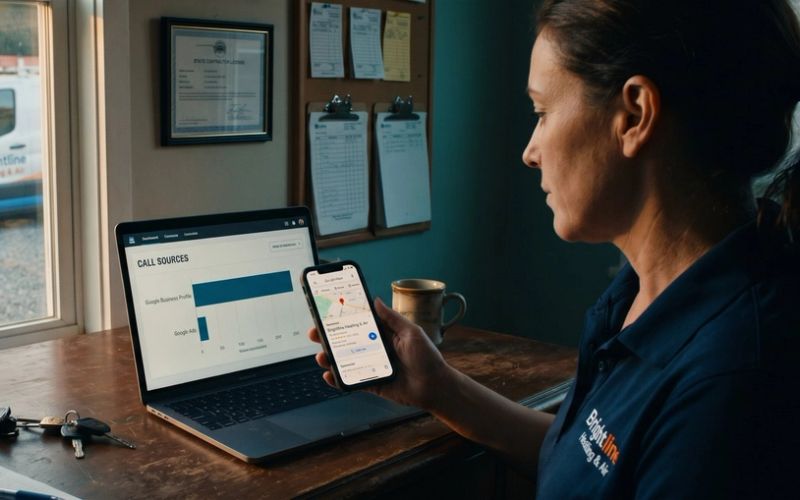
The owner of a garage door repair company asks the question the way most owners do, half hoping for a yes: is Google Ads worth it for a business like mine? He has heard both stories. A friend who runs an HVAC company says it is the best money he spends. A friend who runs a bakery says it ate two thousand dollars and sent her three phone calls.
They are both telling the truth. Google Ads is an auction for people who are already searching, and whether it pays depends on what those people are worth to you, what competitors pay for them, and whether you can turn a click into a customer. All of that can be checked before you spend a dollar.
Start with what it can and cannot do. Darren Taylor, whose Google Ads course has been watched half a million times, names the platform's main limitation: someone with the need who has not searched yet is invisible to a search ad. That is why it can be so profitable and why it cannot work for every business. We cover that split in Google Ads Catches Demand. Facebook Ads Creates It.
Your Competitors' Ads Already Tell You Whether Google Ads Pays in Your Market
The cheapest market research in advertising is on your phone. Before you open an account, search for your three main services the way a customer would, from inside your service area. "Garage door repair near me." "Garage door spring replacement." "New garage door installation." Look at what comes back above the regular results and count the sponsored ads.
Several ads on every search. Other businesses are paying for these clicks, and a local company that keeps buying the same search month after month is very likely making money on it. Demand exists and it pays for somebody. The question becomes whether it can pay for you.
Ads on some searches, not others. Usually the high-value service (installation, emergency repair) draws the ads and the low-value one does not. That is a clue about where the money is, and it is often where your first campaign belongs.
No ads at all. Either nobody searches for what you sell in your area, or the people who tried found it did not pay. Either way Google has nothing to catch yet, and a channel that creates demand may suit you better. We walk through that choice in Which Ad Channel Should a Small Business Actually Start With?
Then go one step further. Google's free Ads Transparency Center lets you search a competitor's business name and see the ads they run, what each says, and when each was last shown. Widen the date filter and you can see whether they were advertising last spring as well as last week.
Read what they say, too. If every ad in your market offers a free estimate and same-day service, that is what a customer will see next to yours.
Your Profit on One Job Sets the Most You Can Pay for a Google Ads Click
Demand existing is not the same as demand being affordable. Work backward from one customer. Our garage door company's average repair job is about $450. After parts and the technician's time, about $250 of that is gross profit. Of the people who call or fill out a form, he books about half. And of the people who click through to his site, about one in ten call or fill out the form.
So one customer is worth $250 to him before marketing. A lead is worth half of that, $125, because he books half of them. A click is worth a tenth of a lead, $12.50. That $12.50 is his break-even cost per click: pay more and every job loses money. He wants profit, not break-even, so the real target is lower, closer to $6 a click and $60 a lead if he wants to keep about half of the gross profit.
Now compare that with what his market charges. Google's free Keyword Planner shows a top-of-page bid range for each search in your area. Use the top of that range, not the middle, as your working cost per click; when we checked the range against what 182 keywords actually cost, the middle came in low on most of them (Keyword Planner's Bid Range Isn't What You'll Pay per Click.). If his searches top out around $6 to $8, he is in business. If they run $20, Google Ads does not pay for him yet, and no account manager can fix that with settings.
When the math says no, the levers are outside Google: a higher average job, a better booking rate on the phone, a page that converts more visitors. We go through this backward math with two very different businesses in A LinkedIn Lead Costs Three Times a Google Lead. Here Is How to Know If That Is Cheap. The platform is different. The arithmetic is the same.
Darren Taylor opens his course the same way: before building anything, find your lead-to-sale rate, cost per sale and average order value, because they set the break-even line. If you do not have those numbers, get them first.
Your Google Ads Bill Is Clicks, Your Own Hours, a Landing Page, and Three Months of Learning
Ask what Google Ads costs and you usually hear a monthly ad budget. That is one line of the bill. Here is the whole first year for our garage door company, in rough figures that show the shape, not a quote.
The clicks. Say $1,500 a month, or $18,000 for the year. Whether that number is big enough for your market is its own calculation, and we work it through in Google Has No Minimum Spend. Your Market Does. One budget detail owners do not expect: Google can spend up to twice your daily budget on a busy day, then spend less on quiet days, so that a month's charges stay within about 30.4 times the daily figure. Plan on the monthly number, not the daily one.
Someone running it. You pay someone or you pay with your own time. An agency or freelancer for an account this size commonly runs several hundred to about a thousand dollars a month, and how the fee is structured matters as much as its size (A Percent-of-Spend Agency Fee Rises Every Time Your Budget Does.). Doing it yourself costs a few hours a week reading search terms, adding negative keywords and checking that leads are real, usually in the evenings.
A page worth sending people to. If your service page already answers what the searcher wants to know (price range, service area, how fast you can come, a phone number they can tap), this line is zero. If it does not, a proper landing page is a one-time cost, and it is usually the line that most improves everything else on the bill.
Tracking. A few hours of setup so Google can see which clicks turned into calls and form fills, plus call tracking if most of your leads arrive by phone. Small next to the rest, and the next section explains why it is not optional.
The learning quarter. The first three months of spend buy information as much as they buy customers: which searches are worth having, what a lead really costs, what your page converts. That is about $4,500 of the $18,000 here. Budget it as tuition, not as a profit center (Your First Ad Budget Isn't an Investment. It's Tuition.), and see How Long Before Your Ads Actually Work? for what to expect along the way.
Add it up and a "$1,500 a month" plan is closer to $25,000 to $30,000 in year one once someone's time and the page are counted. That is not a reason to skip Google Ads. It is the number to test the customer math against.
Google Ads Only Finds More Customers Like the Ones You Track
When you tell Google to get you conversions, it watches which searches, times and devices led to one and bids harder on more of the same. Without tracking it cannot see a single call or form fill, so all it can do is buy clicks, and the cheapest clicks are rarely the ones that turn into jobs. Ivan Mana's five-minute tutorial, watched more than half a million times, puts it plainly: if you have conversion tracking set up, you bid for conversions; if you do not, you are left bidding for clicks. Before launch, three things need to be true:
Every way a customer contacts you is counted. Form fills, calls from the ad itself, and calls from people who visit the site and then dial. For a garage door company most leads are phone calls, so a setup that only counts forms is blind to most of the business.
Each lead is counted once. Darren Taylor warns about the opposite failure, a conversion code firing twice or three times for one form, which makes results look better than they are and teaches Google to chase the wrong things. Submit your own form and call your own ad number, then confirm each shows up once.
What counts is a real lead. Page views, button clicks and time on site are not leads. If you count them as conversions, Google will cheerfully buy more of them. We covered what happens when the count and the sales drift apart in Your Conversion Number Is Going Up. Your Sales Aren't.
Google Puts Your Ad Next to Three Competitors. Your Page and Your Offer Have to Win That Lineup.
On a competitive search, Google can show up to four ads at the top of the page, so the customer reads yours next to three others. Your ad, your page and your offer have to win the side-by-side.
The page has to match the search. Someone who searched "garage door spring replacement" and lands on a homepage about everything you do has to hunt for the answer, and many will not. Google measures this too: its auction weighs how relevant your ad and landing page are, and better quality can mean lower costs per click. A matching page makes you cheaper and more convincing at once. If people arrive and leave, start with the top of the page (You Paid for the Click. Your Hero Has 5 Seconds to Keep It.).
The offer has to give them a reason to pick you. If all four ads say free estimate and same-day service, the customer picks on whatever is left, which is usually price or the star rating. Something concrete wins the tie: a spring replacement price on the page, a 90-minute arrival window, a warranty in writing. "Quality, service and value" is not an offer, because your three neighbors in the lineup say it too, a point we made in Some Businesses Should Not Be Running Ads Yet. For how to build a better one, read Nobody Buys a Product. They Buy the Offer.
Somebody has to answer. A lead that waits until tomorrow has often called the next company in the lineup. If nobody can pick up at 8 p.m., do not buy clicks at 8 p.m. This one is free to fix and it changes the return on everything else.
Google's Default Settings Spend Your First Month for You
Most first-year failures we see are the same handful of choices, and several are Google's defaults. Briefly, with the posts that cover each:
Display and Search Partners switched on. New Search campaigns can come with Google's Display Network and search partner sites included, which spend part of the budget outside Google search. Grow My Ads calls mixing Display into Search "a money grab." Start with both off (Google Has No Minimum Spend. Your Market Does.).
Ads shown to people outside your area. Google's default location setting reaches people who have shown interest in your area, not just people in it. For a local service business that means paying for clicks from people you cannot serve (Your Google Ads Reach People Who Only Searched About Your Town. One Setting Stops It.).
Starting with everything automated. Performance Max and AI Max are offered up front. Grow My Ads' advice to beginners is to leave AI Max off because it "will burn your credit card up" before it has good data. Start with a plain Search campaign on your best service, and treat Google's recommendations as suggestions, not instructions (A 100% Optimization Score Just Means You Agreed With Google.).
Advertising every service at once. Six services on a small budget means six thin sets of data. Grow My Ads' worked example put the whole starting budget on the one service that made up most of the business. Do the same (You Organized Your Google Ads Account. You Starved It.).
Changing things every few days. Every big change makes Google relearn. Set it up carefully, then give it weeks, not days.
Judging it on clicks. Clicks and click-through rate say whether people noticed the ad, not whether it paid.
At Day 90 Google Ads Is Either Making Money, Fixable, or Done
Write your target down before you launch: the most you can pay for a customer and still be glad you did. For our garage door company that is around $125, half his gross profit on a job. Then, at day 90, do the math from your own books, not from Google's columns: total spend divided by the number of customers who actually paid you.
There are three possible answers.
Making money. Cost per customer is under your target and the leads are the kind you want. Keep going. Grow it slowly, because a bigger budget buys pricier clicks first (A Bigger Google Ads Budget Buys Pricier Leads First.).
Fixable. Leads are coming in, but they cost too much or too few become jobs. This is the most common answer at day 90, and it is good news, because the demand is proven. Read the search terms report and ask whether you would choose those searches yourself. Check that tracking counts real leads. Look at what happens on the page and on the phone. One of those is usually the problem, and No Conversions on Google Ads? Diagnose It Before You Blame Google walks the order to check them in.
Done, for now. The searches are there, but even your best weeks cost more per customer than one is worth, and the fixes have been tried. That is not a personal failure. It is the customer math, confirmed with real money. Stop, and change the numbers that decide it (price, booking rate, the page) before you try again.
One caution: on a small budget, 90 days may produce only a handful of customers, and a handful is a hint, not a verdict. If the leads are real but few, the honest answer may be "fixable, and underfunded," which is a budget question, not a Google question.
If the Math Fails Before the First Click, Google Ads Won't Save It
It is worth it when four things are true. People in your area already search for what you sell, and competitors keep paying to show up. One customer is worth more than the clicks it takes to win them, at the prices your market charges. Google can see the calls and forms that become jobs. And your page and your offer can win a lineup of four.
Every one of those can be checked before you spend anything: a few searches on your phone, an hour in the Transparency Center and Keyword Planner, and your own numbers on an envelope. If they line up, Google Ads is one of the most direct ways a small business can buy customers. If they do not, you just saved yourself a quarter's worth of tuition.
If you would rather have someone run that check with you, it is the first thing we do with every new account at our Google Ads agency, before a dollar goes out the door.