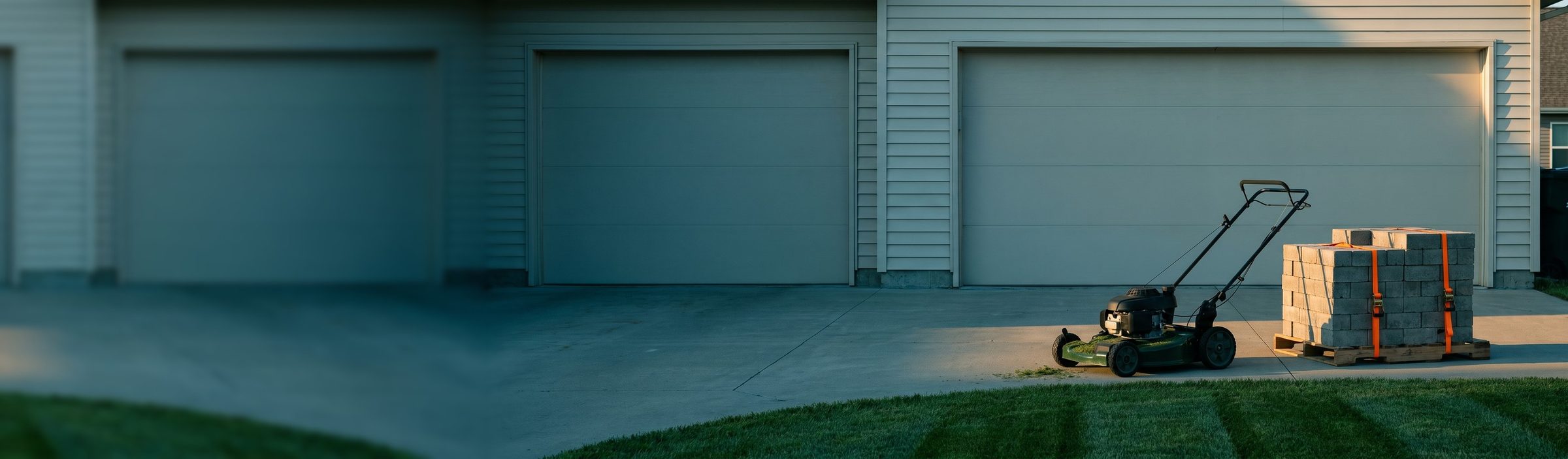
Two leads come in on the same Monday. One homeowner wants the lawn mowed every week through October. The other wants a paver patio behind the house before the Fourth of July. To Google Ads, both are one conversion. To your business, they are different animals: one pays a little every week for months, the other pays a lot, once, after a site visit, a drawing and a deposit.
If the account treats them as the same lead, it will spend the same on each, and one of them will be badly overpaid or badly underfunded. This chapter builds the budget math for a landscaping company the way we build it for clients: what a click costs, what share turns into leads, what share of leads you win, and what a customer is actually worth. Then it shows why mowing and patios end up with very different ceilings.
Google Ads Can't Tell a Mowing Lead From a Patio Lead. Your Budget Has To.
Start with what the work pays. National price guides are vendor data, built by companies that sell leads to contractors, so treat them as rough ranges. HomeGuide puts annual lawn mowing at $900 to $2,000. It puts a 20x20 paver patio at $3,800 to $6,800, and a lawn fertilization program at $260 to $600 a year.
Those are revenue figures, not profit. We couldn't find a published profit margin for landscaping work that we'd trust, and margins differ wildly between a mowing route and a hardscape crew, so use your own. The point stands either way. A mowing customer and a patio customer can be worth amounts that differ by several times, and a campaign with one target cost per lead has no way to know that unless you split them.
Five Numbers Turn a Click Into a Customer. Google Hands You Two of Them.
The chain runs like this: the cost of a click, the share of clicks that become leads, the cost of a lead, the share of leads you win, the cost of a customer, and finally what that customer pays you.
Google gives you the first two. Keyword Planner shows estimated click prices before you spend anything, and once Chapter 1's tracking is live, your own account shows your conversion rate. The last three are yours. Only your books know how many estimates you win, and only you know what a customer is worth after the first job.
For a sense of scale, LocaliQ, an agency, published Search figures from its own landscaping clients for 2025: an average of $8.76 a click, 6.42% of clicks converting, and $117.92 a lead. Those are one agency's clients, not the whole market, and the three figures don't multiply out neatly into each other, which is a good reminder that averages from someone else's accounts are a starting guess at best. Your own account replaces them within a few weeks.
A Mowing Customer Can Cost More in Ads Than the First Month of Mowing Pays.
Take a weekly mowing customer first. Each number below says where it came from, so you can trade in your own.
Keyword Planner's top-of-page estimate for "lawn mowing service" runs from $3.09 to $10.97 across the US. Say your clicks cost $8. If 6.42% of them become leads, which is the LocaliQ average, each lead costs about $125. Now the number only you know: suppose you win one in three mowing quotes. That's an example, not an industry figure. At one in three, each new mowing customer costs about $375 in ads.
HomeGuide prices a mowing visit at $30 to $85. Four or five weekly visits bring in roughly $130 to $370 in the first month. So the first month of mowing may not cover what you paid to win the customer. That isn't a reason to stop advertising mowing. It's a reason to judge a mowing campaign on the season, not the first invoice, and to know your ceiling before Google spends past it.
A Patio Lead Can Cost More Than Twice a Mowing Lead and Still Be the Better Buy.
Run the same chain for hardscape. Keyword Planner's top-of-page estimates are higher: $5.06 to $27.25 for "paver contractor" and $2.65 to $21.06 for "paver patio installation." Say $20 a click. At the same 6.42%, a lead costs about $312, more than twice the mowing lead. Suppose you win one patio quote in four, another example rate. A new patio customer then costs about $1,250 in ads.
Against a $3,800 to $6,800 job, that can be a very good trade. Against a mowing customer, it looks expensive. That's the trap of one shared target. Put patios and mowing in one campaign with one cost-per-lead goal, and the bidding tends to drift toward whichever leads come in cheapest, which in these numbers is mowing. The patio searches get starved, not because they lose money, but because the account was told they cost too much.
The fix is structural. Give each kind of work its own campaign, its own budget and, once you move to target CPA bidding, its own target. Chapter 4 builds the ad groups, and Chapter 7 sets the bids.
A Lead Ceiling Sets the Daily Budget. Google Can Spend Up to Double It on a Busy Day.
Once each kind of job has a ceiling, the budget follows from how many leads you want and can handle. Say the mowing campaign should bring in 20 leads a month at about $125 each. That's $2,500 for the month, or roughly $82 a day. The patio campaign might aim for 8 leads at about $312, which is close to $2,500 as well, about $82 a day, but for a very different number of jobs.
Two Google rules shape how that money actually goes out. The number you set is an average, and on a busy day Google can spend as much as double it. What it won't do is bill more than 30.4 times that daily number in a month. So a busy Saturday in April can run hot without breaking the month. Set each campaign's daily budget from its own lead target, and keep the totals inside what your crews can actually quote. A budget that produces more spring leads than you can call back the same day just buys more of the silence the reviews complain about.
Lawn treatment sits between the two. HomeGuide's $260 to $600 a year for a fertilization program is a smaller ticket than mowing, but it renews if the results hold, and the national lawn brands advertising in our sample sell it with first-visit discounts. Work the same chain with your own program price before deciding its ceiling.
The Close Rate Is the Number You Control. Slow Replies Cut It Before Anyone Sees a Quote.
No number in the chain moves faster than the close rate, and the landscaping reviews we read point straight at the leak. In 208 one- to three-star reviews from people who hired a landscaper or asked for a quote, 99 were about silence, late replies or crews that didn't show up. Thirty-one of those homeowners never got a reply, a quote or the estimate visit at all.
That's money spent on a click, earned as a lead and lost before anyone priced the job. Jobber's 2026 survey of home-service owners, across all trades, found that over 70% of customers expect a same-day response. We couldn't find a trustworthy published close rate for landscaping, only owners trading guesses in forums, so measure yours: estimates sent, estimates won, and how many leads never got an estimate. Raise it from one in four to one in three and every number further down the chain improves without touching a bid. In spring, check those three numbers every week, by service. When the patio close rate sags in April, check how fast estimates are going out before you blame the ads.
A Mowing Season Isn't the Whole Customer. Cleanups, Mulch and Next Spring Count Too.
The worked examples above stop at the first job. Real customers don't. In the Reddit threads where landscaping owners talk shop, mowing comes up as the door-opener: steady and modest. The better margins come from the mulch, cleanups and stonework those same customers buy later. A mowing customer who stays a second season, buys a fall cleanup and asks about a walkway is worth far more than one season of cuts.
How much more is hard to pin down from public data. We found no published retention or churn rate for lawn care customers that we'd trust. NALP's 2025 benchmark study, reported on its website, puts the median at $14,682 in sales per customer a year, but that includes commercial accounts, so treat it as context, not a target. Your own customer list will tell you more in an afternoon: how many of last year's mowing customers came back, and what else they bought.
Reviews and word of mouth add to the value too. Sixteen of the Google reviews we read mention a referral, several reviewers describe finding their landscaper by seeing a crew's work on the street, and Reddit replies on how to hire one keep telling people to ask a neighbor. A customer won through an ad who sends you the house next door has paid for more than one click.
Each Service Needs Its Own Landing Page. A Mowing Click Shouldn't Land on the Patio Pitch.
Separate campaigns only work if each one has somewhere specific to send the click. In our sample of twelve landscaping sites, two have no separate service pages at all, and two more send every ad to the home page even though service pages exist.
A homeowner who clicked an ad for weekly mowing and lands on a page about outdoor kitchens has to go looking. Many won't. A page for each service, with its own photos, its own form and its own reason to call, is what lets the mowing campaign and the patio campaign each earn its own conversion rate. Our Google Ads management starts every landscaping account with those pages mapped before the first campaign goes live.
Next: A Landscaper Selling Patios, Mowing and Snow Plowing Is in Three Separate Auctions.
With a ceiling for each kind of job, the account knows what it can afford. Chapter 4 shows how Google scores each ad against its own page in each auction, and why one "landscaping" ad group can't win them all.
Every chapter is on the guide's home page.