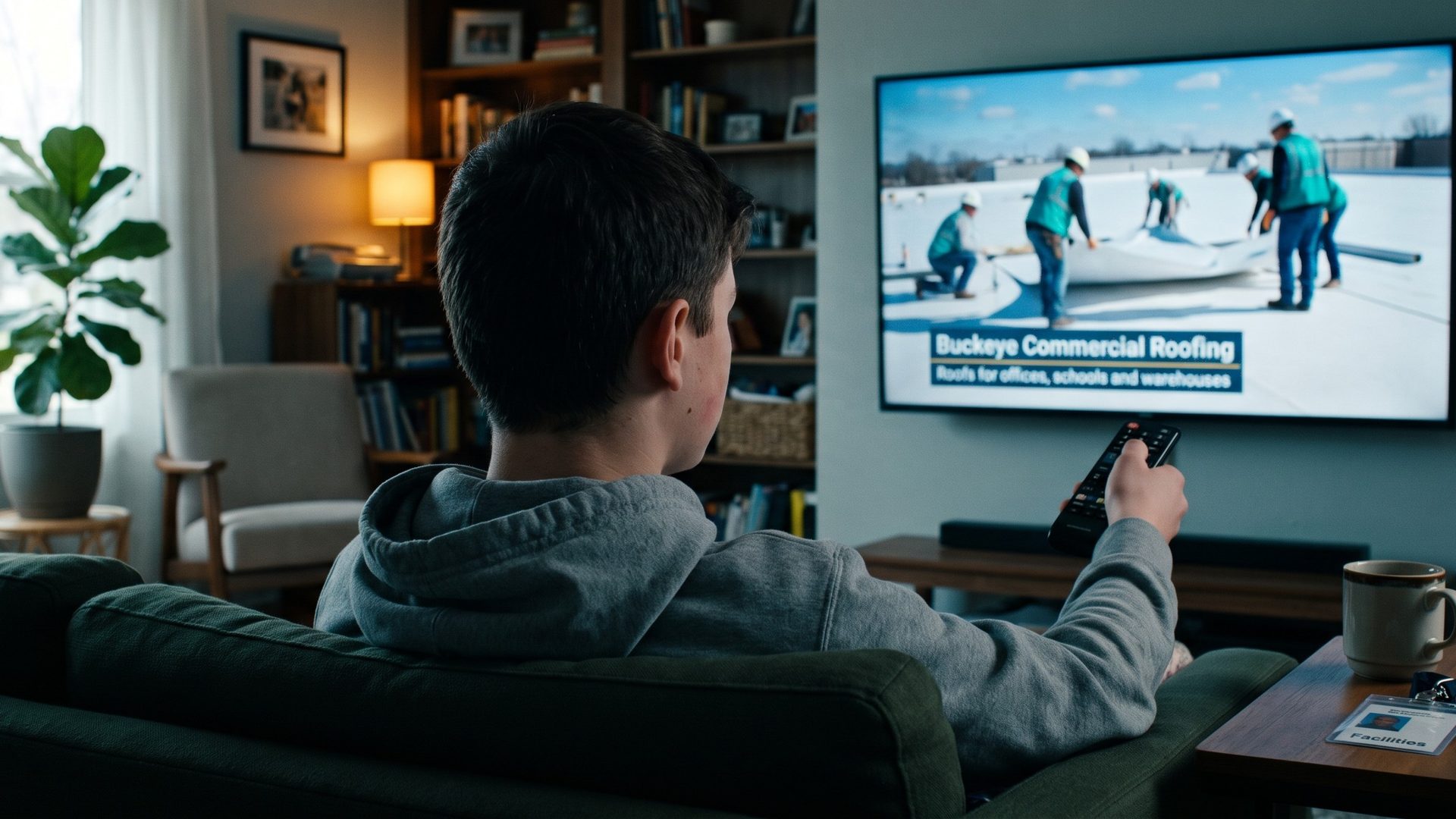
LinkedIn started selling TV ads to advertisers in the UK on November 12. US and Canadian advertisers have had the same option since April 2024. The pitch is easy to like. You upload a company list, and your 30-second spot plays on the living-room TV of the facilities director at the exact property management firm you have been trying to land for two years. You're not paying for a broad cable audience. You're paying for your list, on the biggest screen in the house.
There is a catch, and LinkedIn's own engineers describe it. When LinkedIn's engineering team wrote up how they built the product, they called the TV "a shared household medium... often viewed by multiple users." Your ad goes to the right house. LinkedIn can't tell whether the facilities director is the one on the couch, or their teenager, or their spouse, or nobody, because the TV is on in an empty room.
That doesn't make LinkedIn's TV ads a bad buy. It makes them a particular kind of buy, with particular rules for when they're worth it and how to tell if they worked. This article walks through what you're actually buying, what the reports can and can't tell you, what it costs, and the three things that should already be true before a small business spends a dollar on it. We'll use one example throughout: a 35-person commercial roofing contractor in Columbus, Ohio, whose buyers are facilities managers and property managers at about 1,100 central Ohio companies.
LinkedIn Sells You a Spot on a TV, Not on a Person
LinkedIn calls the product Connected TV, or CTV, and the setup is narrower than most ad types in Campaign Manager. According to LinkedIn's help pages, checked this week:
- Brand awareness is the only objective. You can't run a TV ad on Lead Generation, Website Visits or Website Conversions.
- You switch it on with a "Connected TV Only" setting at the ad set level. When you do, LinkedIn turns on its Audience Network for that ad set automatically, because that is how the ads reach the streaming apps.
- Maximum Delivery is the only bidding option. You choose whether LinkedIn optimizes for impressions or for reach, and LinkedIn sets the price. Some agency write-ups say you can bid manually. LinkedIn's own setup page says you can't, and the setup page is what the platform does.
- It runs in the US, Canada and the UK, in English only.
- The ads play inside streaming apps reached through LinkedIn's partners, including Paramount, Roku and Samsung TV Plus. You can download the full list of apps, which ran to about 2,200 placements when agencies first walked through it, and block the ones you don't want.
What you keep is the targeting. Every option you'd use in a normal LinkedIn ad set works here, including job titles, company size, industries, your uploaded company list and your retargeting audiences. That is the part no TV network can match. A cable buy reaches "adults 35 to 64 in the Columbus market." A LinkedIn TV buy reaches the 1,100 companies on the roofing contractor's list and nobody else.
But look at how LinkedIn gets the ad onto the TV. A TV doesn't have a LinkedIn login. LinkedIn's engineering write-up describes a cross-device identity graph: LinkedIn matches the member's phone and laptop to a household, then matches that household to a TV, partly through data-sharing deals with its streaming partners. When the facilities director's household is a match, the ad plays on that household's TV.
So the ad set says "facilities managers at these 1,100 companies." The thing actually being targeted is the TV in their house. The same write-up says LinkedIn's own brand surveys have to screen for "co-viewing bias": when they ask a member whether they remember the ad, they also have to account for the fact that other people in the room saw it too. LinkedIn isn't hiding any of this. It's just not the part of the pitch that gets repeated.
Every Number in the TV Report Is an Estimate
On a normal LinkedIn ad, the report is a record. A member scrolled past your ad on their phone, it was on screen long enough to count, LinkedIn logged it against that member's profile. You can see which companies engaged, which job titles, how many people watched your video to the end.
On a TV ad, LinkedIn's help page says the delivery metrics are "modeled, not exact." The household match is a probability, so the reach and impression counts tied to your audience are LinkedIn's estimate of how many of your members were behind the TVs that played the ad. Video views on TV aren't reported at all.
Three things in the report tend to mislead people:
- The completion rate looks wonderful, and it means almost nothing. Kiin Labs, a London agency that published benchmarks from 31 LinkedIn TV accounts in September, found a median completion rate of 98.7%. That's not people loving your ad. TV ads can't be skipped. The number tells you the ad played to the end on a screen, which is all a non-skippable ad can do.
- There's no click. Nobody taps a living-room TV. LinkedIn lets you add a website URL to the ad, but it's optional, and on a TV there is nothing to press. Any visit to your site that follows has to be connected to the ad later, by matching.
- The conversions are tiny and indirect. Kiin counted a median of 0.10 post-view conversions per 10,000 impressions. A post-view conversion means someone LinkedIn matched to an exposed household later did something on your site. It's a hint, not proof.
For the roofing contractor, the report will say something like "your ad reached 2,400 members at your target companies." Read that sentence as "LinkedIn believes about 2,400 of your members live in households whose TVs played the ad." It may well be right. You just can't check it the way you can check a feed report.
TV Ads Cost About a Quarter of What You Pay in the Feed
The good news is the price. Kiin's benchmark covered 31 advertisers and about $811,000 in LinkedIn TV spend, and it compared each advertiser's TV costs against the same advertisers' feed ads, which is a fairer test than comparing TV against an industry average.
The median cost per thousand impressions on TV was $25.76. The same advertisers paid a blended $96.43 per thousand in the feed. A thousand TV impressions cost roughly what 270 feed impressions cost, on the same audience.
Small lists don't get that price. Advertisers targeting fewer than 50,000 people paid a median $46.97 per thousand on TV, nearly double the overall median. That's the same pattern you see across LinkedIn: when you narrow the audience, fewer auctions want your money and each one costs more. A roofing contractor's list of 1,100 companies might match only a few thousand LinkedIn members, which puts it firmly in the expensive bracket.
Then look at what the typical test actually bought. The median advertiser in Kiin's data spent $75 a day for 40 days, about $3,000. That reached about one in twenty of the people they were aiming at, about twice each. Almost six weeks of spend, and 19 of every 20 people on the list never saw the ad on TV.
That's not a failure. It's what a $3,000 TV test buys. But it means most of the TV tests in that data set were too small to change anyone's mind about anything, including the advertiser's own. If the roofing contractor runs the median test, most of its facilities managers won't see the TV ad even once. Whatever happens to their leads that month, TV can't be the reason.
Kiin's own rule of thumb, for what it's worth, is that a company should already be spending about $30,000 a month on LinkedIn, with a named company list and a real video, before TV is worth testing. That's a big-company number. We'd put the bar differently for a small business, as you'll see below, but the direction is the same: TV comes after everything else is working, not instead of it.
LinkedIn Says TV Makes Your Lead Ads Cheaper. Nobody Else Has Shown It.
The strongest argument for LinkedIn's TV ads isn't the TV impressions themselves. It's the claim that they make your other LinkedIn ads work better.
LinkedIn makes that claim directly. On AJ Wilcox's LinkedIn ads podcast, a LinkedIn representative said that when the same audience sees both a TV ad and a lead gen ad, LinkedIn has measured an 82% higher lead form completion rate and a 30% lower cost per lead. LinkedIn repeated the 30% figure when it launched in the UK. These are LinkedIn's numbers, from LinkedIn's own analysis of its own product. That doesn't make them false. It means nobody outside LinkedIn has checked them.
Kiin did try. Within each advertiser, it compared the days their TV ads were running against the days they weren't, and checked whether the feed ads did better on TV days. Of 26 advertisers with enough data, the feed did better on TV days for 13. Half. That's what you'd expect if TV made no difference at all.
Neither study settles it. LinkedIn's comparison is between people who saw both ads and people who saw only one, and people who see more of your ads are often the ones who were going to be more interested anyway. Kiin's comparison is between days, and a TV ad seen on Tuesday might not change anything until a feed ad is seen the following week. The honest summary is that the halo effect is plausible, LinkedIn says it's large, and the one independent look found nothing.
So if you test TV, you have to measure it yourself, and there are two ways to do it.
- LinkedIn's lift tests. LinkedIn offers Brand Lift tests and, in beta, Conversion Lift tests for TV ads. Both work by holding back part of the audience and comparing people who could see the ad with people who couldn't. That is the right design. The results still come from LinkedIn.
- Your own holdout. Split your company list in two at random before you start. Run the TV ad set to one half only, and keep everything else, including your lead ads, running to both halves. After the test, compare the two halves in your CRM: meetings booked, quotes requested, deals opened. LinkedIn never touches that number.
The second one is the one we'd trust, with one honest caveat for a small business: if your list is 1,100 companies, each half is 550, and a few deals either way can swing the result. A holdout on a small list can tell you whether TV made a big difference. It can't detect a small one. We covered why no attribution model can give you a single clean answer in You Will Never Know Exactly Which Ad Made the Sale.
LinkedIn TV Ads Are Wasted Until Your Lead Ads Already Close Deals
For most small businesses on LinkedIn, the answer to "should we try TV ads?" is not yet. Here are the three conditions that change it to yes.
Your lead ads are already closing deals. TV is a brand awareness buy. LinkedIn's whole case for it is that it makes your other ads work better, which only helps if your other ads already work. If your lead campaign produces forms that never turn into meetings, TV will make more people vaguely familiar with a company whose lead process is broken. We made the same argument for brand awareness in general in Should Your LinkedIn Ads Build Brand Awareness or Generate Leads? Leads first. Brand once the leads are closing.
Your list is big enough to buy. Small lists pay nearly double on TV, and a short test reaches a sliver of them. If the roofing contractor's 1,100 companies match a few thousand members, a TV test will be expensive per impression and nearly impossible to measure. A local firm with 300 target companies probably isn't there at all. Its money does far more in Thought Leader Ads from the owner, and in retargeting the people who already visited the site.
You have a real TV spot. A 15- or 30-second video made for a living room, not a feed ad played on a bigger screen. That means it works with the sound on, says the company name out loud in the first few seconds, and doesn't end with "click below," because nobody can. A feed video is often built for silent scrolling with captions doing the work. On a TV across the room, the captions are small and the sound is the message.
And one budget check on top of those three: the TV money has to be extra. If funding a TV test means cutting the lead campaign below what it needs to deliver, you've traded a campaign you can measure for one you can't. If your LinkedIn budget is already stretched across too many ad sets, start with You Have Four Campaigns and a Budget for One. For what a working LinkedIn budget looks like in the first place, see How Much Should You Budget for LinkedIn Ads?
A LinkedIn TV Test Without a Holdout Proves Nothing
If all three are true and you want to try it, the setup decides whether you learn anything. Here's how we'd set it up for a business like the roofing contractor:
- Use the same company list as your lead ads. The whole theory is that TV warms up the people your lead ads are trying to convert. A TV ad set aimed at a different, broader audience tests a different idea.
- Exclude your customers and your competitors. Your current clients don't need a TV spot to remember you, and your competitors' staff will happily watch your ad at your expense. We walked through setting up those exclusions in You Cannot Defend the LinkedIn Line Item, So It Gets Cut First.
- Download the publisher list and block what doesn't fit. The list includes channels like K-pop TV and a long tail of small apps. A commercial roofer has no reason to pay for those, even if the household matches. LinkedIn lets you block apps or allow only a short list.
- Run two spots, for 8 to 12 weeks. One video for six weeks tells you about that video. Two give you a comparison, and two months or more gives the slower effect a chance to show up in your lead ads and your pipeline.
- Hold back half the list. As above: random split, TV to one half, everything else to both, then compare the halves in your CRM.
- Read the Companies tab too. In the lead campaign's company engagement report, compare how companies in the TV half and the held-back half engage with your feed ads over the test. It's not proof, but it's a second view that isn't modeled. We used the same report to find where an account's ads were really going in A Handful of Companies on Your LinkedIn List Get Most of Your Ads.
One setting will look like a contradiction if you've read our earlier advice. Our post Should You Turn Off LinkedIn Audience Network? said yes, turn it off, because its cheap clicks on outside sites rarely become leads. That's still right for your lead and website ads. A TV ad set is the one exception. The TV inventory runs through Audience Network, so LinkedIn switches it on when you choose Connected TV Only, and turning it off would leave nothing to buy. Leave it on for the TV ad set, use the block list to control where it plays, and keep it off everywhere else.
If someone outside LinkedIn is pitching you streaming TV ads, the trade-offs are different again, and we covered that version in Someone Will Pitch You Streaming TV and Geofencing Ads. What makes LinkedIn's version different is the targeting: your company list, not a zip code.
TV Is the Cheapest Impression LinkedIn Sells. It's Also the Hardest to Prove.
LinkedIn's TV ads put your company in front of the right households for about a quarter of what a feed impression costs. That part is real. What they can't do is tell you who in that household was watching, whether anyone clicked, or whether your lead ads got better because of it, except through LinkedIn's own estimates.
For the roofing contractor, the right move today is probably to wait: get the lead ads closing deals, build the list, and make a spot worth putting on a TV. For a company that already has all three, a properly held-back test for two or three months will answer the question for its own buyers, which is the only answer that matters.
If you'd like help deciding whether your account is ready, or setting up the test and the holdout so the result means something, our LinkedIn ads management team can do that with you. And if you run it yourself, start with the holdout. It's the one number LinkedIn doesn't produce.