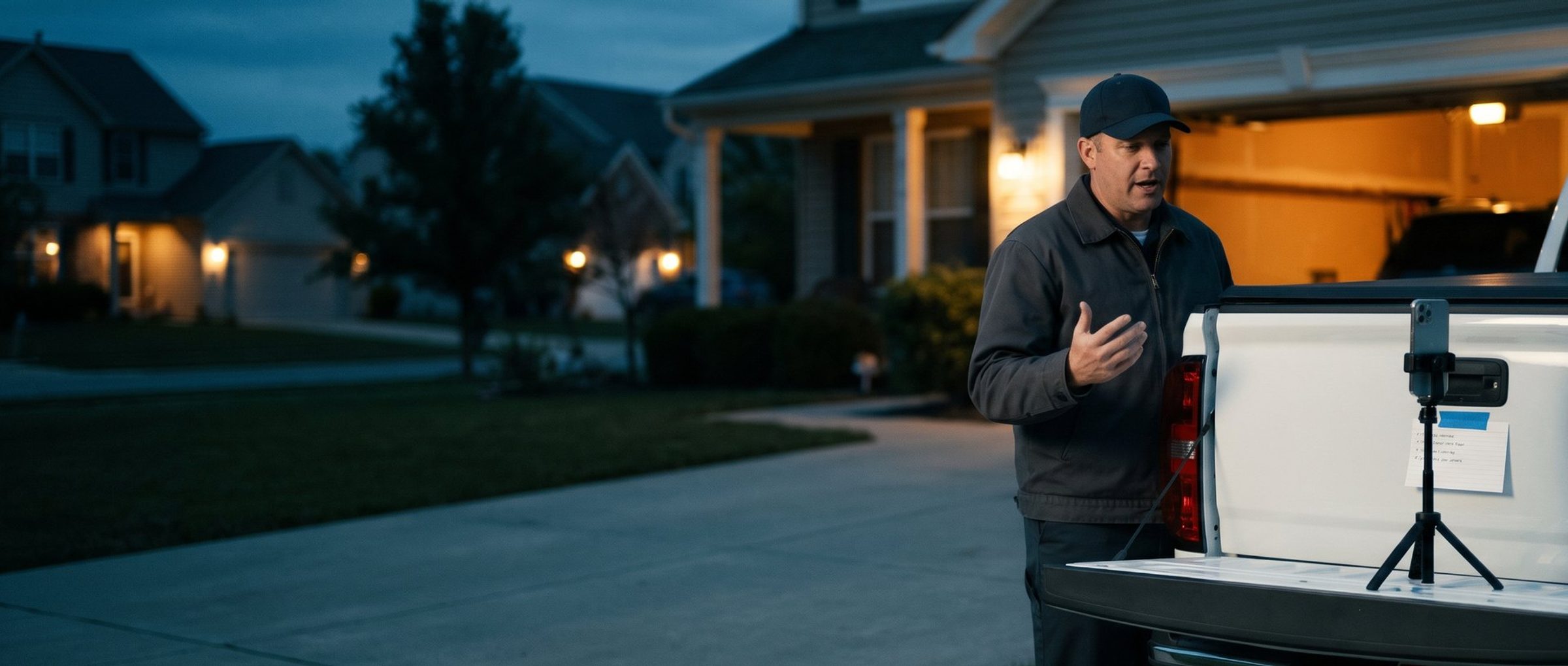
Picture two video ads from the same roofing company. The first one cost about three thousand dollars. A crew came out with a drone, a gimbal and a lighting kit. There is music. There is a slow push-in on the company truck at golden hour. The owner says "quality you can trust" over a shot of a nail gun in slow motion, and it looks like a television commercial, which is exactly the problem. The second one cost nothing. The owner propped his phone on the dashboard in a customer's driveway and talked for a minute and a half about the house he had just left, where the last guy had roofed straight over rotten decking and the homeowner found out when the bedroom ceiling started to sag. No music. No drone. He fumbles one word and keeps going.
The second ad wins, and it is not close. If you have run video on Facebook and Instagram for any length of time, you have probably seen some version of this yourself.
Marketers have a slightly silly name for this format. They call it a "yapper" ad: one person, one camera, little or no cutaway footage, talking straight into the lens the way they would on a video call with a friend. It reads like a post from someone you know rather than an ad from a company. And right now it is the format the people who make ads for a living keep pointing to. Dara Denney, who has worked on more than twenty thousand ads and whose agency's clients tested thousands of new ones in the first quarter of this year alone, puts it on her list of what is converting in 2026 and says it is now outperforming the more traditional scripted creator ads her team runs. Two creative strategists who host a podcast about ads for online brands called it the biggest format of the middle of this year.
There is an easy explanation for why. Your customer's feed is now full of generated people with perfect skin saying perfect sentences. A real face with a real voice, in a real truck, is the one thing in that feed a machine cannot cheaply fake. People are wired to stop for a face. They are even more wired to stop for one that looks like it belongs to somebody.
But here is the part that gets lost when owners hear "just talk to your phone." The talk-to-camera ads that sell are not improvised. They only look that way.
A Talk-to-Camera Ad Looks Like a Rant. It's a Story With One Job.
There is a version of this format that does not work, and it is the version most people make first. The owner sits in the car, points the phone at their face and says something like: "Hey, tired of contractors who don't call back? We always call back. Give us a call." That is not a talk-to-camera ad. That is a radio spot with a face on it. Being in a car does not make it personal, and saying it casually does not make it a story.
What separates the ones that work is that they are built around a person who went through something and came out the other side believing. Harry Delmege, who runs a creative agency and has spent a lot of time breaking down why these ads win, describes the strongest speaker as a "convert": someone who had the problem, tried the usual fixes, found the thing that worked, and now cannot stop telling people about it. A convert's belief is the persuasive part. You cannot argue them out of it, because they lived it.
That gives the ad its one job. Not "explain everything we do." Not "list our services." Just: take the viewer from the moment the problem got bad to the moment it was solved, and let them see themselves in the middle of it.
Which brings us to the myth. "Unscripted" is what these ads look like, and almost never what they are. Delmege is blunt about it: in his view, a talk-to-camera ad without a script is just a person talking. The podcast hosts make the same point from the other side. These ads run longer than most, so every sentence has to justify being there, or the whole thing collapses into rambling. And rambling is the real risk. The longer the ad, the more room there is to lose someone with three sentences of backstory nobody asked for.
The Customer Who Almost Didn't Call You Is Your Best Spokesperson.
For a small business, the speaker is almost always one of three people, and each one can say things the others cannot.
The owner. You can tell the story nobody else can: why you started doing it this way, the job that made you change how you work, the thing the rest of your industry does that you refuse to. An owner talking is human-to-human instead of human-to-company, and owners have been the face of their own ads since long before anyone scrolled a feed.
A real customer. This is the convert in its purest form. The customer who almost did not call, who got three other quotes first, who had been burned before and was certain you would be the same. Their story has a built-in turn, and a stranger watching it hears a neighbor, not a salesperson.
The person who does the work. Your lead tech, your hygienist, your head mechanic. They are the expert. They can explain why the cheap fix fails and what they actually see on the job, with a credibility the owner, who has an obvious reason to promote the business, does not quite have.
There is one more role worth knowing, and it is borrowed straight from storytelling: the person who sent them to you. Delmege calls it the oracle. In a movie it is the mentor who hands the hero the answer. In a small business ad it is the neighbor who said "call the guy we used," the home inspector who flagged the foundation, the mechanic who said "this is a transmission problem, go see these people." The trick is that the oracle can make the big claim on your behalf. "My neighbor said they were the only ones who actually found the leak" lands very differently from "we're the only ones who find the leak." Same claim. One of them sounds like an ad.
Now the line you cannot cross. Some of the agencies teaching this format build their ads by finding dramatic stories on Reddit and having paid creators perform them as if they happened to the creator. For a national supplement brand that is already a legal gray zone. For your business it is not gray at all. The FTC's rule on consumer reviews and testimonials, which took effect on October 21, 2024, bans testimonials that misrepresent that they come from someone who actually used the business, or that misrepresent that person's experience, and the agency can seek civil penalties against businesses that knowingly use them. A paid actor telling a customer story as their own is exactly that.
So: true stories, told by the person they happened to. If you pay a customer, give them a discount, or have any other connection that a viewer would not expect, say so in the ad. The honest version is also the stronger one, because a local viewer may actually know the person on screen.
Your Next Ad Is Sitting in Last Month's Phone Calls.
The agencies go to Reddit for stories because their clients sell to strangers across the country. You have something better: the customers who already called you. Every week you hear the stories this format runs on. You are just not writing them down.
Here is where to look:
- The calls. What did people say in the first thirty seconds, before you got to pricing? That opening line is usually the hook.
- The job that went sideways before you got there. The botched install, the "it'll be fine" from the last company, the fix that lasted a week.
- The objection you hear every single week. "Why are you more expensive?" "Isn't this a do-it-yourself job?" "How do I know you'll show up?" A story that answers it beats a sentence that denies it.
- Your reviews. Not to quote them word for word, but to find the moment in each one where the customer's mind changed. We wrote a whole piece on mining customers' own words for your ad copy. This is the same instinct, pointed at a story instead of a sentence.
When you pick between stories, pick the believable one over the dramatic one. Delmege's team found the same thing over and over: wild stories get people to watch, but the ordinary, happened-to-everyone stories are the ones that keep spending money. A viewer who thinks "that's me" stays. A viewer who thinks "that's nuts" enjoys it and scrolls on.
Then go one level deeper than the problem. "Our AC broke in July" is a fact. "My mother-in-law was staying with us for two weeks in July and the upstairs hit ninety degrees by noon" is a story, because now we know what it cost this person, and it was not the repair bill. The podcast hosts make this point about their own scripts: the surface problem gets a nod, while the consequence underneath it gets someone to stop. Ask every customer story the same question. What did this problem actually do to their week?
A Talk-to-Camera Ad Is Eight Beats in a Row. Swap the Words, Never the Order.
Once you have the story, you build it in an order. We have already laid out the five beats every video ad needs, hook to call to action, so we will not repeat them here. What changes in a longer, one-person ad is the middle. It has to carry a viewer for a minute or more with nothing but a voice, so it needs more turns, and it needs them in the right places.
Here is the build, using a garage door company as the example:
- Start in the middle of it. Not "So, a few years ago I was thinking about..." Start at the moment: "The spring on our garage door snapped at 6:40 in the morning, with my car inside." Delmege's example of what to cut first is exactly this: thirty seconds of setup before the story starts. The viewer does not need to know how you got to the story. They need to be in it.
- The moment it got bad. A meeting at eight. A door that weighs more than the car's engine and will not budge.
- What they tried that did not work. The company that quoted a whole new door over the phone. The other one that said they could come Thursday. This is where the viewer starts nodding, because they have been there too.
- Who sent them to you. "My neighbor said, call these people, they'll tell you if it's just the spring." Let the oracle say the thing you cannot say about yourself.
- How it actually works. One plain sentence on why your way is different. "They replace what broke, and they only talk about a new door if the old one is actually done."
- The objection, the moment it would come up. If the viewer is thinking "probably expensive," the speaker says it first: "I figured same-day meant a rush charge. It was a fraction of the first quote."
- A timeline that keeps it believable. "Car was out by ten. Same tech came back in the spring to tune up the opener." Real stories have time in them. Miracle stories do not, and viewers can tell the difference.
- The ask. Plain and specific. Who to call, what happens when they do.
Between those beats, the speaker needs small turns that pull a drifting viewer back. In a pitch, that is a new graphic. In a story, it is a line: "And that was the good part." "Then he looked at the other spring." "Here's what nobody told me." They work because they are part of the story, not a gimmick stapled on top of it.
Notice what this list is not. It is not a script. It is the eight things the person on camera has to hit, in order. How they say each one is the next problem.
The Script Is for You, Not for the Person on Camera.
Most people freeze on camera. The owner who can explain a torsion spring to a customer for twenty minutes without notes becomes a hostage reading a ransom note the moment the red light is on. There are two reliable ways around it, and they suit different people.
The interview. Do not hand the speaker a script at all. Sit someone across from them, off camera, and ask questions for thirty minutes to an hour. Why did you start doing it this way? What's the worst job you've ever walked into? What did that customer say when you finished? Dara Denney uses this method for founder ads because people open up when they are answering a person rather than performing for a lens, and the emotion comes out on its own. You then cut the best answers together in the order of your beats. It costs more editing time, but almost nothing in nerves.
The script, plus a second take. Write the full script. Have the speaker record it as written. Then have them put the page down and do it again in their own words, hitting the same beats. Run both. The podcast hosts say sometimes the scripted take wins and sometimes the loose one does, and there is no way to know in advance, so test it rather than arguing about it.
Whichever method you use, a few habits separate the takes that sell from the ones that sound read:
- Read the script out loud the next day. Not the same afternoon you wrote it. Fresh ears hear every line that sounds like a brochure, and those are the lines to cut.
- Write it the way a customer talks, not the way your website does. Nobody has ever said "comprehensive diagnostic evaluation" out loud to a friend. They say "he actually found the problem."
- Leave room for a slip. Delmege tells a story about a creator who fumbled picking up the product on purpose, because getting it perfectly smooth made her look like she was selling something. You do not need to fake a mistake. Just do not reshoot the take because of a small one. The stumble is part of what makes it believable.
- Let the voice move. Pauses before the payoff. A change in tone at the turn. A little "um" here and there is fine. A flat, even delivery of a good script will lose to a lively delivery of a decent one.
And one note on writing it with AI. As we said in the scripting piece, a chatbot will happily write you a script, and it will be the average of every script ever written. In this format, average is fatal. The podcast hosts said flatly that in their own testing they could not get an AI tool to write a usable one. The tools default to short, tidy sentences with no subtext. That works for a product page and dies on a face.
A Story Earns Ninety Seconds That a Sales Pitch Never Gets.
The first objection every owner raises is length. Haven't we all been told video ads need to be fifteen seconds?
Not for this. Delmege's winning ads in this format run ninety seconds, two and a half minutes, and in one case over four. Denney sees founder stories that work anywhere from about thirty-five seconds up to two or three minutes. Both note that older audiences will sit through longer ones. Delmege's rule is the right one: "A story is as long as it needs to be." Not one sentence longer.
That does not contradict the case for short ads. As we argued in how long an ad should be, length should follow what you are asking for. A story earns time that a pitch does not, because something keeps happening. Ninety seconds of a list of services is torture. Ninety seconds of "and then the second company never called back" is a story you want to hear the end of.
Two numbers tell you whether it is working, and you need both. Hook rate is the share of people who keep watching past the first few seconds. Hold rate is the share of those who stay well into the video. Watch them together:
- High hook rate, weak hold rate: the opening grabbed people who were never your customers. A big hook rate that falls off a cliff usually means an irrelevant hook, not a bad ad.
- Lower hook rate, strong hold rate: fewer people stopped, but the right ones did. Delmege found that an opening built on curiosity plus a clear benefit pulled fewer viewers than a broad, catch-everyone opening, yet it brought in more serious buyers and won on spending.
In other words, do not chase the hook rate. A talk-to-camera ad that thirty people watch to the end can make you more money than one ten thousand people watch for three seconds.
The Phone in Your Pocket Shoots a Better Ad Than a Rented Camera Crew.
None of this needs a production budget. Here is the whole kit:
- The phone in your pocket. Shoot vertical, at the highest quality the camera offers.
- Natural light. Face a window or stand outside in the shade. A ring light is nice to have, not need to have.
- A cheap clip-on microphone. This is the one thing worth buying. People will forgive a slightly dim picture. They will not sit through bad audio for ninety seconds.
- The place where the work happens. The truck, the shop floor, the customer's driveway with their permission, your kitchen if that is where the business started. A car works well too; it is quiet, private, and reads as real.
Three more things before you hit record:
Say who you are. It sounds obvious, and plenty of advertisers will tell you nobody cares about your name. Denney tested it anyway: a founder opening with their name and what they do performed better than skipping it. "I own the garage door company on Route 9, and this happened last Tuesday" takes four seconds and answers the viewer's first question.
Caption it. Most people will meet this ad with the sound off. Captions are the script for those viewers, and a talk-to-camera ad without them is a silent face moving its mouth.
Decide whose name it runs under. You can run it from your own page like any other ad. If a real customer records their story and posts it on their own account, you can run it as a Meta partnership ad, with the ad showing their name alongside yours. That requires the customer's permission through a partnership ad code, and they can withdraw it at any time. We covered how that works, and what to pay, in You Don't Need an Influencer. You Need Permission.
Once a talk-to-camera ad wins, do not let the script sit in a drawer. The same story works as a long-copy photo ad: write it out as a post, pair it with an unpolished photo from the job, and run it alongside the video. Our piece on small businesses competing with the chain down the road walks through a thirty-second owner video built exactly this way. A winning story is not one ad. It is the raw material for several.
The Camera Was Never the Hard Part. The Story Is.
The phone is not the obstacle. Neither is the lighting, or the editing, or the fact that you hate how you sound on video. The hard part is finding the right story, cutting it to the beats that matter, and getting a person to tell it like they mean it. That is a writing problem and a directing problem, and it is the part most businesses skip.
It is also most of what we do. Our creative production work starts the same way this article does: finding the true stories already hiding in your calls and reviews, building them into ads, and directing the take so it sounds like a person and not a commercial. If you would rather spend your evenings on the business than on your third take in the driveway, we are glad to help. And if you would rather do it yourself, you now have everything we would have told you.