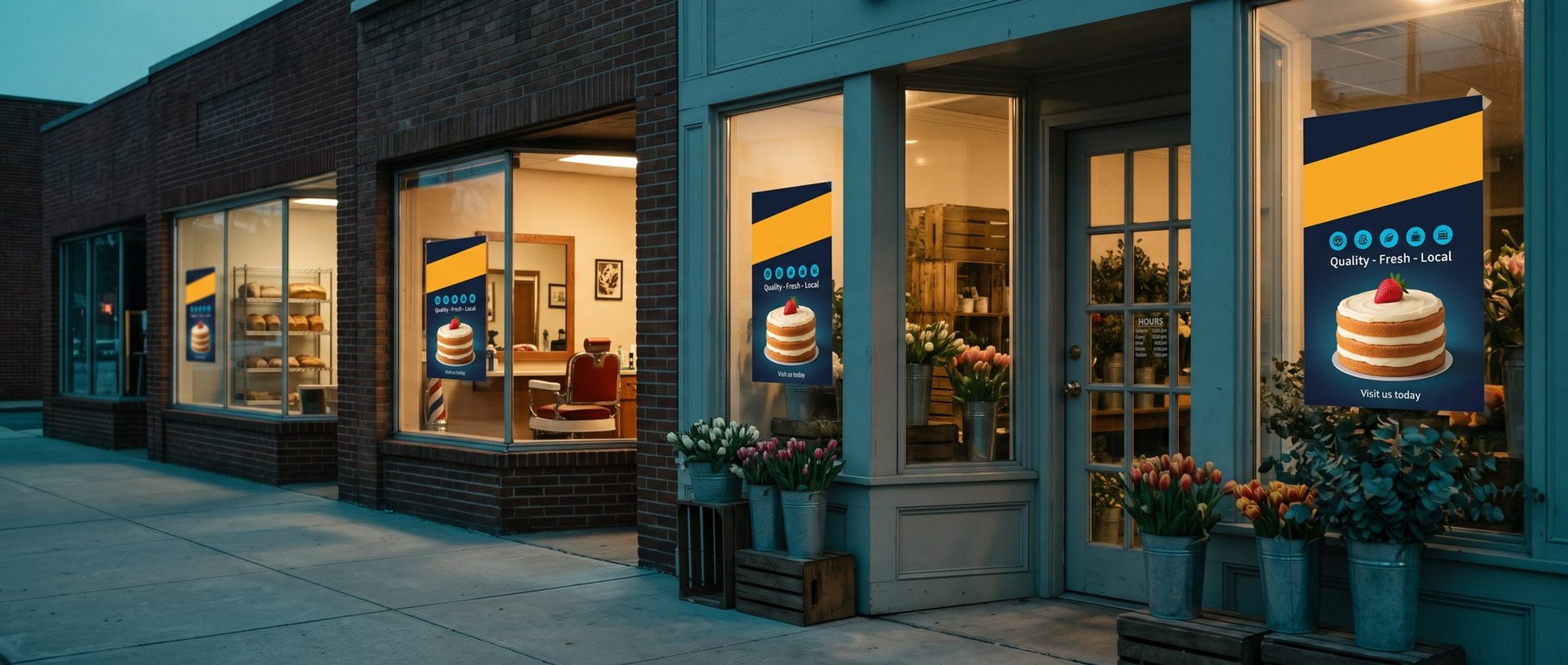
Walk down any main street this year and you will start to see it. The same poster, in a dozen different windows. A big headline set on a slant, two words, one of them in a bright color. A row of little icons that do not mean anything in particular. And a photo that is almost food: a burger with a bun that is a little too perfect, a slice of cake whose layers do not quite line up, a coffee with foam that looks like it was poured by a machine that has read about coffee but never seen one.
None of the businesses behind those posters did anything wrong. They had a window to fill and no time to fill it. In the Federal Reserve's 2025 Small Business Credit Survey, nearly half of employer firms (46%) said they or their staff use AI at work. Among those firms, writing or marketing was the top use, named by 83%. That is not laziness. It is a business owner who is good at baking or plumbing or cutting hair, and who finally found a way to get the flyer done.
We should say plainly where we stand, because it matters for everything that follows. We make AI-assisted ads every week. The images on this blog are made with AI. We think it is one of the best things to happen to small-business marketing in a long time.
The tool is not the problem. The default is.
Customers Aren't Checking Whether You Used AI. They're Checking Whether Anyone Looked.
Here is the distinction this whole article turns on. When you type a request into an image tool and put up whatever comes back, you get the tool's default: its most likely answer to your request. When you start from your own photos, give it your colors and your one message, generate ten options, throw nine away and fix the details on the last one, you get something that was directed.
Both used AI. Only one of them looks like your business.
Customers can almost never tell you which tool made a picture. What they can tell, often within a second and without knowing why, is whether a picture was made with care for this particular place or stamped out for anyone. A hand-lettered chalkboard with a wobbly arrow passes that test. A glossy poster that could hang in any window on the block fails it, no matter how polished it is.
That is the test your flyer is really taking. Not "was this made with AI?" but "did anyone here look at this before they put it up?"
The Default Output Is the Same Flyer Your Competitor Got
There is a simple reason the defaults all look alike. An image tool is built to return the most probable answer to what you asked. Ask for "a bold promotional poster for a cafe with a picture of a latte," and you get the most typical version of that poster it can produce. The cafe two doors down asked for nearly the same thing last week and got nearly the same answer.
That sameness is no accident or glitch. It is what the tool is designed to do. We went deeper on how this flattens paid ads in AI Can Copy Your Ad. It Can't Copy Your Idea., and the same pull applies to everything a local business puts in front of people:
The window. The first thing a walk-in customer sees, and the place where the default poster style has spread fastest.
The menu board and printed menu. The surface where a customer decides what to order, looking at a photo that is supposed to show them what they will get.
The flyer and the door hanger. Handed to strangers who have never been inside, so the flyer is the only evidence they have of what you are like.
Your Facebook page and Google Business Profile. Where people check you out before they visit, and where your photos sit right next to customer photos of the real thing.
On every one of those surfaces, the default output makes you look a little more like everyone else. For a big chain, that is the goal. For you, it is a slow leak in the one advantage you have.
The Photo on Your Menu Is a Promise You Have to Serve
A photo on a menu is not decoration. It is a promise about what will arrive at the table. When the photo looks wrong, the customer does not think "what a strange picture." They think "I wonder what the real thing looks like," and that is a much worse thought for a restaurant to plant.
Researchers have started to measure this. A 2025 study in the journal Appetite showed people food images ranging from clearly cartoonish to fully realistic, with AI-generated food that was close to real but not quite in between. The almost-real AI food was rated as more eerie and less pleasant than both the cartoon versions and the realistic ones. That is the uncanny valley, applied to lunch. A drawing of a taco is fine because nobody expects it to be real. A photo of a taco is fine because it is real. A taco that is ninety percent real, with a fold that bends the wrong way, makes people uneasy, and the effect was stronger in people who are already cautious about unfamiliar food.
NielsenIQ found something similar with ads. In a 2024 study, it showed people a set of video ads made entirely with AI alongside traditional ones, and measured brain activity for about 150 of them. People spotted most of the AI-made ads on their own and rated them as more annoying, more boring and more confusing. Even the ones viewers rated as high quality produced weaker memory activity than the traditional ads, and the moments that looked strangest did the worst.
It is worth being exact about what that study tested, because it gets quoted loosely. It tested ads made entirely by AI, ones viewers could mostly identify. It did not test AI work that a person directed, built on real footage and checked before it ran. What it shows is that the tell costs you. The moment a viewer senses something is off, they spend their attention on what is wrong with the picture instead of on what you are selling.
San Francisco got a live demonstration this summer. A couple opened an all-day cafe and bar on Haight Street in May, taking over a space that had been a neighborhood favorite for decades. They had three kids under five, no permanent sign yet, and a window to fill, so they put up a menu display made with AI images. A Reddit post titled "Yum, slop" drew hundreds of upvotes. Commenters compared the focaccia to a loofah. One wrote that they would rather see bad photos taken in a light box with an old camera than whatever the AI images were supposed to be. Then someone graffitied the awning.
The owners took the display down on July 6. What they put in its place is the most useful part of the story: string lights, and their real pastry case, set in the middle of the window, full of the banana bread and cookies that had been selling out almost daily. SFGATE reported that business was picking up.
Their pastry was always the best ad they had. The default poster was standing in front of it.
There is one more reason the tell matters now, and it will matter more every month. AI images increasingly carry an invisible marker of where they came from. Google embeds a watermark called SynthID in images its own models make, and since May anyone can point Google Lens or Circle to Search at a picture and ask whether it was made with AI. Meta adds an "AI info" label to posts and ads when it detects industry-standard markers that AI tools write into the file, and it applies that label automatically when you use its own tools to generate or significantly change an ad image. We cover the mechanics in AI Can Make You a Video Ad. It Still Can't Make Your Product Move Right. and Meta's AI Will Make Your Ad Images. It Does Not Know What You Sell.
Do not read that as a reason to hide your AI use. Trying to sneak it past people is the strategy most likely to be caught and resented, for the reasons in Everyone Is Automating the Part Your Customers Want Human. Read it as a reason to make sure the label has nothing to confirm. A label on a cleaned-up background behind your real cinnamon roll tells the customer something true and harmless. A label on a cinnamon roll that never existed tells them the thing they already suspected.
Customers Pick the Family-Run Shop for Its Quirks. The Default Poster Erases Them.
Think about why anyone picks the family-run place over the chain down the road. It is rarely price, and it is almost never polish. The chain will always be more polished. People pick the small place because it is specific: the owner who remembers their order, the handwritten specials, the odd lamp in the corner, the photos on the wall of the softball team the shop sponsors.
Seth Godin put the problem with most small businesses bluntly in a recent interview: they tell customers "you can pick anyone and we're anyone." He was talking about marketing in general, but the default AI poster is that sentence turned into a picture. It takes a business with a real face and gives it the face of every other business that typed the same request.
Godin also framed the choice that AI hands every owner. One road uses it to cut costs. The other uses it to make the work better. In his words, "you can't cost reduce yourself to greatness." The default flyer is the cost-cutting road. It saves you an afternoon and costs you the specific, recognizable look that was doing your selling for you.
The irony is that big brands spend fortunes trying to look the way a good neighborhood business looks naturally. The worn wooden counter, the real staff, the slightly imperfect photo, all of it gets art-directed into chain advertising because it signals that someone actually cares. You have the real thing for free. The default poster trades it for the look the chains are trying to escape.
AI Is Fine for the Sign on Your Door. It Has No Business Faking a Photo of Your Food.
None of this means you should stop using AI on your marketing. It means you should sort your marketing by one question: on this surface, what is the customer judging?
Where they are judging the product itself, the product has to be real. Where they are judging something else, such as the date of an event, a layout, or a mood, AI can do a lot of the work. Here is how that sorts out for a typical local business.
Food, products and finished work stay real. The burger on the menu board, the cake in the case, the kitchen you remodeled, the haircut. This is the promise, so it has to be a photo of the actual thing. AI can still help here: brighten a dim shot, clean up a cluttered background, straighten a crooked angle, remove a stray napkin. That is editing a real photo, not inventing one, and it is the approach we argue for in You Already Have the Photos. AI Should Be Editing Them, Not Inventing New Ones.
Your people and your storefront stay real. Customers who come in expecting the face on the flyer and meet someone else feel misled, even if the flyer never claimed it was a staff photo. Your actual front door, your actual team and your actual counter are some of the most persuasive images you own.
Layouts, backgrounds and announcements are fair game. A poster for trivia night, a holiday-hours sign, a seasonal border on your social posts, a textured background for a price list. Nobody is judging these as evidence of your product. Here AI saves real time, as long as it uses your colors, your type and your logo rather than whatever it picks.
Idea rounds are where AI earns its keep. Before you settle on a design, ask the tool for ten very different directions for the same flyer. Most will be wrong. One will show you an angle you would not have thought of. Then build that angle on your real photos.
AI Hands You the Average Flyer Until You Brief It Like a Designer
If you hired a designer to make your flyer, you would not say "make me a cafe poster" and print whatever came back. You would hand them your logo, show them your shop, tell them the one thing the flyer needs to say, and send it back twice. An image tool deserves the same brief, because without one it falls back on its default.
Start from a real photo. Upload a photo of your actual product, your actual storefront or your actual team and build around it. This one step does more than everything else on the list, because it gives the tool your reality instead of its average.
Give it your colors and your type. If you have brand colors and a font, name them. If you do not, take them from your sign or your awning. A flyer in the colors of your storefront looks like it belongs to your storefront.
Say one thing. The default poster crams in a headline, a subhead, six icons and a list of everything you sell. Pick the single message this flyer exists to deliver, such as "new fall menu," "open Sundays now" or "$20 off your first cleaning," and cut everything that is not that.
Add details only your place has. The street you are on, the name of the dish people actually order, the year you opened, the dog that sleeps by the register. Specifics are what separate a business from a template, and the tool will never invent your specifics for you.
Generate wide, then choose. Neil Patel made a version of this point in a recent video: across the campaigns his agency studies, the brands leaning hardest on AI had the lowest brand recall, while the ones pulling ahead used it to explore many directions early and then had a person pick. His phrase for the skill that matters is taste, not prompting. Ask for ten options, choose one, and fix it by hand.
If the Flyer Still Works With Your Name Covered, It Isn't Yours Yet
Before any image goes on your window, your menu, your page or your ads, run three quick checks. They take about a minute, and they are the same checks we run on our own AI work before it goes anywhere.
Cover your name. Put your thumb over your logo and your business name. Could this flyer belong to any shop in your category, in any town? If yes, it is still the default, and it needs your specifics before it goes up.
Zoom in. Look closely at the places AI still gets wrong: hands, fingers, lettering on signs and packaging, the edges of food, anything that should be symmetrical. One wrong detail is enough to make a customer distrust the whole picture.
Ask whether a stranger would believe it. Show it to someone who has never been to your business and ask what they think it is. If their answer is "an AI picture," you have your answer too. If their answer is "a photo of a bakery on Main Street," you are ready.
AI Didn't Make Your Flyer Generic. Printing It Without a Brief Did.
The owners filling their windows with default posters are not making a technology mistake. They are making a time decision, and it is an understandable one. But the fix does not take much time. It takes a real photo to start from, one clear message, and a minute with your thumb over your logo before anything gets printed.
Used that way, AI is a gift to a small business. It gives you the design help you could never afford, at the speed you actually work. It just cannot know what your place is like. That part has to come from you.
This is the same standard we hold our own work to: a person directs every piece of creative we make, and if it looks like slop, it does not ship. If you would rather hand that part to someone, we are glad to help. If you would rather do it yourself, everything above is how.