
Most ad copy advice is about getting more clicks. A B2B ad has a harder job. The words your buyer types are also typed by job seekers, students, homeowners and people who want one part when you only run thousands. Google charges the same for their clicks as for a purchasing manager's. Your ad is the last place you can tell them, for free, that this isn't for them.
This chapter shows what B2B ads in one market actually say, where better lines come from, and how to make sure the line that filters shows up every time. It builds on the one-page-per-product setup from Chapter 4, because the ad and the page should say the same thing.
We Read 70 B2B Ads in One Market. Not One Stated a Minimum Order.
The twelve example companies in this guide are all in the Milwaukee area and all run Google ads: made-to-order manufacturers, equipment makers, distributors and service firms. Google's Ads Transparency Center lists their ads, and we went through each of them by hand. Seventy had readable headlines and descriptions (Chapter 4 counted the 68 with a readable web address).
Many promised speed: 24 of the 70 ads, from four companies, offered parts built in days, same-day shipping or quick turnaround. Here is how often the ads said anything that would turn the wrong person away:
- A minimum order or project size: 0 ads.
- Businesses only, or no residential work: 0 ads.
- A dollar price: 0 ads.
- Who the product is for: 8 ads from 5 companies, mostly in passing, like "don't let a broken banding tool slow down your business."
- A size, tolerance or rating: 5 ads from 3 companies (not counting specs that are only part of a product name).
Two ads did mention order size. Both came from an online machine shop: one said "No Minimums," the other "No minimum orders." That's not a mistake. It's the same idea pointed the other way. Buyers of made-to-order parts complain that small orders get ignored; one wrote on Reddit that "for small orders, US companies don't want to respond unless you call it a prototype run." A shop that wants those small orders says so in the ad, and the buyer with 20 parts to make clicks with confidence.
So naming the order size isn't only about keeping people out. It tells the right buyer they're in the right place, and the wrong one that they aren't.
A B2B Ad Has Two Jobs: Bring In the Buyer and Tell Everyone Else It Isn't for Them.
Chapter 5 showed how many of Keyword Planner's top ideas came from people who weren't buying. Negative keywords block some of them. The rest still see your ad, because they type the same words a buyer does: "injection molding" from a student, "managed it services" from someone whose home laptop crashed, "industrial staffing" from a person looking for work.
You pay for those clicks too. That gives a B2B ad two jobs. It has to make the buyer want to click, and it has to tell everyone else not to.
Practitioners mostly agree on the second job. One specialist who coaches managed IT firms said in 2023 that every ad should carry at least one line saying they only serve businesses. An agency that runs ads for commercial service firms suggests a description line like "We don't take on residential projects." Jyll Saskin Gales, who used to work at Google, suggests words like "enterprise" to put off people who aren't your customer. The dissent comes from a podcast host who argued in 2020 that searchers don't read ad copy at all, but do notice a price.
We think both sides point the same way. The lines that filter best are hard facts a skimmer can't miss: a number, a size, a minimum, a price range, a named type of customer. "Quality parts for every industry" filters nobody. "5,000-part minimum" filters in one glance.
Your Best B2B Ad Headlines Are Already on Your Landing Page and in Your Buyers' Own Words.
Don't start ad copy from a blank page or an AI tool. Start from three places you already have.
Your landing page. The product page from Chapter 4 already names the product, the materials, the certifications and how fast you respond to a quote. Those are headlines. Writing the ad from the page also keeps the two in agreement, which is what Google's ad relevance and landing page experience ratings look for.
Your competitors' ads. Google's Ads Transparency Center shows the ads of verified advertisers that ran in the past year. Search each rival by name and read what they say. In our market, about a third of the ads promised speed, and none stated a minimum order. When the ads on the page make the same promise, the line that stands out is the one nobody else wrote, like a minimum, a size limit or a named customer type.
Your buyers. The words buyers use for what they want are better than anything a copywriter invents. Read your Google reviews and your rivals' reviews. Reread your last few months of quote requests and listen to sales calls. If you have lost deals recently, ask the buyer why. Buyer forums on Reddit, like r/procurement and r/logistics, are blunt about what buyers want. In the reviews and threads we read, buyers praised suppliers who answered quickly and complained about silence, surprise fees and small orders being ignored. A headline like "A Person Answers, Same Day" comes straight from that.
Use an AI writing tool last, as a check on length and variety, never as the source of the ideas.
The Best B2B Ad Examples We Found Sort Buyers With a Number: a Size Limit, a Tolerance, a Part Number.
The few ads in our set that did filter all used something specific a wrong searcher couldn't misread:
- A size limit. A bus bar maker gives the range it makes: up to half an inch thick and 8 inches wide. A buyer who needs something bigger knows not to click.
- A capacity or rating. A mixer maker lists tank sizes and temperature ratings in its headlines, like 750 to 1,000 gallons, rated to 450°F. That's exactly what a plant engineer is checking.
- A tolerance. A machine shop names a tolerance down to plus or minus 0.001 inch, which tells an engineer right away whether the shop can hold the spec.
- A part number. An electrical distributor puts the exact manufacturer part number in the headline. Almost nobody types it except someone looking for that part.
- A named customer. A managed IT firm writes to companies looking to "enhance your internal IT team's capabilities." A home user with a broken laptop doesn't have an internal IT team.
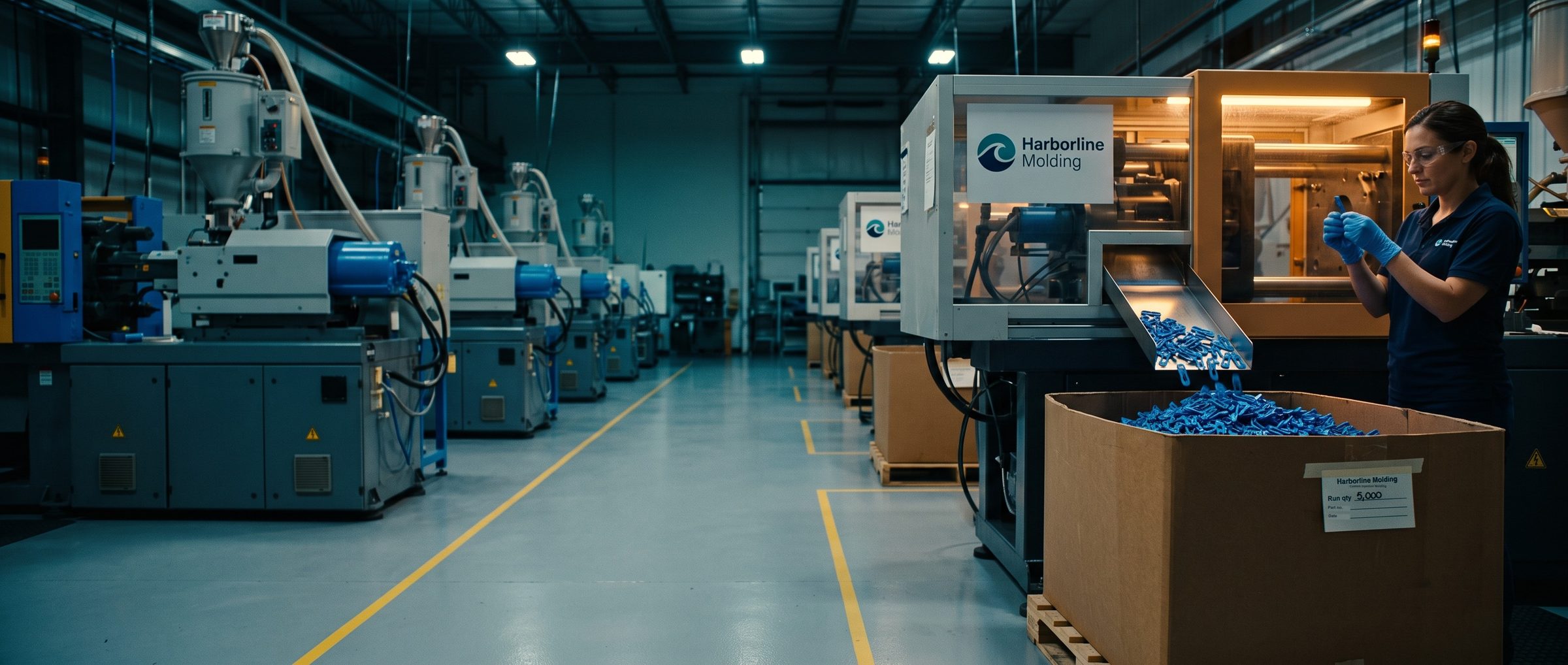
Here's what that looks like put together. Take a made-up contract injection molder we'll call Harborline Molding. A typical first draft sounds like every other ad in the market:
- Custom Injection Molding | Quality Parts, Fast Turnaround | Request a Quote Now
- Precision plastic parts for every industry. Experienced team, competitive prices.
The rewrite keeps the product and adds the filters:
- Injection Molding for OEMs | 5,000-Part Minimum Runs | Quotes Within 48 Hours
- Production molding for manufacturers. Runs from 5,000 parts. Send a drawing for a quote.
- Businesses only. ISO 9001 molder in Wisconsin. Upload your CAD file for a quote.
Each line has a job. "For OEMs" tells a student and a hobbyist this isn't for them. "5,000-part minimum" stops the buyer who needs 50. "Quotes within 48 hours" speaks to the buyer who has waited a week for a quote before. And the minimum filters both ways: if you happily take 50-piece orders, "No minimum order" belongs in the ad instead.
Google Shows Only Some of a B2B Ad's Four Descriptions. The Minimum Order Belongs in Every One.
For one B2B ad, Google lets you write 15 short headlines and 4 longer descriptions. Headlines stop at 30 characters, descriptions at 90. You need at least 3 headlines and 2 descriptions. Google mixes them into a different ad for each search, so a buyer only ever sees a few.
That creates a problem for a filtering line. If the minimum order sits in only one description, Google may show the ad without it. Google's own answer is pinning: text pinned to Headline 1, Headline 2 or Description 1 shows in every ad. The same help page says pinning "isn't recommended for most advertisers," since a pinned line shrinks the mix Google can try.
We launch new B2B ads unpinned and solve the problem by repetition instead. Write the qualifier into every description, each phrased a little differently, and into two or three of the headlines. Whichever combination Google picks, the minimum or the customer type comes along. Once a line has proven itself in the account, it becomes a candidate for the one pin.
Ad Strength Grades Variety. It Can't Tell Whether Your B2B Ad Turned Away the Wrong Buyer.
When you write the ad, Google grades it with Ad Strength, from Poor to Excellent. The grade rewards variety: more headlines, more different ideas, fewer repeats. A qualifier repeated in every description may pull it down.
That's fine. Google's help page is clear that Ad Strength plays no part in Ad Rank, in Quality Score or in who wins the auction, and that it doesn't decide whether an ad can show. It's a writing aid. Google's advice is to run at least two of these ads in each ad group, both rated Good or better. Use the second one to try a different qualifier, like a price range in place of the minimum.
Judge the copy on the numbers from Chapter 1 instead: how many qualified leads each ad group produces, and how many of the calls and forms are job seekers, students or orders too small to take. If a new qualifier cuts clicks but the qualified leads hold steady, the ad is doing its second job. Replace the weakest lines every few months as the search terms report and the sales team hand you new words.
Next: Ad Scheduling Can Keep B2B Ads Off on Weekends
Chapter 9 covers ad scheduling: when a B2B ad should run, and why switching off weekends doesn't lower the monthly bill. The full chapter list is on the Google Ads for B2B guide home. If you want us to write the B2B ads and test them for you, see our Google Ads management.


