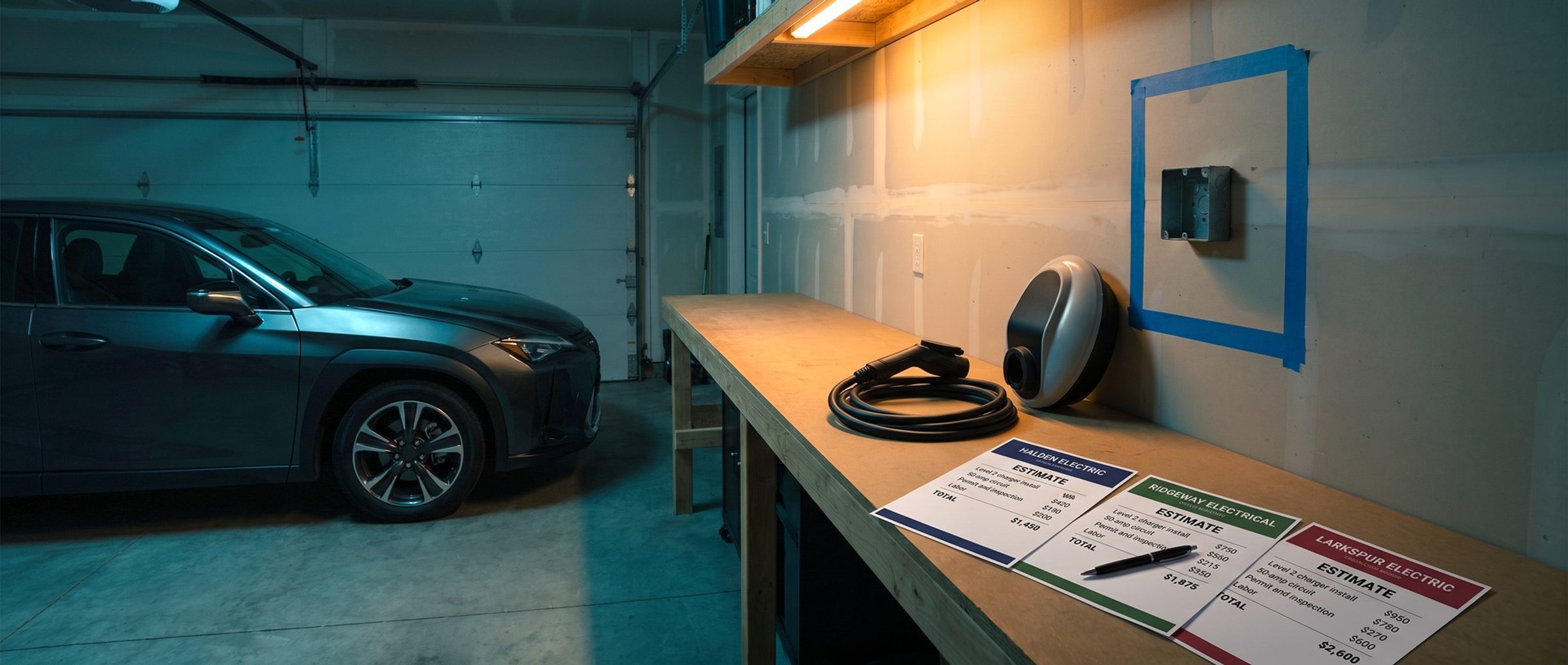
A homeowner wants a charger installed in the garage for a new EV. They call around, the way most people do with a job that size. One review in our example market, Columbus, Ohio, tells how that went: "Got an estimate for a garage EV charging station hookup and they quoted $2500. Had another electrician come and quote $800. Enough said."
Two electricians drove out. Both, quite possibly, paid Google for the click that started the call. One got the job.
That's the part most budget math skips. On Reddit, 19 of the 55 homeowner threads we read about hiring an electrician were some version of "is this quote fair?" Homeowners shop electrical work, so the price of a click means nothing until you know how many of those quote rounds you win. This chapter works the math with real ranges, so you can run it with your own numbers. Your market's prices will differ. The arithmetic won't.
A $15 Click Becomes a $496 Job Once You Count the Quotes You Lose
The method follows a click all the way to a paid job, one link at a time. Here it is with example inputs, each one labeled so you can swap in your own.
The click: $15. Pull "electrician near me" for Columbus in Keyword Planner and the top-of-page estimate lands somewhere between $6.70 and $33.01. Fifteen dollars sits inside that range. Your own figure will come from your own account.
The lead: about $165. LocaliQ, a marketing vendor, reports that electricians' search campaigns convert about 9.08% of clicks into leads, from more than 3,200 campaigns it ran between April 2024 and March 2025. It's a vendor's average, not a law of nature, but it's a reasonable starting point. At $15 a click and 9.08%, each lead costs about $165.
The paid job: about $496. If you win one quote in three, every paid job carries the cost of three leads. That's about $496 in ad spend per job.
One honest caveat about that "one in three." We looked for a neutral, published close rate for electricians and didn't find one. The vendor figures that exist measure booked appointments, not paid jobs. One in three is our reading of homeowners who collect two or three quotes. Your field software knows your real number, and it's worth ten minutes to look it up. Count it the same way every month: a quote is any job you priced for a new customer who came from an ad, and a win is a quote that turned into a paid invoice. Leave out warranty callbacks and repeat customers, who close at rates no new lead will match. If your software tags the lead source, filter to Google Ads. If it doesn't, start tagging this week, because the number you'll use for every budget decision depends on it.
Your Close Rate Moves the Cost of a Job More Than Your Bid Does
Hold the lead cost at $165 and change only how many quotes you win:
- One in four: about $661 in ads per paid job.
- One in three: about $496.
- One in two: about $330.
Now compare the levers. Getting your clicks 10% cheaper, through better bids or a better Quality Score, saves about $50 per job. Winning half your quotes instead of a third saves about $165. Same ads, same budget, a third less spent per job.
That doesn't make bids unimportant. Later chapters spend a lot of time on them. It means an account can be bid perfectly and still lose money, because the leak sits after the phone rings.
Homeowners Hand the Job to Whoever Calls Back and Explains the Price
So what moves the close rate? The homeowners in our research answered that pretty clearly. We read all 125 low-rated Google reviews about electrical work in the example market.
- Silence loses the job. 45 of the 125 described a no-show, a late arrival, or an electrician who came out, looked, and never sent a quote. On Reddit, a homeowner pricing an EV charger wrote, "they just ghost us... I literally WANT to hire you for a job."
- Surprise fees lose the job. 18 complained about a trip, service or "estimate" fee they didn't expect, from $69 to $411. Six of those 18 said a "free estimate" turned out not to be free.
- A cheaper second quote loses the job. 16 said another electrician quoted far less.
The five-star side of the same sample reads like the fix. 113 positive reviews praise an electrician for explaining, being honest, or not pushing. "He is honest, professional, and upfront with pricing," one Buckeye Electric customer wrote. Another, of Quality Electric: "The final cost ended up being exactly what" the company "had quoted me on the initial phone call too."
Price clarity is rare in this market, which makes it an opening. Only 2 of the 12 example websites we studied published a service or diagnostic fee at all. One, Electric Medic, states a $69 service fee and says it's waived when the repair goes ahead. A homeowner who knows that before the visit has one less reason to call the next name on the list.
None of that is a bid setting. It's the phone, the follow-up and the quote. That's why this method treats the front desk as part of the ad budget. A lead that waits a day for a callback is a lead you paid for and handed to the next electrician on the list.
A Service Call Can Lose Money and Still Be the Best Lead You Bought
Electrical jobs vary wildly in size. Cost guides from HomeGuide and Angi, both of which run lead marketplaces, put typical prices at:
- Service call: $100 to $200, including the first hour (HomeGuide).
- Outlets, switches, fixtures and fans: about $280 on average (HomeGuide).
- Breaker box replacement: about $1,475 on average (HomeGuide).
- Level 2 EV charger, installed: $1,200 to $3,000 (HomeGuide).
- Whole-house generator, installed: about $5,157 on average (Angi).
- Rewiring a house: $10,000 to $30,000 (HomeGuide).
Against about $496 in ad spend per paid job, a lone service call loses money. A panel, a charger or a generator covers dozens of clicks.
But the service call rarely stays alone. The homeowner who calls about a dead outlet is standing in a house with a panel, a garage and probably a yard. When the panel needs replacing or the new car arrives, they already have your number, and they tell people. "My neighbor referred me to Buckeye Electiric," one review begins. Another starts, "Safeway Electric Company was referred to me by my Realtor." Five of the positive reviews we read credit a neighbor or a realtor.
That's lifetime value: the first job plus the later ones plus the referrals. We found no neutral figure for how often electrical customers come back, so we won't invent one. Your own records have it. Pull every customer from two or three years ago, add up what each one has spent since, and divide. That number, not the first ticket, is what a new customer is worth.
Ten Paid Jobs a Month Takes About 330 Clicks. The Budget Starts From That Number.
Most owners set a budget by picking a number that feels safe. Run the chain backward instead.
Say you want 10 paid jobs a month from Google Ads. At one quote won in three, that takes 30 leads. At a 9.08% conversion rate, 30 leads takes roughly 330 clicks. Pay $15 for each of those clicks and the month comes to roughly $4,950, which Google treats as about $163 a day.
A smaller shop can run the same math at a smaller size. Five paid jobs a month takes 15 leads, roughly 165 clicks, and roughly $2,475, about $81 a day. Just don't spread that budget across every service and every hour. At $81 a day, a single expensive emergency search at 2 a.m. can eat a good part of the day. Chapter 9 covers the schedule and settings that keep a modest budget on the searches you can actually answer.
Thirty leads a month is also the mark this method uses to open the next stage. Exploration, our name for the campaign that adds broad match and lets Google set bids toward your target cost per lead, waits until the account produces about 30 quality conversions a month. Months two or three is the usual pace, and a budget that reaches 30 sooner gets there sooner.
Two Google rules matter when you set the number. Busy days can run up to double the daily number; quiet days make up the difference. Over a month, though, it won't charge more than 30.4 times the daily figure. So $163 a day means about $4,950 a month, not $163 every single day.
Then make sure each of those clicks has somewhere specific to land. A homeowner searching for a panel upgrade should reach a page about panel upgrades, not a home page that lists twenty services. That match changes what Google charges you, and it changes whether the homeowner calls.
Next: A Panel Search Deserves a Panel Page, and Google's Auction Rewards the Match
Chapter 4 explains how Google ranks ads, why Quality Score is a diagnostic rather than a price, and why tight ad groups with matching pages are the cheapest way up the page. Start with Chapter 1 if your account doesn't yet track paid jobs, and Chapter 2 for which searches deserve the first dollar.
The complete set of sixteen chapters lives on the guide's home page.
When we run Google Ads management for an electrical contractor, the first budget conversation starts with the close rate, not the click price. On your own? Count last month's quotes and wins. That one ratio will tell you more about your ad budget than any bid report.