Yes. An online store can run Facebook ads on $20 to $50 a day and make money doing it. What it cannot do is spread that money across the whole catalog, three audiences and a holiday promo at the same time. A small budget buys a handful of sales a week, and a handful of sales only teaches you something when every one of them lands on the same product.
So the real question is not whether the budget is big enough. It is which product gets it. Most owners answer that by picking their bestseller, and that is often the one product in the store that can't afford to be advertised. This piece walks through the math a store owner can do in ten minutes with their own numbers: how many sales the budget actually buys, why Meta's own rules point to one campaign and one ad set, how to tell whether a product can pay for its own sale, and how long to wait before you judge it.
Twenty Dollars a Day Buys a Store About Five Sales a Week
Start with what the money buys, because almost nobody does this before launching.
What a sale costs you on Facebook comes down to two numbers: what you pay for a click, and how many of the people who click end up buying. Divide the first by the second and you have your cost per sale. If a click costs $0.90 and 3 out of every 100 visitors buy, each sale costs $0.90 divided by 0.03, which is $30.
Those are example numbers, not a benchmark. Your click cost depends on your product, your ad and the time of year, and your conversion rate depends on your store. But the shape of the math holds for everyone, so run it with a $30 sale:
- $20 a day is $140 a week. At $30 a sale, that buys about 5 sales.
- $35 a day is $245 a week, or about 8 sales.
- $50 a day is $350 a week, or about 12 sales.
That is the whole budget. Five to twelve orders a week is a real business result, but it is a small pile of evidence, and everything that follows is about not wasting any of it.
One timing note, since you may be reading this during the holiday rush. Every advertiser on the platform spends more in November and December, so the price of showing an ad goes up and your cost per sale with it. We covered why in How Much Do Facebook Ads Cost?. A test you start this week will read more expensive than the same test in late January. That is not a reason to wait, but it is a reason not to judge a product on its December numbers alone.
Meta Wants 50 Sales a Week From Each Ad Set. A Small Store Can Afford One Ad Set.
Meta's ad system learns who buys from you by watching purchases come in. On October 21, Meta published its peak-season advice for advertisers and put a number on it: each ad set needs roughly 50 conversions a week to learn from, and in Meta's own analysis, ad sets below that ran about 28% more expensive per purchase. Meta did not publish how it measured that 28%, so treat it as Meta's claim rather than a tested fact. The 50 has been Meta's rule of thumb for years.
The same post gave a formula for how many ad sets a budget can support: your weekly budget divided by your cost per result times 50. Run it for a store spending $140 a week at $30 a sale. That's $140 divided by $1,500, which comes out to about 0.09. Not nine ad sets. Not one ad set. Less than a tenth of one.
That number sounds alarming, and it shouldn't. It means a small store will spend most of its life with the status Meta calls "Learning limited," which Meta's help center defines as an ad set that is unlikely to get about 50 optimization events in the week after its last significant edit. For a store at this size, Learning limited is the normal state, not a broken one. Your ads still run and still sell. Meta is telling you it would learn faster with more volume, which you already knew.
What the formula does rule out is the setup that a lot of popular advice still recommends: five ad sets at $5 a day each, one broad and four built on interests, to see which audience wins. On $25 a day, that takes the five sales a week you can afford and spreads them across five piles. Each pile gets one sale, and one sale tells you nothing about an audience. You end up with five tiny, noisy results and no winner. We made the same case for every kind of business in How to Make Meta Ads Work on a Small Budget, and for structure in How Many Meta Ad Campaigns Do You Need?: small budgets win by concentration.
So the setup is simple. One sales campaign. One ad set, with a broad audience so Meta's system does the targeting. Optimized for purchases.
Meta's help center lists ways out of Learning limited, and one of them is choosing an optimization event that happens more often. For a store, that usually means telling Meta to find add-to-carts instead of purchases, because you get more of them. We would not do it. Meta's system is literal about the goal: tell it to find people who add to cart, and that is who it finds. Plenty of them never check out. A smaller number of real purchases teaches the system more about your buyer than a bigger pile of browsers does.
A Cheap Bestseller Can't Pay for Its Own Facebook Ad
This is the decision that makes or breaks a small budget, and it is usually made in about four seconds: "Advertise the bestseller." It sounds like common sense. It often isn't.
Every product in your store has a ceiling, the most you can pay Meta to sell one and still not lose money on that order. You find it like this: take the order value, then subtract what the product costs you, what you pay to ship it after whatever the customer pays, and the card processing fee. Shopify charges 2.5% to 2.9% plus 30 cents on each online card payment, depending on the plan, and the examples below use the 2.9% rate. If the product gets returned often, take off your average return cost too. What's left is the most a sale can cost before that first order loses money.
Picture a small dog treat bakery with three products worth advertising:
- The single bag at $14. It costs $4.50 to make, the store covers about $5 of shipping on a single bag, and the card fee is about $0.71. That leaves $3.79. It's the bestseller by a mile, and it can afford a $3.79 sale. Against a $30 cost per sale, it loses about $26 on every order the ad brings in.
- The three-pack at $36. It costs $13.50, ships for about $7, and the card fee is about $1.34. That leaves $14.16. Better, and still far short of $30.
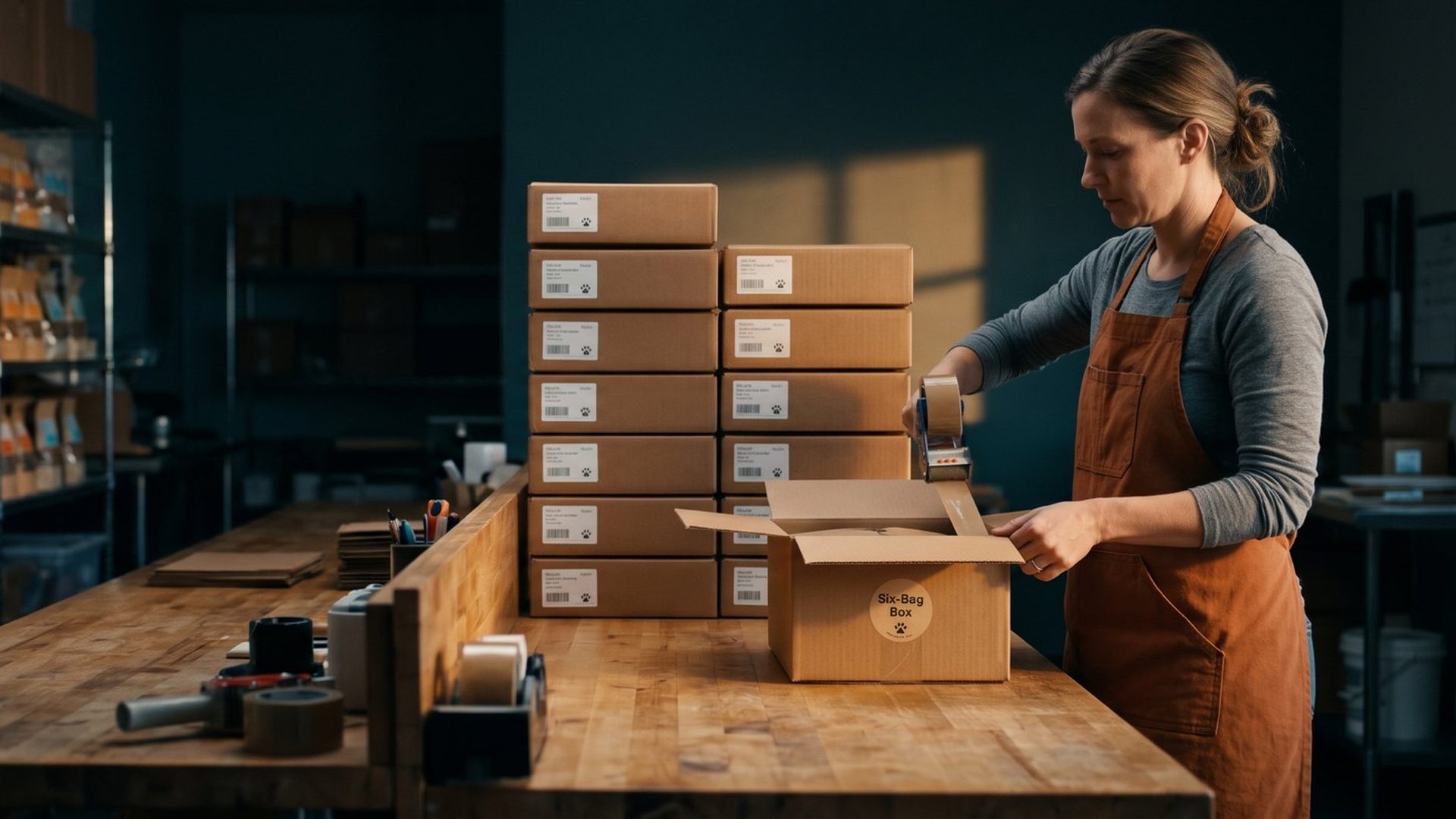
- The six-bag box at $72. It costs $27, ships for about $9, and the card fee is about $2.39. That leaves $33.61. It's the only one of the three that can pay for its own sale at $30.
The single bag sells the most for a reason: it's cheap, it's an easy first try, and returning customers grab one to try a new flavor. None of that makes it a good product to pay Meta to sell. The six-bag box sells fewer units and can carry the ad.
Two cautions before you run this for your own store.
First, repeat orders can change the answer. If your order history shows that a customer who starts with a single bag comes back and buys three more times in a year, the first order is allowed to lose money, because the second and third pay it back. That's a real strategy, and it's the one we walked through in Your First Sale Barely Breaks Even. The Second One Is the Profit. and Is Google Ads Worth It for an Online Store?. But it only works if the repeat buying shows up in your actual order history, not in your hopes, and only if your cash can wait for it. On a small budget, a product that pays for itself on the first order is the safer place to start.
Second, the ceiling is not your target. A product that just clears $30 leaves you about $3.61 for everything else the business costs. If you want the fuller version of this math, including why the return in Ads Manager isn't the return in your bank account, it's in Your Ads Report a 3x Return. At a 30% Margin, Every One of Those Orders Lost Money. and in the third check of What Should a Struggling Online Store Fix First?
Ad Spend Can't Rescue a $30 Order. A Larger Cart Can.
When no product clears the bar, the instinct is to spend more and hope the cost per sale drops. It won't, at least not because of the budget. Spending more on a product that loses $26 an order just loses $26 more often.
The lever that does work is what one order is worth. Three ways to move it:
Build a set around the product you advertise. The bakery's six-bag box exists because six bags share one shipping box, one card fee and one ad cost. Most stores have a version of this: a starter kit, a refill bundle, a two-pack priced a little below two singles. If your best product can't pay for an ad on its own, a set built around it often can.
Put the free-shipping line just above the product. If the three-pack is $36 and free shipping starts at $40, a lot of shoppers will add a single bag to get there. The ad still cost the same. The order is now worth more. We covered how to set that line, and the other ways to grow the cart, in You Don't Need More Traffic. You Need a Bigger Cart.
Test a small price increase on the advertised product. Small stores tend to underprice the exact product they advertise, because it's the one they're most nervous about. Say the six-bag box goes from $72 to $78 and fewer visitors buy, from 3 in 100 to 2.8. The cost per sale climbs from $30 to about $32.14. But what's left after costs climbs from $33.61 to $39.44, so the money left over after paying for the ad roughly doubles, from about $3.61 to about $7.30 an order. A slightly lower conversion rate on a better-priced order is often a better deal than a high conversion rate on an order that can't pay for itself.
A Weak Product Page Doubles What Every Facebook Sale Costs You
Go back to the formula from the start: cost per sale is the click cost divided by the share of visitors who buy. Owners spend nearly all their attention on the first number, swapping ads to get cheaper clicks. The second number is the one sitting on their own website.
Hold the click at $1.00 and watch what the page does:
- If 1 in 100 visitors buys, each sale costs $100.
- If 1.5 in 100 buy, each sale costs about $67.
- If 2 in 100 buy, each sale costs $50.
Same ad, same audience, same budget. Going from 1% to 2% cuts the cost of every sale in half, and on a small budget that can be the difference between a product that pays for itself and one that never will.
For a single-product ad on a small budget, three things on the page matter most.
The ad goes to that product's own page. Not the homepage, not a collection. Someone who tapped on the six-bag box should land looking at the six-bag box, with the price and the Add to Cart button in sight. Every extra tap between the ad and the product costs you buyers you already paid for. Our breakdown of what a product page has to do that a homepage can't covers the rest of that page.
The page keeps the ad's promise. If the ad showed a video of a dog tearing into the box, the page should show that video too. If the ad said free shipping, the page should say free shipping before the shopper has to go looking. People click because the ad made them a promise, and when the page doesn't repeat it, they assume they got the wrong page.
The page works on a phone. Nearly everyone who taps a Facebook or Instagram ad is on their phone. Open your own ad on yours, tap through, and try to buy. If you have to pinch, scroll past a pop-up or hunt for the button, so does every customer you paid to send there.
Two Weeks of Facebook Ads Is the Shortest Honest Test of Whether a Product Sells
With five to twelve sales a week, a single day means almost nothing. One day you'll get three orders and feel like a genius. The next day you'll get none and want to turn everything off. Both are noise. The worst thing you can do on a small budget is react to it, because every significant edit sends the ad set back to the start of learning, and on a small budget you climb back out slowly.
So decide how you'll judge it before it starts:
Give it 14 days without big changes. Two weeks is long enough to collect about two dozen sales at $50 a day, or ten or so at $20, which is enough to see a cost per sale that isn't just luck.
Judge it on your store's orders, not the daily number in Ads Manager. Count what Shopify says sold during those two weeks next to what you spent. Meta's reporting gives itself credit generously, and it changes how it counts more often than most owners realize. It changed again on November 12, as we explained in Meta's November 12 Pixel Change Only Counts Customers Who Log In.
Call it working if the cost per sale sits under the ceiling you worked out for that product. For the six-bag box, that's anything comfortably under about $33. If it's under, the product can carry more budget. If it's well over, change one thing (the ad, the page or the price) and give it another two weeks.
Run three or four ads for the one product, not one. Different ads find different buyers, and Meta needs a few to choose from. If you're stuck for ideas, open the Meta Ad Library, search for stores that sell what you sell, and look at the ads they've been running for months. A store doesn't keep paying for an ad that loses money for months. Borrow the format, not the ad.
Add a second product only when the budget can carry it. If the first product works and you want to test another, add money for it rather than splitting what you have. Otherwise you're back to splitting five sales into piles.
If you would rather not build the campaign yourself, Shopify will offer to do it for you. Read Should You Let Shopify's Autopilot Run Your Facebook Ads? before you switch it on. For a store this size it can be a reasonable start, as long as you know which controls you're giving up.
One Product, One Ad Set, Two Weeks. That's the Whole Small-Budget Plan.
A small budget isn't a handicap for an online store. It's a discipline. It forces you to pick one product that can afford the sale, put every dollar behind it, make the page earn the click, and wait long enough to know. Stores that do that grow into bigger budgets. Stores that spread $20 a day across the whole catalog mostly end up deciding Facebook doesn't work.
If you want a second set of eyes on which product your budget should be behind, that's a conversation we have with store owners every week. You can see how we work with online stores, or how we run Facebook and Instagram ads for small businesses.