Look at the ads running in your town this week and count the faces. A smiling family that has never set foot in your county. A stock-photo technician with perfect teeth and a clipboard he has never used. A voice that sounds like it normally reads the fine print at the end of a car commercial.
Now think about who your customers actually meet. They meet you. You answer the phone, you walk the job, you shake the hand at the counter, you are the one they leave the review about. The ad says "a company." The customer is hiring a person.
So should that person be in the ad? For most small businesses, yes. But "just get on camera" is how owners end up with one shaky selfie video that runs for a month, does nothing, and convinces them they are "not a video person." The face works when there is a script behind it and other faces beside it. Here is how to tell whether you belong on camera, what to say when you get there, and how to keep your own face from becoming the thing that holds your ads back.
The Customer Is Buying You Whether Your Ad Shows You or Not
Start with what your customer already believes. Every year Gallup asks Americans how much confidence they have in a list of institutions: Congress, the courts, big business, the media, and so on. In the June 2026 survey, 67% said they had a great deal or quite a lot of confidence in small business, the best score of anything on the list. The year before, the same poll put big business at 15%.
That trust is not attached to your logo. Nobody has a warm feeling about a brand mark they saw for the first time on Tuesday. It is attached to the idea of a real person who owns the place and answers for the work. An ad with your face in it borrows that trust directly. An ad with a stock family in it throws it away and competes as one more faceless company in the feed.
There are three more reasons owner ads pull their weight.
Authority without props. When the person who runs the business explains how the work gets done, it carries weight that does not need a celebrity, a pile of 400 reviews, or a "#1 in the region" badge. Viewers assume the owner knows what they are talking about, because it is their name on the truck.
A story nobody can copy. A competitor can match your price next week. They can copy your offer, your colors, even the layout of your best ad. They cannot copy the reason you started, the job that taught you to do it differently, or the way you talk about your customers. That is the one part of your marketing with no knockoff.
A real person stands out more every month. Feeds are filling up with faces that were generated, not filmed. A person who is obviously real, standing in a shop that is obviously theirs, gets rarer and more noticeable as that happens.
None of this is new, which is part of why it can be trusted. In 1971 Frank Perdue's ad agency put the chicken farmer himself on television with the line "It takes a tough man to make a tender chicken." Dave Thomas, the founder of Wendy's, went on to make 652 television commercials for his own restaurants, a Guinness World Record. Neither man was an actor. Both were the reason the product could be believed.
For a service business, the case is even stronger. When someone hires a roofer, a dentist, or a house cleaner, they are letting a person onto their property or into their mouth. The question underneath every one of those purchases is "who is going to show up?" An ad that shows them answers it before they ask.
You Belong on Camera When Your Face Changes the Decision
Owner ads are not right for every business, and pretending otherwise is how good advice turns into a bad month of ad spend. The test is simple: does seeing you change whether someone buys? If it does, you belong in the ad. If it does not, you are decoration.
The signs it does:
- You do the work, or you are the one customers meet. The owner-operator roofer, the dentist who sees every new patient, the baker behind the counter at 6am. If the customer will meet you, show them now.
- The purchase runs on trust. Anything involving a home, a body, a child, a pet, or a lot of money. The higher the stakes, the more a real face is worth.
- There is a real reason the business exists. You started it because you saw the job done badly, or because you wanted something the market did not have. A reason is a story, and a story is an ad.
- You can answer the hard question better than anyone. Usually that question is price. Nobody can explain where the money goes as credibly as the person who sets the price.
The signs it does not, or not yet:
- You plan to sell the business in the next couple of years. A winning ad built around your face is an asset the next owner cannot use, and if you step away, the ad keeps promising a person who is gone. Build the brand around the work instead, or feature the people who will stay.
- You run several locations under one name. "I'll be the one at your door" falls apart when a crew from the other location shows up. You can still appear, but the promise changes to "I hired and trained every one of them," and you need to be able to stand behind it.
- You will not prepare. Being awkward on camera is not a dealbreaker. Being unprepared is. Charisma matters far less than clarity, and clarity comes from a script.
One more thing worth knowing: the face does not have to be yours. If customers mostly meet your lead technician, your office manager, or your hygienist, that person can front some of the ads. The logic is the same, the person in the ad is the person they will meet. Just get their permission in writing first, for the same reasons we covered in who owns a testimonial video once it is in an ad.
An Owner Ad Is a Script First and a Selfie Video Second
Here is the mistake almost every owner makes the first time. They hear "people want authentic," prop their phone against the coffee maker, and talk off the top of their head for two minutes. Authentic, yes. Also rambling, unfocused, and missing the one sentence that would have made someone call.
Authentic does not mean unplanned. The best owner ads look like you just started talking, and every line of them was decided in advance. Teams that make these ads at volume say nearly all of the work happens before anyone presses record. The filming itself takes minutes. The writing is the job.
An owner ad needs six parts, in this order:
- Open on the customer's problem, not on you. The first couple of seconds belong to the viewer. "If your roof is more than fifteen years old, this is for you" earns the next sentence. "Hi, I've been in business since 2009" usually does not. We dug into why in what the first three seconds of an ad have to do.
- Say who you are in one line. Name, what you do, where. "I'm Dana, I own Cedar Ridge Roofing here in Fort Wayne." It sounds too plain to matter, but it is the signal that separates an owner from a hired spokesperson. Some creative teams who test it find the plain introduction lifts results. Test it yourself rather than taking anyone's word for it.
- Give the reason. Why you started, or why you do the job the way you do. Make it concrete. "I started this company after watching a crew leave roofing nails all over my parents' driveway" beats "we're passionate about quality" every time.
- Name what you do differently. Two or three specifics a customer could check. "We tear off every old layer. We pull every permit. The same crew starts and finishes your job."
- Show proof. Jobs completed, years in business, a warranty, a review count. One or two, said plainly.
- Make a soft ask. Owners can get away with a gentler call to action than a brand can, because the relationship is the point. "Book a free roof check and I'll tell you honestly whether you need a new one."
Write it the way you talk, in short sentences. Then read it out loud. Every place you stumble is a sentence that is too long or a word you would never actually say. Fix those, and you have a script you can deliver without sounding like you are reading one. For the full story structure behind a talk-to-camera ad, the beats and why their order matters, see why the best video ad looks like someone ranting into a phone.
Four Ads Only the Owner Can Make Believable
You do not need a creative strategy deck to get started. You need four ads, each built on a different job only an owner can do well.
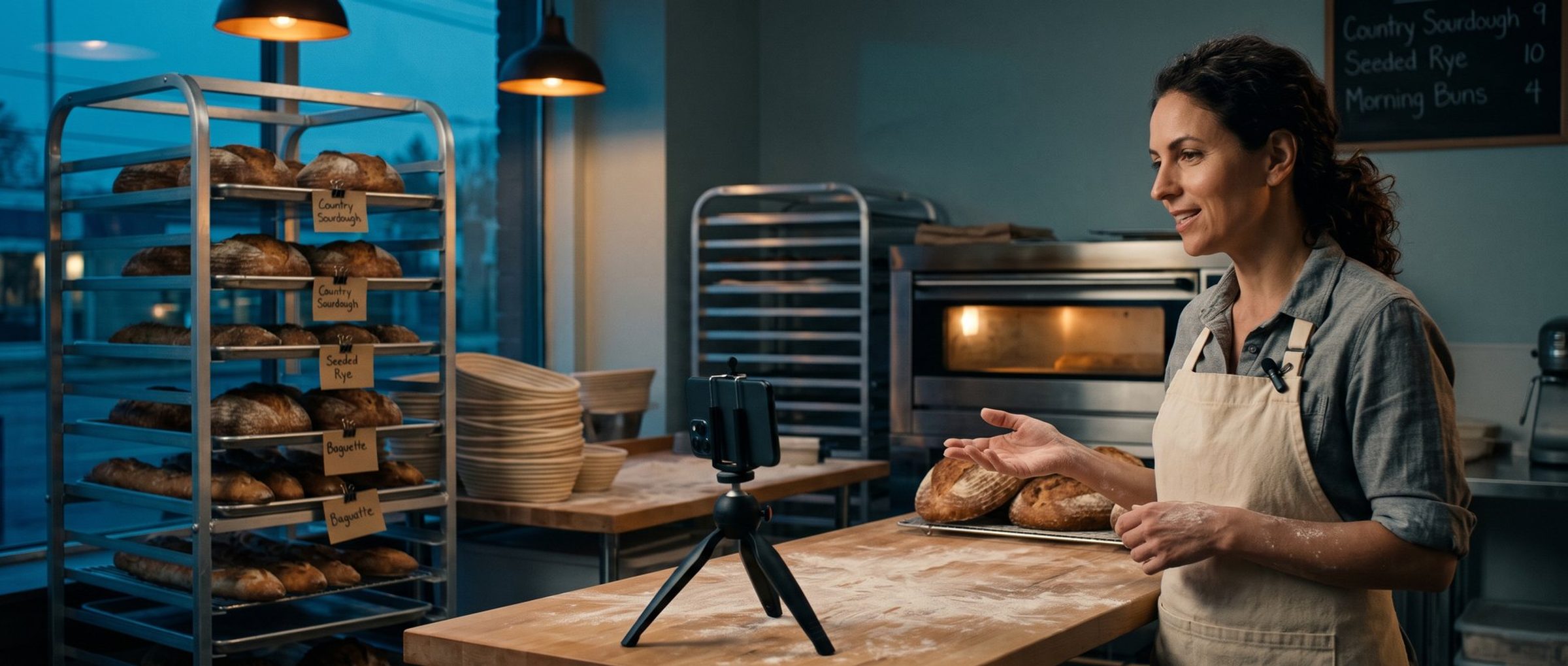
1. The origin story. Why the business exists. A bakery owner who explains she opened because the only bread in town came in a plastic bag, then walks the viewer through the 4am start that makes hers different. These can run longer than you would expect, anywhere from 45 seconds to two minutes, as long as the story keeps moving. People will watch a real story far longer than they will watch a pitch.
2. The price answer. Most of your lost customers did not say no to you. They said no to a number they did not understand. A roofer who stands in front of a torn-off roof and says, "My quote is going to be higher than the guy down the road. Here is exactly where that money goes," then walks through the tear-off, the permits, the employed crew, and the ten-year warranty, is answering the objection that kills most jobs. Nobody but the owner can say this credibly. From a salesperson it sounds like a pitch. From the owner it sounds like an explanation.
3. Showing the work. The owner doing the thing. A dentist walking the camera through exactly what a nervous new patient will experience at a first visit, from the front desk to the chair to the "here's what we found" conversation. An owner demonstrating is more convincing than a narrator describing, because you can see they actually know how.
4. The lesson. Teach one thing customers routinely get wrong. "Three signs your roof needs repair, not replacement." "Why your sourdough goes stale in a day and ours doesn't." It gives people a reason to watch that is not about buying, and it quietly makes the case that you know more than whoever else they were going to call.
Beyond those four, an owner is the natural voice for anything timely: a new location, holiday hours, a seasonal opening, a price change. "Here's what's changing and why" lands better from the person who made the decision.
Your Face in Every Ad Makes Six Ads Look Like One to Meta
This is the part the "every business needs founder ads" crowd tends to skip, and it matters more than any script tip.
Meta's ad delivery system groups ads that look alike and treats them almost as one, showing the bundle to the same slice of people. We went deep on how that works in why hunting for one winning Meta ad backfires. Now picture what an owner who falls in love with owner ads does next. Six ads, all the same person, same kitchen, same shirt, same framing, same eye-level phone angle. To you that is six ads. To the system it looks a lot like one, and your reach flattens while the same people see your face over and over.
Your face is the strongest signal in the ad, which is exactly why it can make every ad look the same.
The fix has two parts.
Make owner ads one part of the mix, not all of it. A healthy set has the owner in some ads, customers telling their story in others, the work itself in others (a before-and-after, the finished job, the product being used), and a plain offer in at least one. Different people, different kinds of proof, different doors into the business.
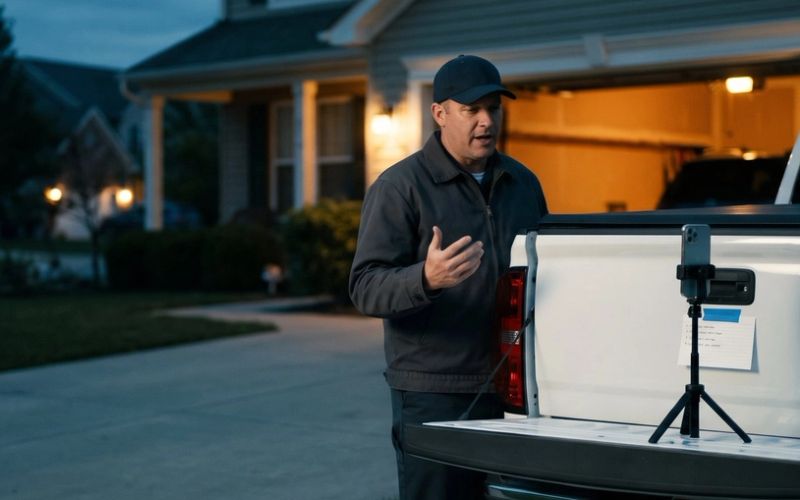
Vary the owner ads themselves. Change the setting: the job site, the truck, the shop floor, the front counter. Change the format: a walking selfie, a seated interview, a voiceover over footage of your crew at work where your face never appears at all. Change the angle: origin, price, lesson, demonstration. If you could swap two of your ads and nobody would notice, they are one ad.
One Organized Afternoon Beats a Rented Film Crew
The gear question stops more owners than any other, and the answer is almost insultingly simple.
What you need: the phone in your pocket, filming vertically for feeds and stories. A clip-on microphone, which costs about the price of lunch and matters more than any camera upgrade, because people forgive slightly soft video and click away from echoey sound. Daylight from a window in front of you. And a set that is wherever the work happens: the shop, the truck, the job site, the chair. Your real workplace says more than any backdrop you could buy.
Batch it. Do not film one ad at a time. Write ten different openings and three different middles (say, an origin version, a price version, and a lesson version), then record each one once. An editor can join any opening to any middle, which turns one sitting into 30 different ads. Each recording takes a minute or two. Most owners finish in an afternoon and walk away with a few months of material.
If you hate being on camera, you still have two good options. Record a voiceover of your script and lay it over footage of your work, so customers hear you without watching you. Or have someone sit just off camera and interview you: "Why did you start this company? What do people get wrong about the price?" Most owners who freeze reading a script open right up answering a question about their own business. Cut the best answers into ads.
Edit for the scroll. Cut every pause and false start. Add captions, because a large share of people watch with the sound off, which we covered in making a video ad work with the sound off. If you use music, keep it quiet and under your voice.
Put it on the calendar. The owner ad that never gets made is the most common kind. Book two hours like a customer appointment, write the scripts the week before, and show up.
Then make the page match. If the ad is you talking to the customer, the page they land on should sound like the same person: your photo, your words, the same promise you made on camera. An owner ad that clicks through to a generic contact form throws away the relationship it just built.
A Competitor Can Copy Your Offer. Nobody Can Copy You.
Every advantage you have in advertising can be bought by someone with a bigger budget, except one. Nobody else can be you. Nobody else started your business for your reasons, learned the job the way you did, or can look into a camera and say "I'll be the one who shows up" and mean it.
If you want a place to start this week, write the price answer tonight. It is the ad most businesses need most and almost none run. Film it Saturday morning in the place where the work happens, then write three more openings for it while you are still warmed up.
We write scripts and run these shoots for small businesses all the time, and if you would rather hand over the planning and the editing, our creative production team can take it off your plate. If you would rather do it yourself, everything you need is above. Either way, your customers already want to know who they are hiring. Show them.