Yes, LinkedIn retargeting is worth it for most small B2B companies. The people who already visited your website, watched your video or opened your lead form are usually the cheapest people in your whole LinkedIn account to win business from. They know your name. Some of them have already looked at your prices.
So why do so many owners say they tried it and it did nothing? Almost always for the same reason. They took everyone who had ever touched the website, put them in one audience, and showed them one ad asking for a demo or a consultation. Then they left that ad running for three months.
That isn't retargeting. It's one sales pitch on a loop, aimed at people who mostly weren't ready to hear it. This article walks through what to do instead: who belongs in your warm audience, what they should see, how often, what comes next, and how to tell whether any of it worked. We'll follow one example the whole way through, a managed IT company that sells support contracts to offices with 20 to 200 employees.
Most LinkedIn Retargeting Fails the Same Way: One Ad, One Ask, Shown to Everyone
Here is the typical setup behind "we tried retargeting and got nothing."
The owner installs the Insight Tag, LinkedIn's tracking code, on the website. They build one audience called something like "All website visitors, 90 days." They create one ad set aimed at it. Inside that ad set sits one ad, sometimes two, and the ad says some version of "Book a free IT assessment." Two months later the same ad is still running, the click-through rate has sunk, and the owner concludes that retargeting is a waste of money.
Three separate things went wrong there, and each one is fixable.
- Everyone got treated the same. The office manager who read one blog post about printer security and the operations director who spent four minutes on the pricing page were in the same audience, seeing the same ad.
- The only message was the ask. Nobody got a reason to trust the company first. The ad assumed the decision was already made.
- The ad never changed. The same person saw the same picture and the same headline week after week, until they stopped seeing it at all.
The middle one is the most expensive. A visit to your website is a sign of interest, not a decision to buy. At any given moment, most of the companies in your market aren't shopping for what you sell, and that includes most of the people who wander onto your site. We made the full case for advertising to those people anyway in At Any Given Moment, 95% of Your Buyers Aren't Ready. Retargeting is where that idea pays off, but only if your ads give them something to do other than buy today.
A Pricing Page Visitor and a Blog Reader Need Different LinkedIn Ads
The first fix is to stop treating your warm audience as one group. LinkedIn lets you build website audiences from specific pages rather than the whole site, and it lets you choose how far back each audience looks: 30, 60, 90 or 180 days, according to LinkedIn's own help pages.
That gives you a ladder. For the IT company, it might look like this:
- Read a blog post or a guide. Interested in the subject, not necessarily in the company. A 180-day window, because this group needs time and repetition.
- Watched at least half of a video ad. LinkedIn can build an audience from people who watched 25%, 50%, 75% or 97% of a video. Half or more means they gave you real attention.
- Visited the services or pricing page. This person was checking whether you fit. A 30- or 60-day window, because interest like this goes stale quickly.
- Opened your lead gen form and didn't send it. LinkedIn builds audiences from people who opened a form, separately from people who submitted it. This group was one tap away.
Two more steps make every rung of that ladder better.
Filter the warm audience by who could actually buy. A website audience includes job seekers, students, competitors and your own vendors. On LinkedIn you can layer your normal targeting on top of a retargeting audience, so the IT company can keep only visitors with operations, finance, office management or IT job functions at companies of 20 to 200 employees. Warm and wrong is still wrong. This is the one thing LinkedIn retargeting does better than retargeting anywhere else, because LinkedIn knows the job title of the person who visited.
Exclude the people you've already won. Upload your customer list and your employee list as exclusions, and exclude anyone who already submitted a form in the last 30 days. Otherwise a slice of your budget goes to showing "Book a free IT assessment" to a client who signed last year.
A warning on size. LinkedIn won't serve ads to any retargeting audience until it matches at least 300 member accounts, and filtering shrinks every rung. If you split too finely, you end up with five audiences that never run. We wrote a whole article on getting past that floor without much website traffic, using video viewers, document readers and form openers, in You Don't Have the Website Traffic to Retarget. LinkedIn Will Retarget Anyway. For a small company, two rungs is a perfectly good start: a broad "interested" group and a narrow "was checking us out" group.
Half Your Retargeting Budget Belongs on Proof, Not the Pitch
Once you've grouped people, decide what they see. The most useful way to think about it is a newsletter that nobody signed up for. The people in your warm audience didn't give you an email address, but you can reach them for the next few months anyway. A good newsletter doesn't ask for money in every issue. It earns the right to ask by being worth reading the rest of the time.
AdConversion, a B2B ad agency, recommends splitting a retargeting budget roughly in half: half on content, half on offers. That's a sensible starting point for a small business, and it maps onto four kinds of ads:
- Proof. A short case study with a real number in it ("cut help desk tickets by a third in four months"), or a 30-second video of a client explaining why they switched.
- How you work. What happens in the first week of a contract. Who answers the phone at 7 a.m. What the monthly report looks like.
- What you know. A useful point about the buyer's job that has nothing to do with your sales pitch, like the three IT problems that cost a 50-person office the most time.
- The offer. The actual ask.
Here is the practical part. Put the content ads and the offer ads in two separate ad sets, each with its own budget. If you load all of them into one ad set, LinkedIn will steer most of the impressions toward whichever ad gets the most clicks, and that is often the offer, because the people closest to buying click it. Your proof ads quietly stop showing. Two ad sets means you decide the split, not the algorithm.
And make the offer smaller than you think. "Book a free IT assessment" asks a stranger for an hour of their time and a sales conversation. "Get our 15-point checklist for what to ask an IT provider" asks for an email address. The bigger ask still belongs in the account, aimed at the narrow rung of pricing page visitors. Everyone else gets a smaller step first. We went through how to build that smaller step in Nobody on LinkedIn Wants a Demo. Offer Them Something Smaller.
Two Ads in Three Months Is Not Retargeting
Now the number most owners never look at: how many times each person actually saw your ads.
LinkedIn calls this frequency. It's total impressions divided by the number of people reached, and you can add it to your reporting in Campaign Manager by choosing the Delivery columns. Plenty of owners worry their retargeting is too much and annoying people. The more common problem is the opposite: a small budget spread over a 90-day audience works out to two or three impressions per person. That's not a campaign. Most people scroll past an ad twice without registering whose it was.
Impactable, a LinkedIn ads agency, makes the same point. It says a 90-day frequency of two or three gives you almost no chance of building trust, and puts its own target for a 90-day retargeting campaign at roughly 15 to 20 impressions per person. Not every one of those will be noticed, and that's the point. You need that many to be noticed a handful of times.
Here is what that costs, using the IT company. Say its filtered warm audience holds 1,000 people. Fifteen impressions each over 90 days is 15,000 impressions. LinkedIn is not cheap per impression. B2B advertisers commonly pay somewhere around $50 to $70 per thousand impressions, so call it $60. That makes 15,000 impressions about $900 over the quarter, or roughly $300 a month.
Now the version most owners run. Two or three impressions each is 2,000 to 3,000 impressions, about $120 to $180 over the whole quarter. It's cheap, and it buys almost nothing, because nobody in that audience saw you enough times to remember you.
If you've read Your LinkedIn Audience Is Small Enough to Wear Out, this might sound like the opposite of what we said there. It isn't. That article is about cold audiences, people who have never heard of you, seeing one ad over and over until they tune it out. A warm audience needs repetition too, but repetition of the same ad wears people out on either list. What changes with a warm audience is that you can afford to keep showing up, because the list is small and the people on it already know who you are. The rule for both is the same: keep frequency climbing only as long as the click-through rate holds.
Fifteen Views Only Work When Each One Is a Different Ad
High frequency with one ad is what gives retargeting its bad reputation. AdConversion describes the bad version precisely: the same ads running for 60 days, a frequency above 18, and a click-through rate that has collapsed. Fifteen views of one ad is spam. Fifteen views spread across ten or twelve different ads is a story someone gets to know over a few months.
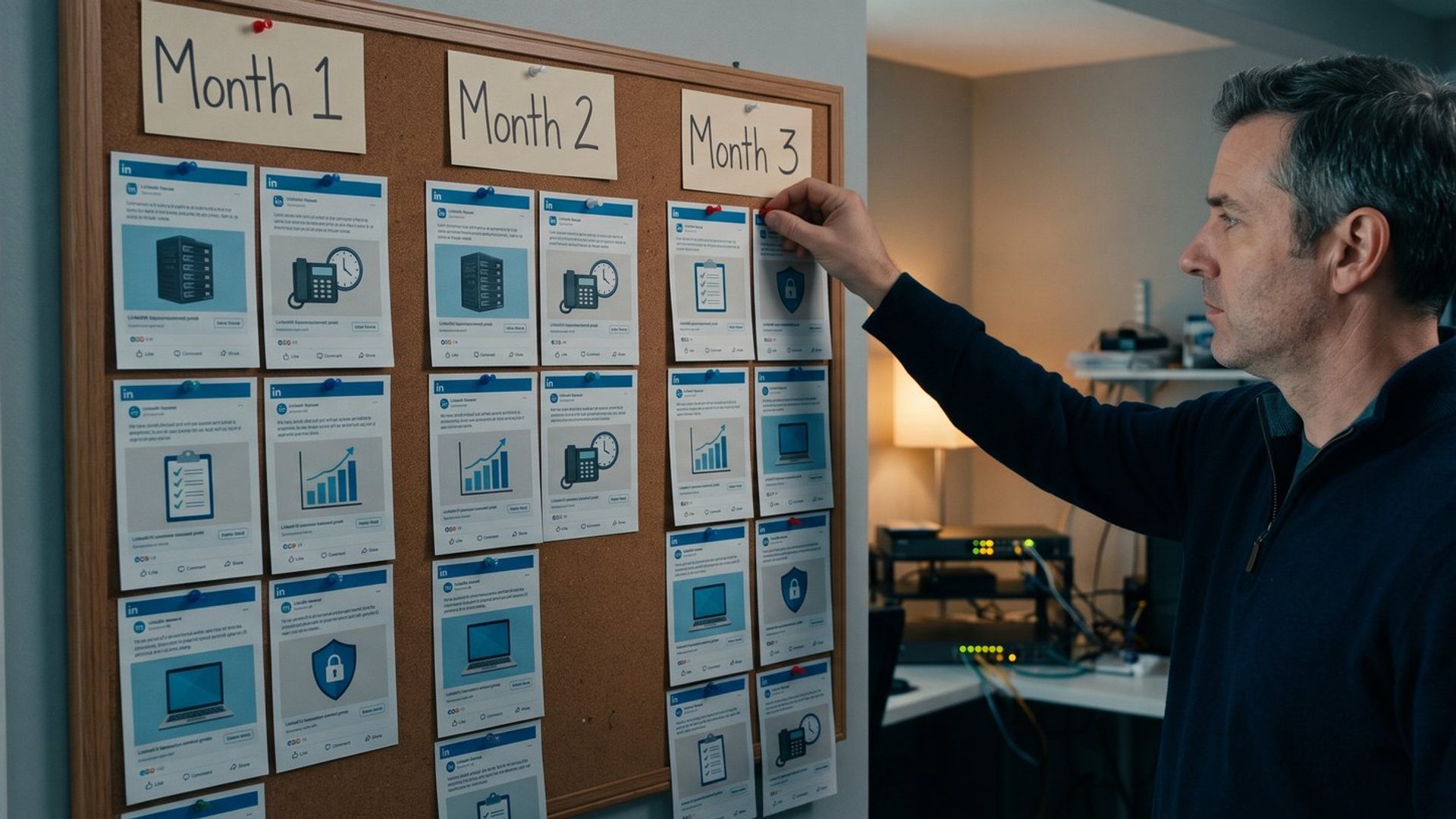
For the IT company, that means building 8 to 12 ads before launch, spread across the four kinds above: three or four proof ads, two or three on how they work, two or three on what they know, and two or three versions of the offer. Then add a few new ones every month and pause the ones that have clearly stopped working. Most small businesses already have the raw material. Every client result, every question a prospect asks on a sales call, every process the team is proud of is an ad.
The sign that a warm audience is getting tired is the same as on a cold one: frequency keeps climbing while the click-through rate falls. When you see that pattern in an ad set, it needs new ads, not a bigger budget.
Some agencies recommend switching the ad set's rotation setting to the even option for retargeting, since even exposure sounds like exactly what a sequence needs. We'd leave it alone. LinkedIn's help page says the even option "enters each creative into the auction evenly," and equal entries into the auction aren't equal impressions; we explained why in Your LinkedIn Audience Is Small Enough to Wear Out, and the same reasoning holds for a warm audience. Variety comes from how many ads you build and from the two separate ad sets, not from that switch.
The Prospect Who Opened Your Lead Form and Left Has Earned the Direct Ask
The ladder from earlier isn't just a way to sort people at the start. It's a way to move them. As people take actions, they qualify for the next rung, and the next rung gets a different ad.
- Someone engaged with a proof ad, or visited the pricing page. They start seeing the bigger ask, the assessment, on top of the smaller checklist offer everyone gets. They've seen enough of you to consider it.
- Someone watched at least half of your first video. They get the second video, the one that goes a level deeper, rather than the first one again.
- Someone opened your lead gen form and closed it. This is the warmest group you have, and the smallest. They get a plain, direct ad that answers the question that probably stopped them ("No contract required for the first 90 days" or "The assessment takes 30 minutes, and you'll get the report either way").
This is retargeting based on what people did, not on what you hope they're thinking. It also keeps the expensive, direct offer pointed only at people who've earned it, which is where it converts.
There's one more warm group most owners forget, and it doesn't come from your website at all: the leads who already talked to you and went quiet. A stalled quote or an inquiry nobody followed up on is a warmer prospect than any website visitor. You can upload those contacts as their own audience, and we walked through exactly how in The Cheapest LinkedIn Audience You Have Is the Leads That Went Quiet.
Cost per Lead Can't Tell You How Many Retargeted Prospects Became Customers
The last piece is judging whether it worked, and the default number misleads you in both directions.
Your offer ad set will usually show a beautiful cost per lead. That's partly real and partly flattery. Some of the people who filled out the form were coming back anyway. Retargeting reached them a day before they would have typed your name into Google. Meanwhile your content ad set will show a poor cost per lead, or none at all, because its job was never to produce a form fill. It was to make the offer ad work later. Judge each ad set on its own cost per lead and you'll cut the half that's doing the warming, then wonder why the other half got worse.
The better test is the one your CRM can run. Take the companies in your warm audience over the quarter and ask three questions:
- How many of them became leads, through any channel? A retargeted prospect who later calls you directly still counts.
- How many of those leads moved forward? Booked a call, received a quote, went to a second meeting.
- How many signed?
Then compare that to the quarter before you ran retargeting. It isn't a perfect experiment, but it measures the thing you care about. Two things help. LinkedIn's website tracking only credits an ad inside a set window, while your CRM can follow a deal for a year, which matters when a contract takes months to sign; we explained the difference in Your LinkedIn Website Tag Stops Counting at 90 Days. Your CRM Can Count for a Year. And LinkedIn will show you which companies engaged with your ads, so you can check those names against your pipeline directly, as we covered in LinkedIn Tells You Exactly Who Clicked. Almost Nobody Looks.
LinkedIn Won't Run Your Retargeting Ads Until the Audience Hits 300 Members
Retargeting is worth it for most B2B companies, but not on day one. Three things should be true first.
- Your warm audience clears 300 members after filtering. Below that, LinkedIn won't serve the ads at all. If you're under it, spend a month building the audience with video and document ads aimed at your cold targets, and come back.
- You can fund it properly. For a warm audience of about 1,000 people, that's roughly $300 a month on top of whatever you spend reaching new people. Spending a third of that just buys the two-impressions version.
- You have more than one thing to say. If all you have is the offer, write the proof ads first. They're the half that makes the offer work.
One housekeeping note before you start. LinkedIn archives a retargeting audience that hasn't been used in an active or draft ad set for 30 days, and an archived website audience stops collecting visitors. If you build audiences now for a campaign you plan to run next quarter, attach them to a draft ad set so they keep filling.
Get those pieces in place and retargeting stops being the campaign you gave up on and becomes the most efficient money in the account. This is work our team does every day in our LinkedIn ads management, so if you'd rather hand it off, we can help. And if you're building it yourself, everything above is what we'd do.