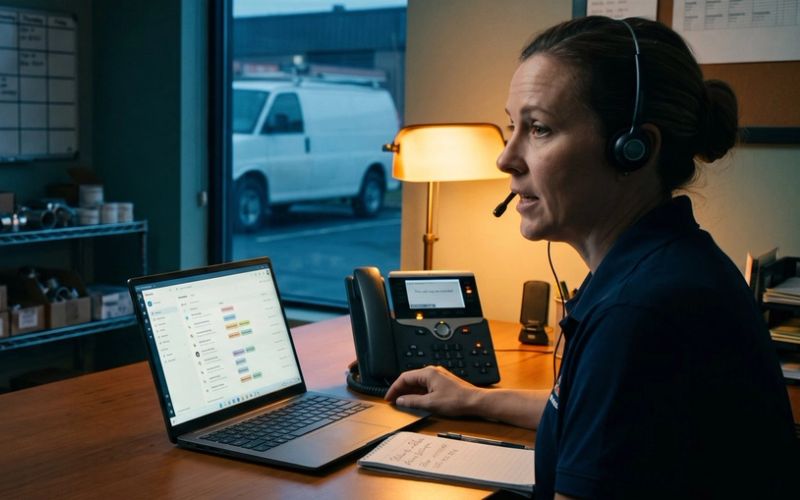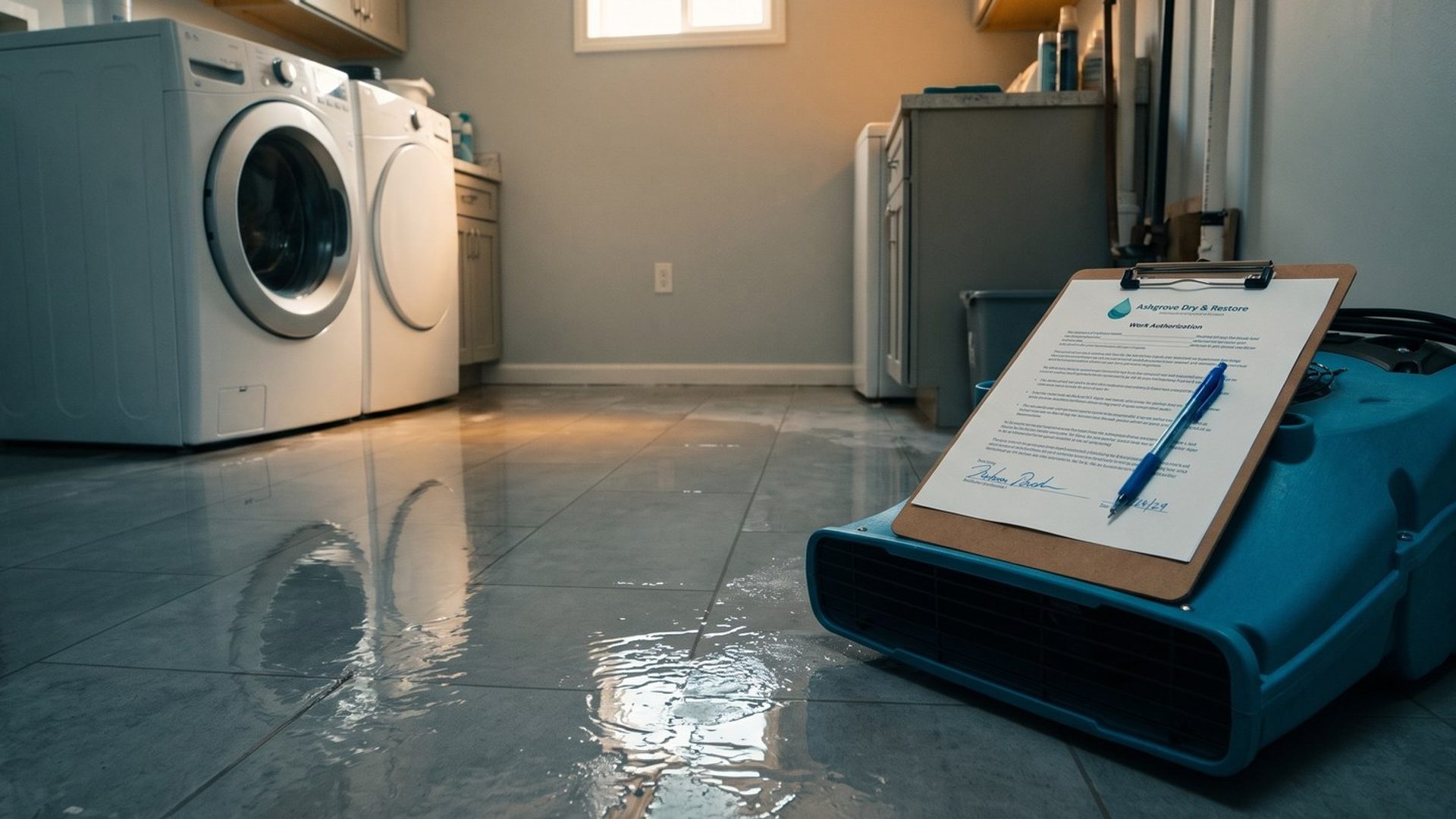
A homeowner finds two inches of water across the laundry room floor at 6 a.m., searches on her phone, taps your ad and calls. Your crew is there before lunch. She signs the paperwork, the extraction starts, and the drying equipment runs for the next few days. Weeks later, an insurance check covers the bill. In your Google Ads account, the only thing that happened was a phone call.
That gap is where restoration accounts go wrong. The account sees calls and form fills. It never sees which of those became a job, or what the job was worth. Google's bidding then does the only thing it can: it finds more people who call. Some have a soaked basement. Others want to rent a dehumidifier or apply for a technician job.
Conversion tracking fixes that. It measures what the ads produce, and it is all Google's bidding has to learn from. This chapter sets it up so the account learns from booked jobs, not ringing phones.
Five of 12 Restoration Sites List More Than One Phone Number. Each One Needs Its Own Tracking.
Start by listing every way a homeowner or property manager can reach you, because each one needs its own tracking. In one example market, Sacramento, we went through 12 restoration company websites, independents and franchise locations alike. Every one of the 12 shows a phone number, and five of them list more than one: a local line and a toll-free line, a number per office, or different numbers on different pages. One site even shows one number while its tap-to-call link rings a different one. Two sites load third-party call-tracking software. Your town will differ.
The phone. For most restoration companies, the phone is the lead. Google Ads tracks calls two ways. Calls from your ads use a Google forwarding number on your call asset: Google reports the call's length, start time, the caller's area code and whether it connected, and it doesn't charge for people who dial that number by hand. For website calls, Google slips its own forwarding number onto your page in place of yours whenever the visitor arrived from an ad, and charges nothing for it. Google swaps the number you set up; a second or third number on the site goes untracked until you set it up too, or until you trim the site to one number. Short calls don't count, and you decide where short ends.
The form. A "request service" or "free inspection" form is the second door. It gets its own conversion action and should collect an email address and a phone number, the two fields that later match a booked job back to the click.
Chat and text. If your site runs a chat widget or a text-us button, find out whether it can report a conversion when a visitor starts a conversation or leaves a phone number. Ask your chat vendor whether it can send an event to Google Tag Manager. If it can't, those leads are invisible, and the searches behind them look worse than they are.
Paid services like CallRail and CallTrackingMetrics go further: you keep the recordings, you see which keyword drove each call, and CallRail can hand calls to job software such as JobNimbus and Jobber. Google's forwarding numbers cover the basics free, so treat these as extras.
A Homeowner Who Calls Twice About the Same Leak Is Still One Job.
Each conversion action has a count setting: "One" or "Every." For leads, Google's own guidance is to count one per click, because "usually only one, unique lead per ad click likely adds value." A homeowner who calls, gets cut off and calls back is one lead, not two.
The defaults don't all match that. Call conversions default to One. Your form is a website action, and those start out set to Every: a worried homeowner who hits submit twice becomes two leads. Go through each lead action before launch and switch it.
Call length is the other setting. Our standard is 30 seconds. A homeowner standing in an inch of water who reaches your voicemail and leaves a message is still a lead, so a long minimum throws real leads away. A very short one counts hang-ups and wrong numbers.
Google has also started listening. When the caller and the business are both in the US or Canada, Google can record calls through its forwarding numbers and let its AI decide whether each one was a real lead; with no recording, it goes by the call's length. Look at how your account is set before you launch, and decide which you trust. Either way, the call is still only the lead. The job comes next.
Most Restorers Wait Three to Eight Weeks for the Insurance Check. That Is Too Slow to Train Google's Bidding.
The obvious next step is to tell Google when a job is paid and how much it paid. In restoration, the payment arrives late.
In the 2026 restoration benchmarking survey published by Cleanfax, most restorers said they wait three to eight weeks for insurance payment, and more than 18% said they wait longer than eight weeks. On the homeowner's side, J.D. Power's 2026 property claims study puts the average time from first notice of loss to final payment at 40.7 days. Texas regulators' review of the February 2021 freeze found insurers closed residential claims after 61.4 days on average.
Now set that against Google's limits. When you send a sale back with enhanced conversions for leads, Google won't import it if it arrives more than 63 days after the click. The older click-ID import allows 90. And if you change a conversion's value after you've sent it, Google says you have up to seven days after it was first recorded for that change to be readable by automated bidding.
So a paid-invoice conversion arrives either too late to count or long after the click Google is trying to learn from.
A Signed Work Authorization Tells Google Which Click Became a Job.
Restoration already marks the moment a lead becomes a customer: the work authorization. The IICRC's public-review draft of its contents standard defines a service agreement, "aka Work Authorization," as a document the property owner signs "requesting that the contractor perform damage repairs and accepting responsibility for paying the contractor," and says restorers "should enter into a service agreement before performing emergency services." Restoration software treats it the same way. Encircle lists "Work Authorization Signed" as a job milestone, and Albi ships an emergency work authorization template.
That signature is the booked job, and it is the conversion to bid on. It's meant to be signed before emergency work starts, so it usually comes on the first visit, long before the insurance check. It means the homeowner chose you. And it's much closer to revenue than a phone call.
Google's own tips agree. Give a bidding strategy one target rather than several stages that overlap, and make it a target you hit at least 15 times a month. A busy restoration company books a lot more than 15 jobs a month long before it has 15 paid invoices from the same month.
Set the conversions up as a ladder:
- Calls and forms are the leads. Track them from day one. At launch, before any booked jobs have been sent back, they can be primary so the account has signals. Once booked jobs flow, move them to secondary.
- The signed work authorization is the primary conversion, the one bidding learns from. Give it a value: your average first invoice for the job type is a fine start.
- The paid invoice is a secondary conversion with its real value. It doesn't steer bidding, but it tells you which campaigns produce money and which produce small jobs or unpaid ones.
None of the Restoration Platforms We Checked Sends Booked Jobs to Google Ads on Its Own.
That signature gets recorded in your job software, which Google Ads can't see, so something has to pass it along. Google's current method is enhanced conversions for leads. When a homeowner submits your form, the Google tag captures a hashed (scrambled) copy of the email and phone number. When that lead later becomes a booked job, you send Google the same email or phone with the conversion name, and Google matches it to the original click. Google recommends collecting both, and a phone number needs its country code.
Google now calls the older method, uploading jobs by click ID, "a legacy feature." Since June 15, 2026, Google has been moving uploads for both methods to its Data Manager API and blocking them in the Google Ads API for most advertisers.
The harder question is how the job gets out of your software. Google's Data Manager has built-in connectors for HubSpot, Salesforce and Zoho's CRM. We checked the documentation for the restoration platforms we see most often:
- Albi records lead sources, including the click ID on calls through its own call tracking, and connects through Zapier.
- Xcelerate records lead sources and offers Zapier, webhooks and an API.
- DASH records lead sources and offers an API to partners.
- Encircle offers Zapier and an API.
- Restoration Manager says it tracks referrals and marketing ROI.
None of them documents a built-in upload of booked jobs to Google Ads. That leaves three working paths:
- Run your leads through a CRM that has a Google connector, such as HubSpot, and mark the job booked there.
- Use a Zapier step from your restoration software to Google Ads when a job reaches "work authorization signed."
- Export booked jobs on a schedule and upload them through Data Manager.
Whichever you choose, the booked job has to go back carrying the same email or phone the lead came in with. If most jobs start on the phone, have whoever answers type the caller's number and email into the job record. That is what the match runs on.
A Thank-You Page That Fires Twice Doubles Your Leads on Paper. Google Learns From Leads That Never Existed.
Bad conversion data doesn't just make reports wrong. It trains the bidding on the wrong thing.
- Use one tag setup. If the Google tag sits on your site twice, once hard-coded and once through Tag Manager, keep the Tag Manager copy and remove the other. That's Google's preference too.
- Test every action. Run Tag Assistant while you submit your own form and call your own ad, then confirm each counts once, not zero times and not twice.
- Remove junk conversions. Page views, "time on site," clicks on the phone number that never became a call, and thank-you pages that fire on refresh all count people who aren't leads. Clear them out or move them to secondary before launch.
- Use data-driven attribution. Google no longer supports first click, linear, time decay or position-based attribution. Data-driven is the default for most actions, and last click is still available.
- Set a long enough window. The conversion window can stretch to 90 days for some sources. Make sure the booked-job action's window covers the gap between a click and a signature.
Every chapter after this one assumes the account knows what a booked job looks like.
Next: Homeowners Type What Broke, Not Who Fixes It.
With booked jobs counted, the next question is which searches deserve the budget. Chapter 2 starts with what homeowners actually type when water shows up, from "water heater leaking" to "water damage restoration near me," and why a new account bids first on the searches nearest a booked job.
Want the whole plan first? The guide home lists all sixteen chapters.
When we take over a restoration account for Google Ads management, tracking gets built in week one, ahead of any keyword. Running it yourself? Call your own ad, submit your own form, and check what the account recorded.