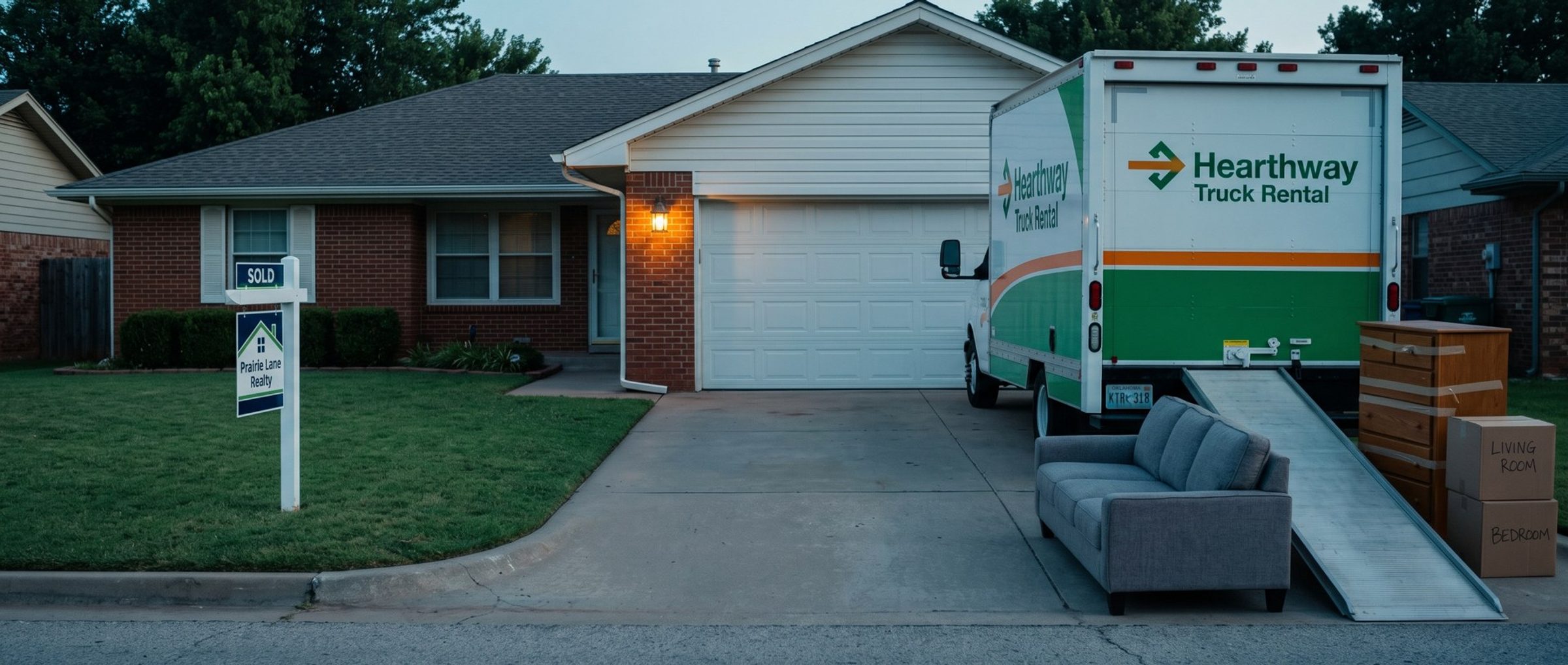
Nobody wakes up wanting a storage unit. They wake up with a closing date, a lease that ends in three weeks, a parent's house to empty, or a garage that can't hold one more box. Storage is the answer to a problem that started somewhere else, and that shapes where your advertising money should go first.
Marketers describe the path from that problem to a signed lease as a funnel with five stages: people who don't yet know they need storage, people who know they have a problem, people weighing ways to solve it, people looking for a unit, and people who already know which facility they want. Each stage searches differently, costs differently, and calls for a different Google product. This chapter walks down the funnel with real storage searches, then explains why a new account starts at the bottom and climbs.
Volumes and bids below are US figures from Google's Keyword Planner, pulled in October 2026, with a few from our example market, Oklahoma City. A smaller market shrinks every number here; it doesn't reorder the stages.
A Storage Rental Starts With a Life Change, Long Before Anyone Types "Storage."
The top of the funnel is the life event itself. We read 1,895 Google reviews of storage facilities in our example market, and 49 of them say why the renter needed a unit. A move was the most common reason by far, followed by a business needing space, a death in the family, and military orders.
People in those moments search for the event, not for storage:
- "downsizing" draws about 60,500 searches a month
- "moving checklist" draws about 12,100
- "how to declutter" draws about 2,400
Some of those people will rent a unit within weeks. Most won't, and nothing in the search tells you which. That's why the goal at this stage is awareness: being the facility name they've already seen when the need turns real. Google's tools for that are video and Demand Gen, which can reach audiences Google labels "Moving Soon" and "Recently Moved." Chapter 11 covers how. For a new account, though, this stage is where money disappears quietly, because the people who see the ad are months or years from a rental, if they ever rent at all.
Advertisers Bid Three Times More for "Storage Units Near Me" Than "How Much Is a Storage Unit." They Know Who Rents Today.
The middle of the funnel is people working out whether storage fits and what it costs. Their searches are questions:
- "how much is a storage unit," about 12,100 a month
- "storage unit sizes," about 3,600
- "what size storage unit do i need," about 1,000
Price is the question they ask most often. We counted 96 "People also ask" questions across the storage searches we ran in our example market; price came up in 44.
Keyword Planner shows what advertisers have been willing to pay for each search. It reports a range of top-of-page bids drawn from past auctions; the high end is the 80th percentile. For "how much is a storage unit," the high end is $7.23. For "storage units near me," it's $21.81, three times as much. For "storage unit sizes," $10.06. Our reading of that gap: across thousands of auctions, advertisers have found that people asking what a unit costs rent less often than people asking where the nearest one is, and they bid accordingly.
The goal here is to drive interest and help a decision, and your website does that job better than an ad. A plain size guide (what fits in a 5x10, a 10x10, a 10x20), prices posted on the unit pages, and a clear answer about fees and insurance turn a researcher into a renter when they come back. Ads for these searches can come later, once the account knows what a rental is worth.
"Near Me," "10x10" and "Climate Controlled" Are the Searches That Rent Units This Week.
The bottom of the funnel is someone looking for a unit, not information. Their searches name a unit, a feature or a place:
- "storage units near me": roughly a million nationwide each month, 8,100 of them in our example market
- "10x10 storage unit," about 14,800
- "climate controlled storage near me," about 60,500
- "cheap storage units near me," about 49,500
These are short, specific and urgent. Someone typing "10x10 storage unit" has measured their stuff, or at least guessed. Someone typing "near me" wants the closest facility with a unit open. The goal here is simple: compel action. Show the unit, the price, the location and a way to rent it now.
Town names belong here too. In our example market, people search "storage units norman ok" about 880 times a month, "storage units edmond ok" about 720 and "storage units moore ok" about 480, with top-of-page high bids around $17 to $21, close to the near-me searches. A renter who types a town has already narrowed the map. If your facility sits in or beside that town, those searches are as ready to rent as "near me." List the towns your renters actually come from, not every town in the county; a 20-minute drive is a long way to haul a sofa.
This is where a new storage account spends first. Chapters 6 and 7 build the first campaign around these searches. We call it Isolation: only exact match, bids typed in by you, so the budget reaches people looking for a unit and each move-in traces back to one search.
Four in Ten Storage Searches Ask for a Chain by Name. Those Renters Picked Their Facility Before They Typed.
The last stage is someone who already knows where they want to go. They search a facility's name. Searches for your own facility's name are usually cheap clicks from people who already chose you, so they get a small campaign of their own from the first month. Without it, another advertiser can show above you on your own name.
The same stage is crowded with other people's names. Searches that type a national chain's name make up more than four in ten US searches to rent storage. Those searchers chose a facility before they searched. Chapter 5 explains why a new account sets those names aside instead of chasing them.
Performance Max and Demand Gen Learn From Move-Ins. A Brand-New Storage Facility Has Zero to Give Them.
Each stage of the funnel has a Google product built for it. Here's how they line up, in the order a storage account usually adds them:
- Month one: Search. An Isolation campaign on unit searches like "storage units near me," your town names and unit types, plus a campaign for your facility's name.
- Usually months 2-3: Exploration. Our name for a broad-match twin of the Isolation campaign that bids to a target cost per conversion and turns up searches you never listed. It switches on when rentals and qualified leads reach about 30 a month. A single facility usually needs two or three months to hit that mark, and a busy group of facilities can hit it sooner.
- Usually months 6-7: Performance Max. Google's campaign that runs across Search, Maps, YouTube and more. It waits for the same steady 30 conversions a month, with move-ins flowing back to Google as Chapter 1 set up.
- Later: Demand Gen and YouTube. These reach the life-change and research stages. Google's own guidance for Demand Gen on target CPA asks for a budget of ten times or more your target cost per conversion. Few new storage accounts can spare that, and like Performance Max, Demand Gen also waits for about 30 quality conversions a month.
- A test beside Search: Local Services Ads. Google lists "Storage" as a category. Chapter 12 covers when to try them and what you give up.
- Last: AI Max. A Search setting where Google's AI picks extra searches to show on, close to how broad match behaves, and drafts some of the ad text. Chapter 13 explains why it goes at the end.
It feels backward. Plenty of marketing plans open with brand awareness and work down to sales. In Google Ads, the order flips because of how the system learns. Every campaign after Isolation relies on Google's automated bidding, and automated bidding learns from conversions. A new account has none. Starting with unit searches produces rentals quickly, and those rentals, sent back with their value as Chapter 1 describes, are what every later campaign needs to work. The scale comes as you climb.
The exception is budget. If you can fund video for months without shorting the unit searches, awareness can start sooner. Most independent facilities can't, and shouldn't try.
Next: A Storage Tenant Stays About a Year and a Half and Pays About $2,000. Build Your Google Ads Budget From That.
Chapter 3 puts dollar figures on the bottom stage: the price of a click, the clicks it takes to fill a unit, and a tenant's rent across a typical stay. Move-in tracking comes first, so if that isn't running, go back to Chapter 1. Every chapter is listed on the Google Ads for Self Storage guide home, and if you'd rather have help building the account, our Google Ads agency team works with storage operators.