
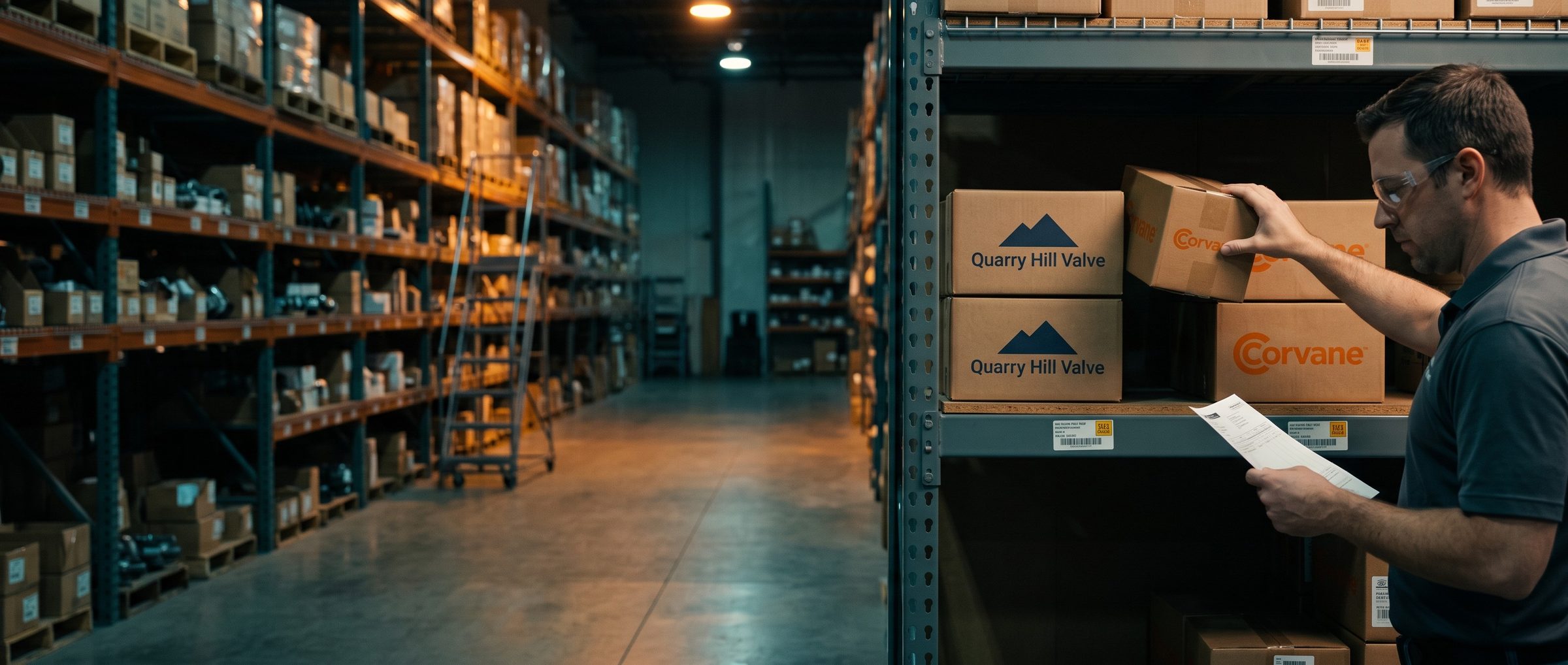
Most B2B manufacturers don't sell only direct. They sell through distributors, dealers, reps and resellers, and those partners advertise too. Sooner or later a maker searches its own company name on Google and finds a distributor's ad sitting above its own listing, sometimes offering its products at a different price, sometimes pointing buyers toward a rival brand the distributor also carries.
That's channel conflict, and it now plays out in the ad auction as much as in pricing meetings. This bonus chapter covers what distributors actually do in their ads, what Google's trademark rules allow and don't, how a manufacturer can control its name in ad text, and why a simple brand campaign is still the first defense. It follows the lead quality chapter, Chapter 14.
A B2B Distributor's Google Ads Are Full of Brand Names It Doesn't Own.
Among the twelve example companies in this guide, two are distributors whose ads put other makers' names front and center, and their ads show how it works from the distributor's side.
- An electrical distributor: all 8 of its readable text ads lead with a maker's brand and part number. The headlines name Hubbell, FINDER, ABB, PULS, Siemens and other major electrical brands, each followed by a specific model number and a same-day shipping promise.
- A packaging distributor's tool repair service: 7 of its 11 readable ads name the brand of tool it repairs: Signode, Orgapack, FROMM and Polychem.
That's legitimate, everyday distributor advertising. A buyer searching for a specific Siemens safety switch wants to know who has it in stock, and a plant whose Signode strapping tool broke wants someone who repairs Signode tools. The distributor is meeting real demand for a brand it really sells or services.
From the manufacturer's side, though, each of those ads can land in the same auction as the maker's own ads when a buyer searches the maker's name. When the distributor is a good partner, that's extra reach. When it's a reseller undercutting authorized dealers, or a distributor steering buyers toward a house brand, it's channel conflict with a cost per click attached.
Google's Trademark Policy Lets Anyone Bid on Your Brand Name. Only the Ad Text Can Be Restricted.
The first thing most manufacturers want to know is whether they can stop it. For a manufacturer hoping the answer is yes, Google's policy page is a letdown: bidding on someone else's trademark as a keyword sits on its list of things it won't restrict. Anyone can bid on your company name or your product names, and Google won't stop them.
What Google can restrict, after the trademark owner files a complaint, is the trademark's use in ad text. Once a trademark owner complains, Google limits two uses in ad text: a direct competitor putting the B2B brand's name in its own ad, and wording that is confusing, deceptive or misleading about it.
There's an important exception for resellers. Google won't restrict ads whose landing page is mainly for selling the trademarked products, their parts or compatible products, as long as two conditions hold:
- The landing page must clearly provide a way to buy, and show commercial information such as rates or prices.
- The ad and the page must make clear the advertiser is a reseller or an information site.
A few more details matter for a B2B brand owner. Complaints apply to specific advertisers, identified by their web address, in the countries and industries where the owner has shown trademark rights. And Google gives at least seven days' warning before suspending an account over a violation.
A Trademark Complaint Keeps Your Name Out of Unwanted Ad Text. You Can Still Let Your Best Distributors Use It.
Google's trademark troubleshooter gives an owner two relevant options: report an ad in live search that uses its trademark, or authorize an advertiser to use its trademark in ads (or withdraw an earlier complaint).
Put together, our reading of the policy gives a manufacturer a workable approach:
- You can't stop distributors from bidding on your name as a keyword. Don't spend effort trying.
- You can restrict your name in ad text by filing a complaint against specific advertisers, named by their web address.
- You can then authorize the distributors you want to use it, so your best partners keep your name in their headlines.
One wrinkle is specific to B2B. Many distributors and dealers don't publish prices; they quote. Google's reseller exception asks for a landing page with commercial details, and gives prices or rates as the example. A quote-only distributor page may not clearly qualify, which is one more reason to authorize partners explicitly rather than rely on the exception. Google doesn't spell out how it treats quote-only pages, so treat that as our reading, not a rule.
Everything else about channel conflict, like minimum advertised prices, who may bid on which brand terms, and co-op advertising money, is a matter for your distributor agreements, not Google's settings. Google enforces trademarks. It doesn't enforce your channel policy.
What to put in writing with your distributors
Google won't settle channel conflict for a manufacturer, so the agreement with each distributor has to. In our experience, a short written brand policy prevents most of the arguments. It usually covers:
- Which of your names a distributor may bid on, for example product and part names but not the bare company name, or the company name only when paired with "distributor" or a city.
- Whether they may use your name in ad text, and the authorization you'll file with Google for the ones who may.
- Where their ads must send the click: a page that actually stocks or quotes your product, not a page that pushes a house brand.
- How pricing in ads is handled, if you have a minimum advertised price policy.
- Who handles the brand search for your company name itself, usually the manufacturer, so a buyer looking for you lands with you or is routed to the right partner by territory.
Before acting on a complaint from your sales team, check it. The auction insights report shows which advertisers appeared alongside your brand ads. Google's Ad Preview and Diagnosis tool, which Chapter 5 used to find competitors, shows the live page for a search without adding impressions to your own ads, so you can see exactly what a buyer sees before you pick up the phone to a partner.
A Brand Campaign Is the Cheapest Way to Hold the Top Spot When Distributors Bid on Your Name.
Whatever the rules say, the most reliable defense for a manufacturer is to show up on its own name, every time someone searches it. A brand campaign, a Search campaign that bids only on your company and product names, is part of this guide's setup from the first day, separate from the product campaigns. On your own name, your ad and your site are as relevant as anything gets, which in our experience often makes brand clicks among the cheapest in the account.
A few settings keep brand traffic where you can see it:
- Keep brand searches in the brand campaign. When Performance Max joins the account, add your company name as a brand exclusion there. Google advises exactly that for advertisers who keep their own name in a separate campaign.
- Add your brand as a negative keyword in the product campaigns, so a search for your name doesn't get counted as a product lead from the exact match campaign in Chapter 6.
- Check the auction insights report on the brand campaign every month. It shows which other advertisers appeared in the same auctions as your brand ads and how often, though not which keywords they bid on.
For a distributor, the same logic runs the other way. Bid on the maker's brand plus specific part numbers or models, the way the electrical distributor's ads name the brand and model, and get the maker's authorization to use its name in your ad text. That keeps you on the right side of both Google's policy and the relationship.
Google Also Lets You Bid on a Rival Maker's Brand Name. Protecting Your Own Name Comes First.
The same rule works for you. Nothing in Google's policy stops a manufacturer from bidding on a competitor's brand as a keyword. What you can't do, if the competitor complains, is use their trademark in your ad text.
Our method treats competitor bidding as a later, separate decision. In Chapter 5, competitor names went into the negative keyword list of the main campaigns. A test on a rival maker's name should get a separate campaign and budget line, so the B2B sales team can see what each of those leads really cost. Someone who typed a brand often wants that brand; your ad has to give them a real reason to look elsewhere, such as a shorter lead time, a lower minimum or a compatible part.
In our research into what B2B practitioners teach, we found no established rule for distributors bidding on a manufacturer's brand. Treat any competitor campaign as an experiment, run it after your own brand campaign is covered, and measure it on qualified leads like everything else. For a distributor, the equivalent question is which maker brands to bid on at all. In our view, the answer is usually the ones you stock deepest and can quote fastest, because those are the searches where you can actually win the order.
Next: Google Ads Can't Target a Company by Name. B2B Account Based Marketing Works Around It
The final chapter takes on account based marketing: a sales team with a list of named target companies, and the limits of what Google Ads can do with that list. Every chapter is listed on the Google Ads for B2B guide home. If you'd like help sorting out brand bidding with your distributors, see our Google Ads management.


