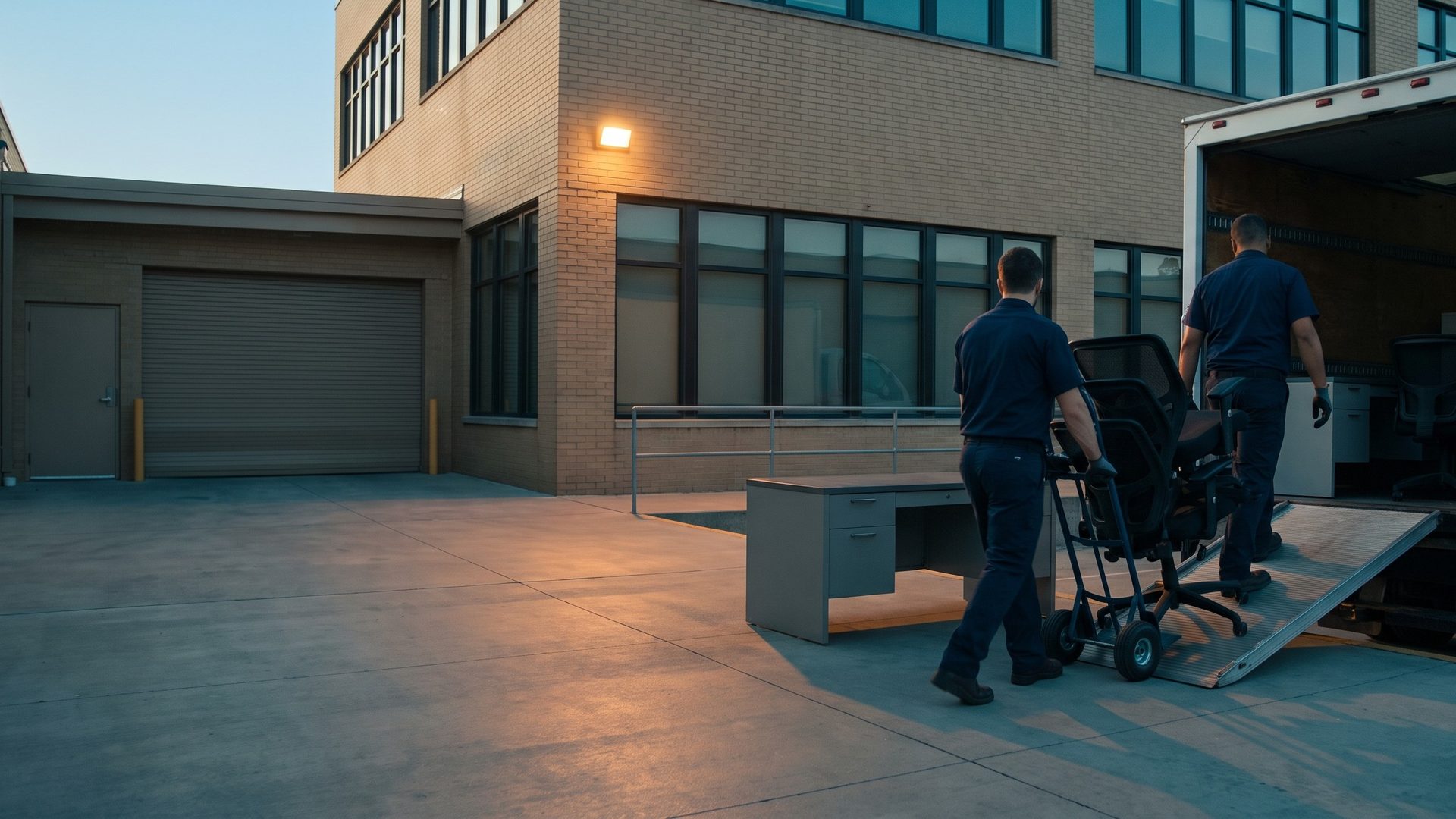
The Junkluggers' 2024 franchise disclosure breaks out something most haulers never measure: how much of the money comes from businesses. Across the 74 franchisees open for all of 2023, commercial jobs averaged 28% of gross revenue. The median owner was at 26%. The lowest was at 6%, and the highest at 75%.
Every one of the 12 junk removal businesses we profiled in our example market, Charlotte, North Carolina, says it serves businesses as well as homes. Most of them sell to both from the same pages, with the same ads, under the same budget.
Chapter 15 split dumpster rental into its own campaign. This last bonus chapter does the same for property managers, offices and contractors, the customers who search on their own calendar, care about different things and, when the job goes well, call back.
Business Jobs Made Up 28% of One Franchise's Revenue, and 75% for Its Most Commercial Owner
The spread matters more than the average. Two owners in the same franchise system, with the same trucks, the same brand and the same national ads, ended up at 6% and 75% commercial. A share that wide isn't set by the market. It's set by what each owner went after.
The national brands treat business customers as their own line. 1-800-GOT-JUNK runs a program for property managers that promises "Next-day service for property managers. From unit cleanouts to illegal dumping and more." Its commercial request form asks for the business name, the industry and a "Frequency of Service Needed," with one-time, weekly, monthly and as-needed as the choices, and it says "If you need service weekly, monthly, or quarterly, we offer bulk pricing discounts." College HUNKS runs national accounts, Junk King runs key accounts, and the Junkluggers' booking form opens with one question: "Is this service for a residence or a business?"
None of that works if the ad account can't tell the two customers apart. In a shared campaign, a business search and a homeowner search land on the same ads, draw from the same budget and count as the same conversion, so the account can't show which half is paying for the trucks.
Commercial Junk Searches Peak in October, a Month After Homeowners Do
Keyword Planner shows the two calendars side by side. Over the past year in the US, "commercial junk removal" averaged 3,600 searches a month. It climbed to 5,400 in September, peaked at 6,600 in October, held at 5,400 in November and January, and fell to 1,900 in April and May.
"Junk removal near me" ran on a different schedule. It peaked at 135,000 in September and again in January, and hit its low of 60,500 in November.
Put the two together and November stands out. It's the month homeowner searches bottom out, and business searches are still near their high. A hauler running one shared budget through the fall sees a quiet month and cuts spend, right when property managers and offices are still looking.
Separate campaigns fix that the same way they did for dumpsters in Chapter 15. Each one gets its own budget that can rise and fall with its own season. Watch your own search terms report for the first year, because one year of national search data is a starting point, not a forecast for your town.
Office Junk Clicks Run to $40. Bid for the Repeat Account, Not the First Job.
Business searches cost more at the top of the page. Keyword Planner's US top-of-page high estimates:
- "office junk removal": $40.00 (260 searches a month)
- "office furniture removal": $31.67 (1,600)
- "commercial junk removal": $26.41 (3,600)
- "apartment cleanout": $22.00 (880)
- "construction debris removal": $17.01 (4,400)
- "foreclosure cleanout": $12.12 (1,600)
For comparison, "junk removal near me" tops out at $23.27. As always, these are estimates drawn from past auctions, not prices.
Notice what's missing. "Property management junk removal" draws about 30 searches a month. Property managers don't search for themselves. They search for the job: the apartment cleanout, the foreclosure, the office furniture. So the campaign groups business searches by job type, the way Chapter 4 grouped homeowner searches by item. Office cleanouts and office furniture in one ad group, apartment and rental cleanouts in another, foreclosures in a third, construction debris in a fourth, each with an ad and a page written for that job.
The bids follow the value. One national cost guide puts a typical business junk job at about $500, against about $210 for a single-family home. A $40 click on a job worth twice as much can still pay. And unlike a homeowner, a property manager with a full building comes back. We didn't find a public number for how often business customers rebook, so use your own job records: how many of last year's commercial customers booked more than once, and what they spent in total. That total, not the first ticket, is what the manual bids from Chapter 7 should be set against.
Keep the two campaigns apart with negatives in both directions. "Commercial," "office," "apartment cleanout" and "foreclosure" go on the homeowner campaign's negative list, so business searches only reach the business ads.
A Property Manager Who Books Once Comes Back. Write the Page for the Second Job.
A homeowner landing page sells speed and a fair price for one job. A business page has to answer what a property manager asks before handing over a building:
- How fast you turn a unit. One hauler we profiled promises rental cleanouts "ready to rent again in under 24 hours."
- Proof of insurance. 1-800-GOT-JUNK's FAQ says it provides a certificate of insurance before commercial jobs. Another profiled hauler says "Certificates of insurance are available for commercial and property management clients," and a third names property managers and HOAs as "Additional Insured at no charge."
- Recurring service. Weekly, monthly or on call, with one hauler offering "Discounted volume-pricing and recurring schedules for regular commercial customers and GCs."
- How billing works. Invoices, accounts and who to call.
- Photos of business jobs. An office, a vacant unit, a job site, not a garage.
The form should ask what the business needs, not just where the couch is. The business name, the type of property and how often they expect to need service tell you which leads are worth a call back today.
Then count those leads apart. Give the business quote form and the booked commercial job their own conversion actions, and set the business campaign to bid on them with a campaign-specific goal, the same setting Chapter 15 used for dumpsters. Once there are enough booked jobs, give each one its real value from your records. Then the business campaign's cost per booked job can be judged on its own, against what a business account is worth.
New York City Licenses the Hauler Who Takes a Business's Junk: $5,000 for Two Years
Business work can come with rules that homeowner work doesn't, and they vary by city and state.
In New York City, the Business Integrity Commission says "You need a Trade Waste Removal License for your business to remove, collect or dispose trade waste from businesses in New York City." The license lasts two years. The license fee is $5,000, which covers the first vehicle, plus a $600 background investigation fee, $600 per business owner for disclosure forms and $500 for each added vehicle. Owners are background checked. A one-time, on-call bulk pickup is exempt from the city's Commercial Waste Zones, but the Sanitation Department says those jobs still "must be collected by a carter that holds the appropriate BIC license or registration." Construction debris haulers register separately.
New Jersey draws its line in a different place. The state requires an A-901 license from companies that haul waste generated by others, and lists "Clean outs, trash outs, clean ups and junk removal from homes, businesses, offices, garages, barns, sheds, warehouses" as that kind of work. In New Jersey, the license question covers homeowner jobs too.
Federal rules add one more difference. The EPA's household hazardous waste exclusion follows where the waste came from. Leftover paint from a home is household waste. The same cans from a business cleanout aren't, and can fall under the federal hazardous waste rules for businesses.
The ad account comes last in this order, not first. Before a campaign promises commercial junk removal in a city, check what that city and state require for business waste, and don't write "licensed" in an ad unless the license covers the work being advertised. This is our reading of the rules for two places, not legal advice for yours.
If you'd rather someone else build the business side as its own campaign, our Google Ads management runs homeowner and commercial accounts side by side.
Homeowner, Dumpster or Business, Every Junk Campaign Gets Built in the Same Order
That's the whole guide. The order holds whether the campaign is for couches, roll-offs or apartment buildings:
- Count booked hauls, not clicks, as Chapter 1 set up.
- Start on exact match with hand-set bids, then move to broad match and Maximize Conversions once the account books about 30 quality conversions a month, as Chapter 6 and Chapter 7 laid out.
- Bring in Performance Max and AI Max only after Search is booking jobs, as Chapter 10 and Chapter 13 covered.
- Give each customer type its own campaign once it has its own searches, its own season and its own value: dumpsters in Chapter 15, businesses here.
You're reading Chapter 16 of Google Ads for Junk Removal, sixteen chapters written for haulers in every state.