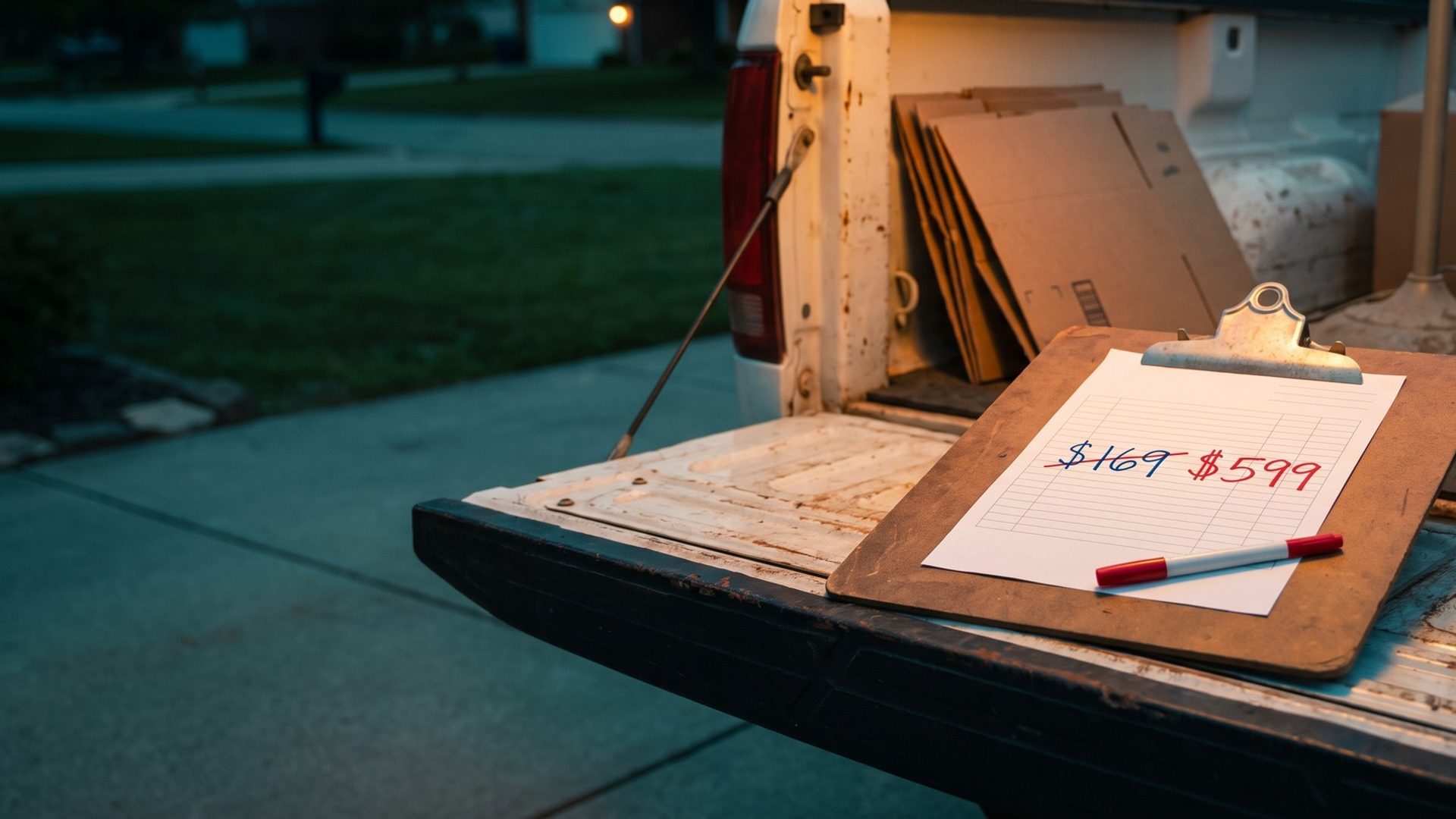
Here's a junk removal review that shows up, in one version or another, in every market:
"When I called, I was told the cost would be $169, which was supposedly their lowest pricing tier. However, when the crew arrived, they quoted us $599 instead."
We read all 104 Google reviews rated one to three stars across 16 junk removal listings in our example market, Charlotte, North Carolina. Fourteen described a final price above the quote, every one of them a junk job. Only late arrivals and no-shows came up more often, in 36. Another 13 reviewers called the price too high without a quote changing, and four described a crew that opened high and dropped the number after pushback.
This is a bonus chapter, and it's about the number. What to charge, how to say it in an ad, and the rules that decide whether a price in a Google ad is a sales line or a liability.
The Phone Price and the Curb Price Are Where Junk Removal Reviews Turn Ugly
Read the 14 price reviews together and the pattern is the same: a first number that sounded firm, and a second number that showed up with the truck. The first number came by phone in at least six of them, and otherwise from an online estimator, a website price list or a photo. The second came on arrival or on the bill.
Some samples, in reviewers' words, businesses withheld:
- "I sent in a picture of the couch and was quoted a price of $128.00 including taxes and disposable fees." Then: "they shocked me by charging me $218.00."
- "The online estimator gave me a price that was $150 less than what they told me when they got there."
- "I was quoted a price but when they showed up, they jacked price up by $237 more dollars!!"
The timing makes it worse. "We were moving out that day, so they had me in a corner and had to pay," one wrote. Another noted the crew raised the price "by that time they had already loaded the truck." And some complaints weren't about a change at all, but a fee nobody mentioned: "I didn't like the fact no one told me there was a $95 minimum fee to haul away any items."
Junk is genuinely hard to price over the phone. A "garage full of stuff" can be a quarter of a truck or two trucks. But the reviews aren't angry that the price was hard to guess. They're angry that it moved after they'd committed.
The fix starts on the phone, before any ad is involved. Give a range, not a single number, and say out loud what moves it: more volume than described, heavy items, stairs, the things with disposal fees. Then confirm the final price at the curb before anything goes on the truck. Junk King's Charlotte page puts it in one line: "If you agree to our price, we take your junk." That order, price first and loading second, takes the "they had me in a corner" review off the table, because the customer can still say no.
Most Hauler Websites Publish a Price. Only One of 131 Junk Ads Leads With One.
The haulers we profiled aren't shy about price on their websites. Ten of the 12 show at least one dollar figure, and six publish a real price list: a truck-fraction rate card, an item list or a flat rate. Here's what the market publishes, from their own pages:
- College HUNKS in Charlotte gives a range of "$99.00-$699.00," based on three load sizes from an eighth of a truck to a full truck.
- Alago prices a single item or minimum at $149, then $219 for an eighth of a truck, $309 for a quarter, $449 for half, $579 for three-quarters and $699 for a full truck.
- EasyGig sells one flat rate: $150 for a full pickup-truck load, disposal and labor included.
- Junk King quoted "$95 for a single mattress" in a Charlotte blog post about a recent job.
- 1-800-GOT-JUNK publishes national averages from its own jobs: $107 to $396 for small loads, $396 to $600 for medium and $600 to $1,099 for large.
Then look at the ads. Of the 131 readable junk removal ads we pulled from Google's Ads Transparency Center, exactly one led with a job price: EasyGig's "$150 Flat-Rate Junk Removal." About 15 offered a dollar-off coupon instead, and 19 promised "upfront pricing" or "no hidden fees" without a number attached.
So the honest answer to "how much should I charge for junk removal" is less about the figure than the structure. Price by truck fraction, with a real minimum for small loads and a single-item price for the mattress-only customer. Publish it. Then let the ad point to it. Your own numbers depend on your dump fees, your labor and your truck; Chapter 3 worked through that math. A published price also lets the people hoping for free pickup, the ones Chapter 2 warned about, rule themselves out before they cost you a phone call.
An Ad That Says "From $149" Owes the Customer a $149 Haul
Once a price goes in a Google ad, Google's own rules apply to it. Its policy on dishonest pricing bars "failure to clearly and conspicuously disclose the payment model or full expense that a user will bear," and it names "bait-and-switch tactics" outright: advertising "at an enticing, often unrealistic, low price to lure customers, with no genuine intent to sell it."
The same policy carries a note aimed at businesses like this one. For on-site work that's urgent and priced by the job, Google says businesses must "clearly and prominently disclose in their ads or on their landing pages all applicable fees" and "whether their estimates are binding." Junk removal isn't named in that note, but an on-site service whose price depends on what the crew finds is exactly what it describes. Our reading: treat it as yours.
In practice that means three things:
- A "from" price is a real minimum. If the ad says "From $149," a real customer with a real small load pays $149. A starting price no actual job ever meets is the bait-and-switch Google describes.
- The page says what raises it. Volume, weight, stairs, and the items that cost more to dispose of, such as mattresses, tires and appliances with refrigerant.
- The page says whether the quote holds. If the on-site quote is binding once the crew sees the load, say so. If a phone or photo quote can change, say how and when, before anything goes on the truck.
"Free" in a Junk Ad Comes With Federal Rules Most Haulers Have Never Read
"Free" is the most powerful word in a junk ad and the most regulated. The Federal Trade Commission's Guide Concerning Use of the Word "Free" covers any offer where something is free if you buy something else, and it's specific.
- The conditions go first. All "the terms, conditions and obligations upon which receipt and retention of the 'Free' item are contingent should be set forth clearly and conspicuously at the outset of the offer."
- No hidden markup. A customer told something is free "has a right to believe that the merchant will not directly and immediately recover, in whole or in part, the cost of the free merchandise or service by marking up the price of the article which must be purchased."
- Not forever. A free offer on a single kind of service shouldn't run in one trade area "for more than 6 months in any 12-month period."
One more rule lands squarely on this trade. If a service "usually is sold at a price arrived at through bargaining, rather than at a regular price," the Guide says it's improper to offer something else "Free" with it. A hauler that sets every price on-site, by negotiation, has no regular price to attach a free offer to.
How that sorts out for common junk ads, in our reading:
- "Free estimate" is fine. It isn't a free item tied to a purchase.
- "Free mattress pickup with any full load" is a "free with purchase" offer: state the condition up front, and don't raise the full-load price to pay for it.
- "Free junk pickup" when the customer pays disposal fees isn't free, and the ad shouldn't say it is.
A Price Ladder on the Landing Page Turns a Price Shopper Into a Booking
Chapter 12 showed what price shoppers cost in Local Services Ads: a caller who only wanted a number is a lead you pay for. Search clicks work the same way. A shopper who lands on a page with no price calls to ask, or leaves to find one. A shopper who lands on a page with a clear ladder either books or rules you out without costing a phone call.
What the page needs:
- The ladder in plain units. Truck fractions mean little to customers, so translate them. Alago's site describes each step by trash bags, from about 10 for an eighth of a truck to about 85 for a full one.
- A photo quote. Five of the 12 sites we profiled offer a text number or a "text us a photo" link, and three give an instant price online. A photo is the fastest way from "how much?" to a number the customer can hold you to.
- The minimum and the surcharges, in writing. The $95 minimum fee in that review wasn't the problem. Nobody mentioning it was.
- One line on whether the quote holds, and when it can change.
Those same facts help the rest of the account. Chapter 13's AI Max rule, "Don't generate assets with prices," exists because a price that only makes sense with its conditions shouldn't be shortened into a headline by a machine. A page that states its prices clearly gives your own ads something accurate to point to.
If you'd rather someone else wired your price list into the ads and the landing page, our Google Ads management builds both for junk removal companies.
Next: "Dumpster Rental Near Me" Outsearches "Junk Removal Near Me"
Half the haulers we profiled also sell something the junk customer doesn't need: a roll-off they load themselves. Chapter 15 covers dumpster rental as its own campaign. For the AI Max rules that keep prices out of generated ads, see Chapter 13.
You're reading Chapter 14 of Google Ads for Junk Removal, sixteen chapters written for haulers in every state.