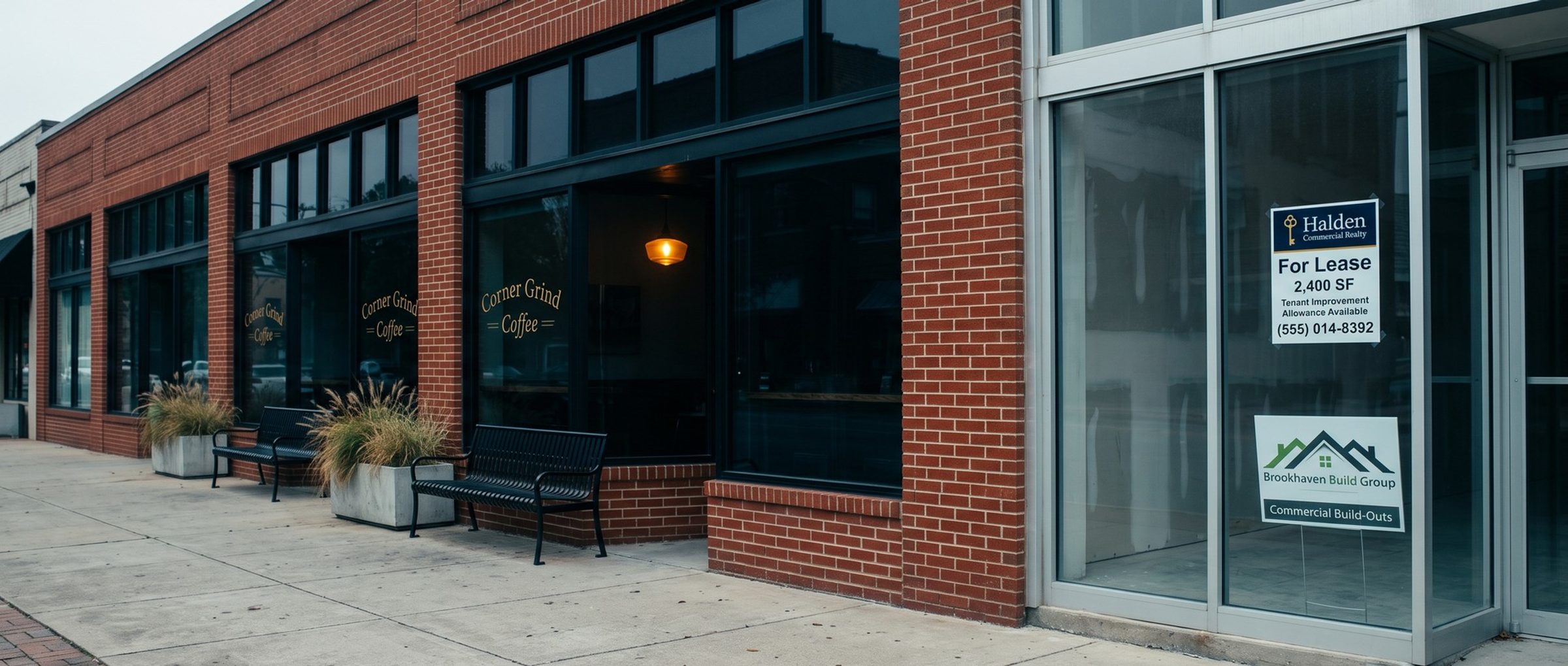
A dental group finds a second-generation space it likes. Before anyone calls a builder, there are weeks of back-and-forth with the landlord's broker: the rent, the term, and how much money the landlord will put toward the build-out. Somewhere in those weeks, the practice owner types "tenant improvement allowance" into Google to find out what's normal.
That search is a real person with a real project, and it isn't a builder's lead yet. Across the US, Keyword Planner counts roughly 1,600 of those allowance searches every month (it gives "TI allowance" identical figures). The builder-side version, "tenant improvement contractor," sits near 590.
Below, owners' searches get lined up from lease talks to signed builder, each Google campaign type gets matched to a stretch of that line, and the first dollars of a new account land at the hiring end. It builds on Chapter 1, which made sure only project inquiries count as leads.
Someone Asking What a Warehouse Costs Hasn't Picked a Builder Yet
Marketers describe a buyer's path as a funnel with five stages. For a commercial building project it looks like this:
- Unaware. A business is outgrowing its space, or a lease is running out. Nobody has searched for construction yet.
- Problem aware. The owner starts pricing the problem: "cost to build a warehouse" (around 880 US searches monthly), "commercial construction cost per square foot" (around 390).
- Solution aware. The owner learns how buildings get bought: "design build vs design bid build" (around 1,300), "construction manager at risk" (around 880), "what is design build" (around 590).
- Service aware. The owner looks for a firm: "commercial general contractor" (about 4,400), "design build firm" (about 4,400), "tenant improvement contractor" (about 590).
- Most aware. The owner types a builder's name, often one an architect, broker or past client mentioned. Chapter 5 covers those searches.
Each stage asks something different of an ad. Early on, the job is to get noticed; then to earn interest; then to win the comparison between builders; at the bottom, to get the call. A builder can be in front of an owner at every stage, but it pays very differently for each.
These volumes are national. In one example market, Cincinnati, these commercial phrases show 40 or fewer searches a month in Keyword Planner, most at its floor of about 10, because it reports small local numbers in rough steps. Expect your own metro's figures to differ. Expect the order to hold: lease and cost questions first, builder searches last, and each one thin in any single city.
An Owner Reading About Tenant Improvement Allowances Is Still Negotiating the Lease
A tenant improvement allowance is the money a landlord agrees to put toward building out a tenant's space, settled while the lease is negotiated. Many of the people searching for it are likely owners still deciding which space to take and how much of the build-out the landlord will cover.
People who have been through it say the builder comes in around the same time, for a reason. In a restaurant owners' forum, one experienced commenter told someone building their first restaurant: "You need to get your architect and GC on board to give you some rough buildout cost estimates BEFORE signing the lease." The same comment explains why: those numbers help "as you negotiate TI and final condition of the building that the landlord hands off to you."
So the owner reading about allowances may well need a builder, possibly within a few months. Right now they need a lease, a floor plan and a rough number. Another 320 searches a month ask "what is a tenant improvement allowance" outright. Many of those are likely owners at the very start, though brokers and landlords look it up too.
The owner searching "tenant improvement contractor" is further along: they have a space, or nearly have one, and want someone to build it. That's the search a new account pays for first, even though it's less than half the size.
More People Search for a Design-Build Firm Than Ask What Design-Build Means
It would be easy to turn the tenant improvement numbers into a rule that research always outsearches hiring. It doesn't. Two more pairs from the same Keyword Planner pull:
- Design-build. "Design build firm" out-searched the two questions about the method combined ("design build vs design bid build" plus "what is design build," about 1,890 a month) in 11 of the last 12 months. Its 4,400 average includes a summer spike (14,800 in July 2026); a typical month runs closer to 2,650. Either way, here the hiring search is the bigger one.
- Warehouses. "Cost to build a warehouse" and "warehouse construction" each draw about 880. A tie.
The lesson isn't that one stage is always bigger. It's that size and stage are separate questions. Sort your searches by how close the owner is to hiring first, and only then by volume. A big search full of owners a year away from a contract will spend a lot before it signs anything; a small one full of owners ready to talk gets to a project inquiry sooner.
You can usually read the stage from the words in the search:
- Still researching: cost, price, per square foot, "what is," "vs," allowance. The owner is learning, not choosing.
- Ready to hire: contractor, builder, company, firm, "near me," and a type of work or building. Nationally, "commercial contractors near me" runs around 4,400 a month and "commercial general contractors near me" around 1,600, and both read like an owner with a phone in hand.
- Ready to hire a product, not a builder: some big searches name the thing rather than the service. "Pre engineered metal buildings" runs around 8,100 a month, and it can mean an owner shopping for a building kit as easily as one looking for a builder to put it up. Searches like that need their own ad group and a close watch on what they bring in.
- Not an owner at all: "construction bid" (around 1,000) and "construction RFP" (around 590). Those can come from contractors hunting for work as easily as from owners putting a job out. Chapter 14 covers bid searches.
One more group lands in builder searches: homeowners. Searches like "kitchen remodel contractor" or "home builders near me" are large and look like construction, but they're a residential business with different customers and different math. If that's the work you do, our Google Ads for Contractors guide covers it. This guide stays with commercial work.
An Owner Comparing Builders Belongs in Search. An Owner Comparing Leases Belongs on YouTube Later.
Each stretch of that path has a Google campaign type that suits it.
Search reaches people at the moment they type, so it fits the bottom two stages: owners searching for a commercial builder by type of work, and owners searching for a builder by name. Every keyword is chosen, every search can be read, and every project inquiry can be traced to the search and click that produced it.
Demand Gen is the campaign that shows a builder's project photos and videos to owners who aren't searching: between YouTube videos and Shorts, in the Discover feed and Gmail, on Maps, and across Google's partner sites. It can put a builder's finished projects in front of owners who are still pricing, comparing delivery methods or touring spaces, before they search for a builder at all. Chapter 11 covers it. It comes after Exploration, once tracked project inquiries arrive steadily, because its bidding learns from those results.
Performance Max spreads one budget over every Google channel together, and it waits until the account is producing a steady 30 or so quality conversions a month. Chapter 10 covers when it fits.
A Small Budget Belongs With the Owners Ready to Call a Builder
A billboard, a trade show booth and a magazine ad all aim at owners long before they need anyone. A Google Ads account for a commercial builder works the other way around. It starts at the bottom, where owners are already looking for a builder, and climbs once it has proof of what works.
Month one runs two campaigns:
- Isolation, our term for a campaign of exact match keywords with bids typed in by hand, aimed at builder searches only: commercial general contractor, tenant improvement contractor, office build-out, plus the building types you put up.
- Brand: your company's name in a campaign of its own, so owners who were told about you find you first.
Take a builder doing offices, retail and light industrial. Its opening list could be five tight groups, each pointing owners to a page about that work: commercial general contractor; commercial construction company (around 3,600 US searches monthly); tenant improvement contractor with commercial build-out; commercial remodeling contractor (around 880); warehouse construction (around 880). A church builder or a medical builder would swap in its own building types; some of those are small nationally ("church builders" sits near 210) and smaller still in any one market, which is fine for exact match. Chapter 5 builds the full list, and Chapter 6 explains why the word "commercial" earns its place in most of it.
As project inquiries arrive and Chapter 1's tracking counts them, the account moves up. Next comes Exploration. That's our label for a second campaign that switches to broad match and lets a target cost per conversion steer the bids. For most builders it opens around months 2-3. The real trigger is reaching about 30 quality conversions a month, which a high-spend builder can hit early and a single-market firm may take a good while to reach. Demand Gen and Performance Max come after that.
A builder with a large budget can start higher, running Demand Gen to owners still planning while Search runs at the bottom. Even then, the bottom goes first in line for the money, because it's where tracked inquiries come from, and tracked inquiries are what every later campaign learns from.
The rest of this guide follows that order: what a client is worth (Chapter 3), how Google grades your ads (Chapter 4), which searches to buy (Chapters 5 and 6), and how to bid on them (Chapter 7). If you'd like a team that builds accounts this way for commercial builders, our Google Ads agency does it.
Next: A First Lead Can Be Worth Every Job That Follows
Chapter 3 prices a commercial client the way owners actually buy, project after project with a builder they trust, and turns that figure into a ceiling for what one click is worth. The full chapter list is on the Google Ads for Construction Companies guide home.