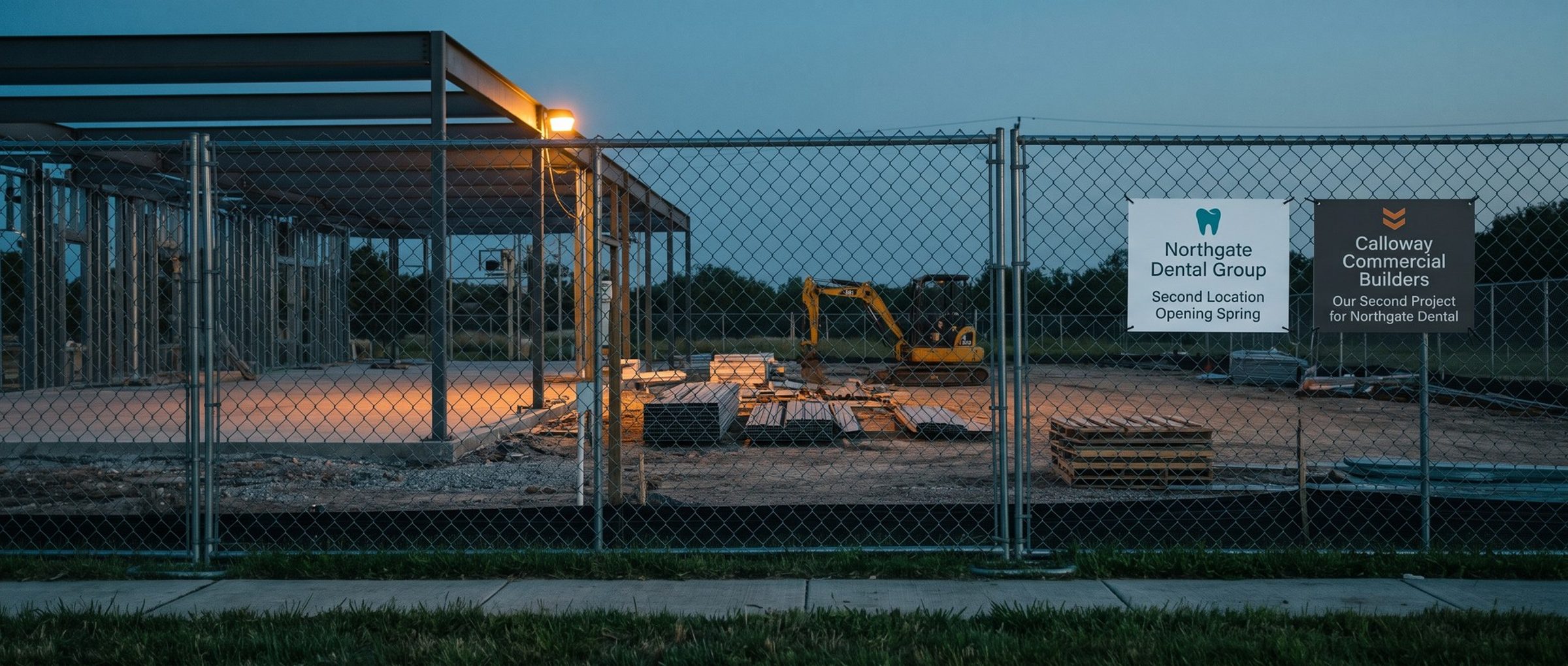
A dental group hires a builder for its first office: a 2,400-square-foot build-out in a strip center. Three years later it signs a second lease across town and calls the same builder without asking anyone else for a price. The click that started the first job paid for itself twice, and the second time it cost nothing.
Most budget math for Google Ads stops at the first contract. For a commercial builder that leaves out the part research on owners and builders ranks first: the relationship that brings an owner back.
This chapter prices a commercial client the way they actually buy, works backward from that value to the most a click can cost, and compares the answer with what Google's auction asks for builder searches. It builds on Chapter 2, which picked the searches to buy first.
Top-of-Page Bids on Commercial Builder Searches Run About $3 to $30. The Click Is the Cheap Part.
Every search in Keyword Planner carries a pair of numbers, a low and a high, marking what advertisers have paid to sit above the free results. It is not what you'll pay per click on average, and Google doesn't tie it to a match type, but it's the best public signal of what an auction costs before you run one.
For the searches a commercial builder buys first, the US ranges in October 2026 looked like this:
- "commercial general contractor": $5.00 to $23.24
- "commercial construction company": $3.02 to $22.22
- "tenant improvement contractor": $4.90 to $16.69
In one example market, Cincinnati, "commercial contractors" showed $3.56 to $23.38. Your market's figures will differ, and Chapter 7 shows how to bid on them. For now the point is the scale: the top of these three ranges is about $23, and the broadest builder search, "commercial contractors," runs $3.93 to $30.43 nationally. Hold that number against what one of these clicks can turn into.
Retail Build-Outs Average $157 a Square Foot. A Small Store Is a Six-Figure Contract.
Cushman and Wakefield's 2026 fit-out survey puts the national average for an in-line retail build-out at $157 a square foot. It ranges from $120 in the Midwest to $217 in Northern California.
Take that dental group's 2,400-square-foot space. At the Midwest rate it comes to about $288,000; at the national average, about $377,000. Other kinds of work run on their own numbers. The same firm's office survey, for instance, prices a New York City office fit-out at $220.62 a square foot in hard costs alone, before design fees and furniture. Whatever the building type, even a small space is a six-figure contract.
The builder doesn't keep the contract amount, of course. In the Construction Financial Management Association's survey of contractors for fiscal 2025, reported by Engineering News-Record, the average pre-tax net margin was 6.8%. On a $288,000 to $377,000 build-out that's roughly $19,600 to $25,600 of profit. It's an average across many contractors and many kinds of work; your own margin is the number that counts. Either way, one signed client is worth hundreds of times the price of one click.
92% of Multi-Site Owners Say They Keep Contractors Long Term. Only 35% of Contractors Say the Same.
In a 2019 study, Dodge Data & Analytics and Sevan Multi-Site Solutions surveyed owners who build at many sites, and contractors who work for them. Their finding: "Nearly all owners (92%) believe that they frequently form and sustain long-term partnerships with contractors, but only 35% of contractors find that to be true."
Owners and builders don't see their relationships the same way. That gap matters for budgeting, because a builder who doesn't expect repeat work will price every new client as a one-time contract and decide that Google Ads costs too much to win one.
Reviews point the same way. In the example market we read 736 Google reviews of commercial builders and their trades and sorted them by who wrote them. Of the 137 written by commercial clients, 13 describe working with the same builder on more than one project or over several years, and about 20 more say they would hire the builder again. One client of a local general contractor put it plainly: "We have been doing work with Wright Contracting since 2010, so when it came time to renovate our new office space, we knew exactly who to call."
The Owners Who Built With You Twice Set Your Lifetime Value
No survey we found reports what share of a commercial builder's revenue comes from repeat clients. Your own records can answer it better than any industry average could, because they describe your clients, your market and your kind of work.
Pull the last five years of signed projects and work through four questions:
- How many clients did you have? Count owners, not projects. A developer who built three buildings with you is one client.
- How many projects did each build with you? Divide total projects by total clients. If 40 clients gave you 60 projects, the average client built 1.5 times.
- What was the average profit per project? Use your own job costing, not the contract amount.
- Who did they send you? Add the projects that came from a past client's referral, or from the architect or broker they introduced you to. In the owner forums we read, architects or engineers were mentioned in 33 owner posts and comments, brokers or landlords in 24, referrals or recommendations in 20, and Google or reviews in 6. Owners there talk about architects, brokers and referrals far more often than about Google.
Multiply the projects per client by the profit per project and add a fair share of referred work.
One question comes up as soon as a builder does this: which marketing source gets credit for the second project? The repeat owner didn't click an ad the second time. But the second project only exists because the first one went well, so its value belongs to whatever won the first project. If an owner first found you through a search ad, the ad earned the whole relationship, not just the opening contract. Track where every new client first came from in your CRM, and the lifetime value lands on the right source. That's what an average client is worth to you over time: your lifetime value. The reviews and references those clients leave also help win the next owner who has never heard of you, which is value a spreadsheet won't show but a win rate will.
A $23 Click Is Small Money Next to an Owner Who Builds Twice
Once a client has a dollar value, the arithmetic runs in reverse, from that value down to a ceiling on each click. The steps, with an example whose inputs are illustrations only, not benchmarks:
- Lifetime profit per client. Say your records show the average client builds 1.5 projects at about $25,600 of profit each. That's $38,400.
- What you'll spend to win one. Decide what share of that you're willing to put into marketing. At 10%, that's $3,840 per signed client.
- Your win rate. If you sign 1 of every 5 project inquiries, each inquiry can cost up to $768.
- Your inquiry rate. If 1 of every 40 clicks becomes a project inquiry, each click can cost up to about $19.
In a new account you won't know your own inquiry rate or win rate yet. Start with conservative guesses, then replace them with real numbers once Chapter 1's tracking has a few months of project inquiries and signed work to count.
That $19 sits inside the ranges for the two broad builder searches in the first section, near the top, and above the range for "tenant improvement contractor." Change any input with your own numbers and the ceiling moves. A builder whose clients rarely come back would see a much lower ceiling; one whose average client builds three times would see a much higher one.
The win rate is the input you control most directly. Commercial clients write about it: of the 137 commercial-client reviews we read, 44 mention communication or responsiveness, close to the 49 that mention the schedule. A builder who calls back the same day and explains the next step clearly is likely to win more of the inquiries the ads produce, and every point of win rate raises what a click is worth.
The inquiry rate depends on where the click lands. An owner who searched for a tenant improvement contractor should land on a page about tenant build-outs, with photos of finished spaces and a form that asks about the project. Chapter 4 covers how those pages and tight ad groups affect what Google charges.
The same numbers set a budget. If the account can afford $768 per project inquiry and you want four inquiries a month, the most it should spend is about $3,070 a month. Start below that while Isolation (our name for exact match keywords with hand-set bids) proves which searches produce inquiries, then raise it as the inquiries arrive. There's a second limit besides money. Our Exploration stage, broad match on a target cost, only makes sense once roughly 30 quality conversions land each month. A builder logging four project inquiries a month is nowhere near that, and Chapter 7 deals with exactly that gap. None of this makes Google Ads cheap. A new account will spend real money before the first signed contract, and a single-market builder may wait months for enough inquiries to judge it. What it does is replace "that seems expensive" with a number you can check. If you'd like help setting that number for your company, our Google Ads agency works through it with builders before a dollar is spent.
Next: Owners Write "Build Out," Not "Design-Build"
Chapter 4 looks at the words owners actually use when they talk about construction, and why ad groups written in those words do better in Google's auction. The full chapter list is on the Google Ads for Construction Companies guide home.