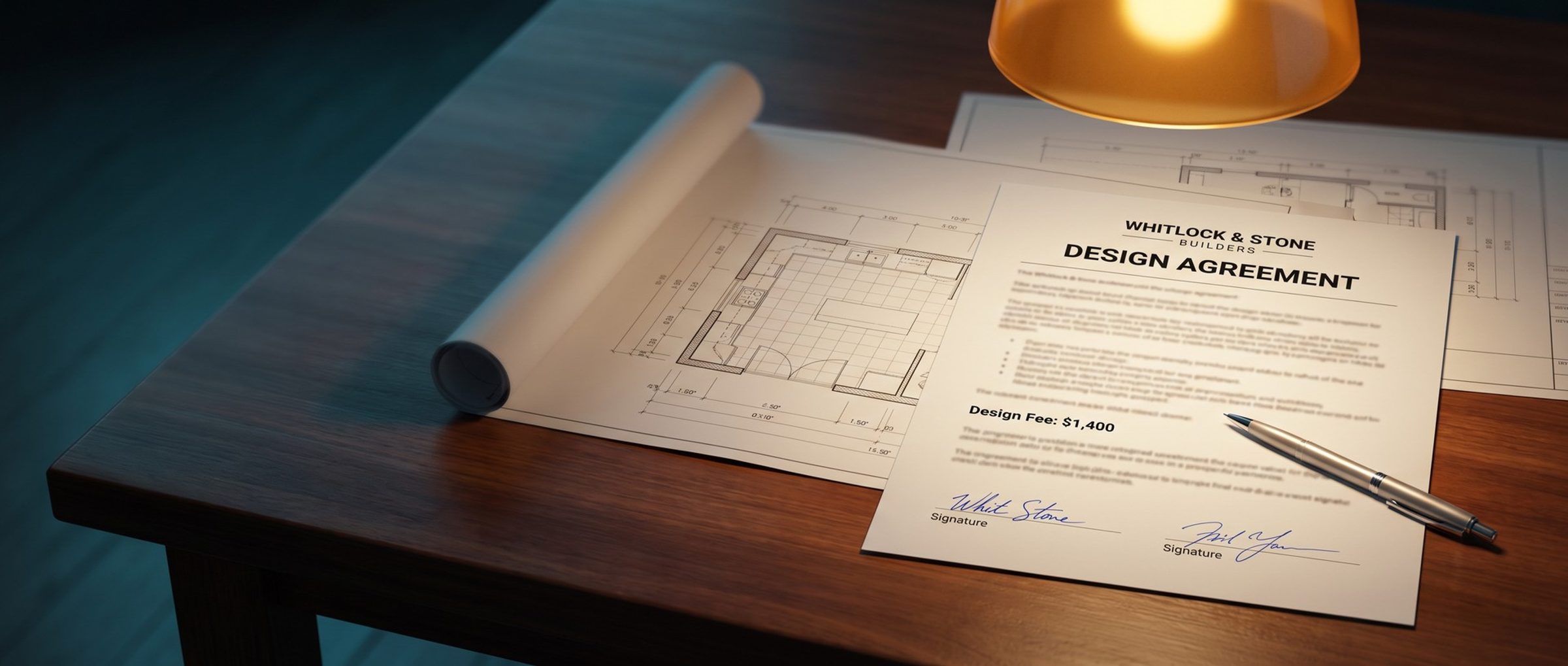
Between the free estimate and the signed build contract, a lot of remodelers sell something most of their ads never mention: the design.
We profiled 12 remodeling and design-build websites in our example market, Raleigh-Durham. Four of them offer a free first visit and then a paid design step. CQC Home refers to a design contract and a Design & Feasibility Study. BoCo Modern mentions an "estimated design fee" after its complimentary consult. Riverstone Construction describes a "fixed-fee pre-construction phase." Riverbirch Remodeling is the only one that prints its prices: $835 and up for bathrooms, $1,400 for kitchens, $2,800 for a full house and $3,500 for additions. Haven Design Build mentions a conceptual design agreement too. Outside our sample, the fees can run much higher: one design-build firm's sample proposal, posted in a contractors' forum, listed a "Full Service Design Fee $7,000 (due with this design contract)."
For the firms that sell one, the design agreement is a turning point. It's the first time a homeowner pays you anything. It's a decision made weeks before the build contract, and sometimes months. And in almost every remodeling account we've seen, Google Ads never hears about it.
This bonus chapter is about fixing that, and about why the design agreement may be the most useful number a design-build firm can send back to Google.
The Design Agreement Is the First Time a Homeowner Pays You. Google Never Hears About It.
Chapter 1 laid out the order: Google bids on the booked estimate, and the signed contract goes back to Google with its price. It also laid out the catch. Google won't take a contract uploaded more than 63 days after the click through enhanced conversions for leads, or more than 90 days after the click through a click ID upload. A remodel that takes four months from first call to signature misses both.
Google's own help page for click ID uploads is direct about what to do then. Google holds onto each click's ID for just 90 days, so its instructions point a business with a slow close toward reporting some earlier, paid step that happens before the 90 run out.
For a design-build firm, that event already exists. The design agreement is signed after the estimate visit and before the build contract, it comes with a real fee, and in our experience it usually lands well inside the window. It's the earliest moment a homeowner proves they're serious with money, which is the kind of proof Google has never been able to see from a form fill or a phone call.
Google Bids on the Booked Estimate. The Design Agreement Shows Which Clicks Paid.
Here's the tempting mistake: if the design agreement is that valuable, why not make it the conversion Google bids toward?
Because Google's own guidance points elsewhere. For lead businesses, Google wants the bidding stage to be common, 15 or more a month across the account, and quick, ideally inside a week of the click. A remodeling account books estimates often enough and fast enough to meet that. It almost never signs 15 design agreements a month, and they rarely come within a week of the click.
So the booked estimate stays the primary conversion, the one Google bids toward, exactly as Chapter 1 set it up. The design agreement goes in as a secondary conversion with the fee as its value. Google's definitions spell out the difference: primary actions feed the Conversions column and drive bidding, while secondary actions are for observation, reported in the All conversions column and not used for bidding.
That still gets you something no booked estimate can. Once design agreements flow back with their fees, you can see design dollars by campaign, ad group and keyword. Not just which searches booked estimates, but which searches turned into homeowners who paid you before the build. For most remodelers, it's the first real revenue signal the account has ever had.
Here's what a month of it can look like, with illustrative numbers. The account books 40 estimates. Nine homeowners sign design agreements worth $14,540 in fees. The kitchen ad group booked 12 estimates and produced 3 kitchen designs at $1,400 each, $4,200. The bath ad group booked 18 estimates, more than any other group, and produced 4 bath designs at $835, $3,340. On booked estimates alone, baths look like the winner. On design dollars, kitchens earn more from fewer estimates, and an addition group that booked only 5 estimates but signed 2 additions at $3,500 earns $7,000 by itself.
The fees in that example are Riverbirch's published prices; the counts are made up to show the shape. Your own month will look different, and that's the point: without the design agreement in Google Ads, you can't see it at all.
It changes how you read everything in the earlier chapters:
- Bids (Chapter 7): an ad group with a higher cost per estimate may still be the cheapest source of design agreements.
- Broad match (Chapter 6): you can see whether the long-tail searches broad match finds produce paying homeowners or just estimate visits.
- Performance Max (Chapter 10): it has to earn its budget with design dollars, not just estimates.
Four of 12 Sites Sell a Paid Design Step. Only One Publishes the Price.
The design step is common in our sample. Talking about it in advance is not. Only Riverbirch puts numbers on its page, and none of the 38 home-project advertisers whose ads we read mentioned a design fee in an ad.
That silence costs something. In the low-star reviews we read, 6 of 121 complained about paying for an estimate or design, and none of the reviews praised a paid design phase by that name. Contractors in the example market are split, too. A general contractor with 26 years in the trade wrote: "I've done the paid estimate. it was a train-wreck. I only see it working if it is the industry standard in your area, which it isn't in NC."
That's not an argument against charging for design. It's an argument for saying so before the homeowner is surprised by it, the same logic Chapter 14 applied to project minimums. In our experience, the firms that make a paid design step work state three things early:
- That design is a paid step, on the project page and in the first call.
- What it costs, or at least the range, the way Riverbirch does.
- Whether the fee is credited toward the build contract if the homeowner goes ahead.
Not every remodeler should charge for design, and nothing in this chapter says you must. A bath and kitchen firm in a market where free estimates are the norm may do better keeping its first visit free and its design time inside the contract. If you don't sell a design step, look for the next paid commitment that happens inside the window instead. For many firms that's the deposit on the build contract, if the homeowner pays it within a few weeks of the click. The principle is the same: send Google the first point where a homeowner puts money down.
A homeowner who knows that before the estimate visit and books anyway is exactly the kind of lead you want Google to find more of. And a design agreement signed by that homeowner is a conversion worth reporting.
A Design Agreement Uploaded After Day 90 Tells Google Nothing.
None of this works unless the agreement gets back to Google while Google can still match it to a click. That's a routine, not a project:
- Capture the click on the first form. Chapter 1 set up the click ID in a hidden field and the homeowner's email and phone on the lead record. The design agreement needs the same record.
- Mark the design agreement in your CRM the day it's signed, with the date and the fee.
- Export signed agreements every week, with the click ID or the homeowner's email and phone, the signing date and the fee, and upload them. Google's advice for offline uploads is to send them regularly, ideally daily, so weekly is the floor, not the goal.
- Set up the conversion action as secondary, with the value taken from each upload rather than one fixed number, since a bathroom design and an addition design aren't worth the same.
Which upload route you use matters for the clock. Chapter 1 set up enhanced conversions for leads first, which matches on the homeowner's email or phone and gives you 63 days. The click ID route gives you 90. A design agreement signed in week six fits either; one signed in week ten needs the click ID.
If your CRM already tracks deal stages, the design agreement is usually one more stage between "estimate scheduled" and "contract signed." Chapter 1 noted that HubSpot can map lifecycle stages to Google Ads conversion actions with a deal amount; the design agreement becomes one of those mapped stages, with the fee as the amount.
Two details keep the numbers honest. If the design fee is credited toward the build, report the fee at signing anyway; the contract's value comes later, as its own conversion. And if a homeowner cancels and you refund the fee, correct the conversion in Google Ads too, so the account doesn't keep learning from a sale that didn't happen.
When the build contract signs later, it still goes back too, as Chapter 1 described, as long as it's inside the window. If it isn't, the design agreement has already told Google, and you, which clicks turned into paying homeowners.
If you'd rather have us wire the design agreement into the account, from the form field to the weekly upload, our Google Ads management sets it up for every design-build firm we work with.
Next: A Firm Without EPA Lead-Safe Certification Can't Even Offer Work on a Pre-1978 Home.
Chapter 16, the last bonus chapter, covers the federal lead-paint rule for homes built before 1978, which reaches offering the work as well as doing it, and the state license rules that shape what a contractor's ad can say.
This chapter is part of Google Ads for Contractors, our sixteen-chapter guide for residential general contractors and construction companies anywhere in the US.