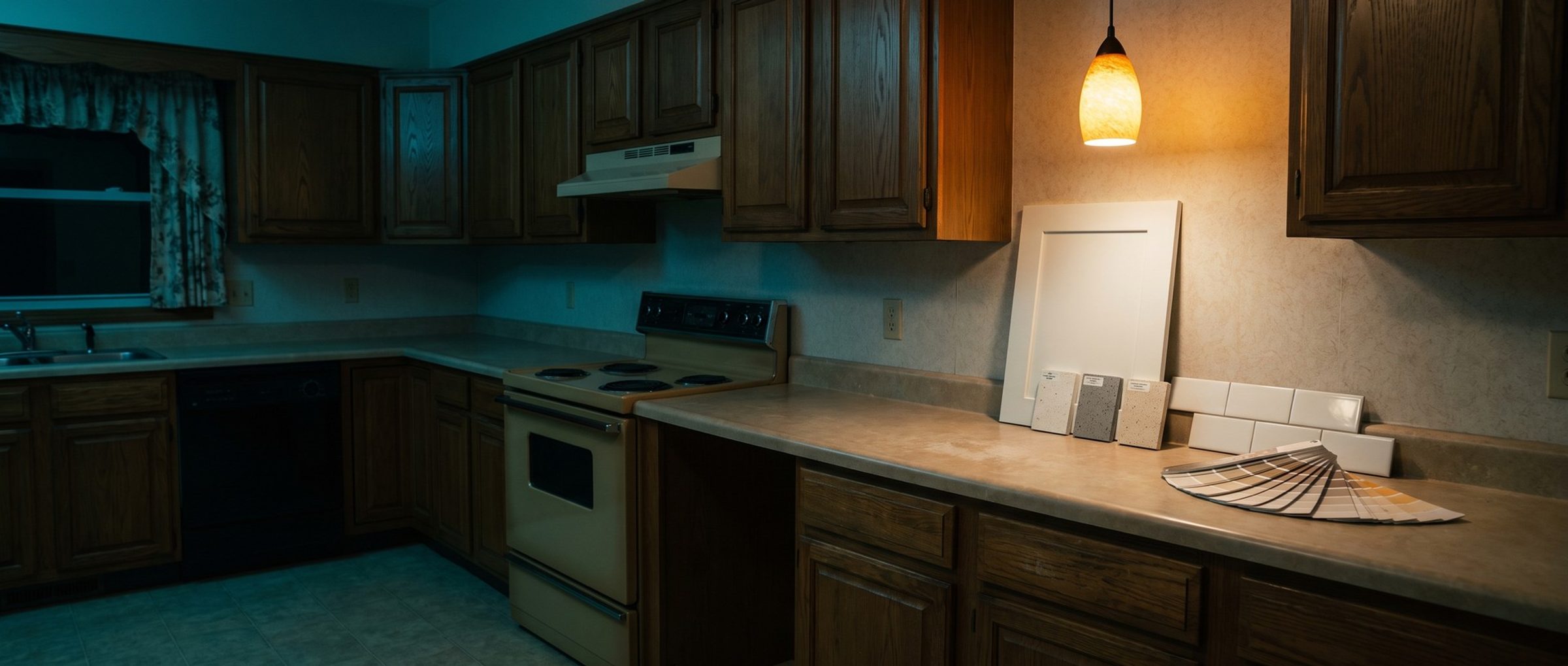
Chapters 1 through 10 all start the same way: a homeowner types something, and a remodeler's ad answers. "Kitchen remodel contractor." "Home addition contractor." A search is the moment someone raises a hand.
But nobody wakes up and searches for a contractor out of nowhere. The kitchen has been bothering them for a year. They've saved photos, watched renovation videos, priced countertops and argued about the island. By the time they search, they've often already decided what they want, and sometimes who they'd like to build it.
Google knows a lot of that is happening. When we pulled Google's own list of audience segments for this guide, it included a "Home Renovation" life event with two segments under it: "Renovating Home Soon" and "Recently Renovated Home." The same list has an in-market segment called "General Contracting & Remodeling Services," plus others for kitchen and bathroom cabinets and for kitchen and bathroom counters.
Demand Gen is the campaign built to reach those people before the search. Its ads appear in renovation videos on YouTube and Shorts, in the Discover feed, in Gmail, on Maps and across Display sites, wherever a homeowner is still collecting kitchen ideas. This chapter covers who to reach, what it really costs a remodeler, what to show them and how to judge it.
Demand Gen Finds the Homeowner While the Remodel Is Still an Idea.
Search targets what someone types. Demand Gen targets who someone is, using the audience segments Google builds from what people watch, browse and search across its products.
Two kinds matter for a remodeler. Life events are milestones, and Google's own description of them is useful: because one milestone leads to a lot of related purchases, a life-event segment is often larger than an in-market segment, which is tied to a single purchase. Someone renovating a home soon is buying a contractor, but also cabinets, flooring, lighting and maybe a loan. In-market segments are people Google sees actively shopping for one kind of thing right now, like general contracting and remodeling services.
Here's where we start a remodeler:
- Renovating Home Soon. The life event this guide's H1 is about. It's as close as Google gets to "about to hire someone like you."
- General Contracting & Remodeling Services. Homeowners Google sees shopping for exactly what you sell.
- Kitchen & Bathroom Cabinets and Kitchen & Bathroom Counters. The two biggest projects most remodelers want, seen from the materials side.
- The custom segments from Chapter 10. The remodeling searches that booked estimates, and rival remodelers' sites.
And two to leave on the shelf:
- Recently Renovated Home. They just finished. Your kitchen ad is three years early.
- Construction Jobs. It's in Google's in-market list, and it's the job-seeker problem from Chapter 2 in audience form: people looking for work on a crew, not for a crew to hire.
One setting carries over from Chapter 9, and it matters even more here. Google's location page lists Demand Gen among the campaigns where "Presence or interest" is the default, so a Demand Gen campaign can reach people who are only curious about your area. Switch it to Presence and draw the same map your crews drive. An audience of people renovating soon is only useful if their homes are in your service area.
Audiences go on each ad group, so you can keep them apart: one ad group for Renovating Home Soon, one for the in-market segments, one for your custom segments. Each gets its own budget share and its own results, and you'll know which one actually books estimates instead of guessing from a blend.
A $350 Booked Estimate Means a $3,500 Daily Demand Gen Budget.
This is the part most agencies skip, and it decides whether Demand Gen belongs in your account at all.
Google's Demand Gen pages are specific about money. Bid to a target cost per estimate, and Google wants a daily budget ten or more times that target; a thin daily budget is the first thing Google blames when a new Demand Gen campaign struggles. It also says a campaign needs about 50 conversions to build a solid picture of what's working.
Now run that against the numbers in this guide. Go back to the $350 booked estimate from the Chapter 7 example. Ten times $350 is $3,500 a day. That's more than $100,000 a month, and that's what Google recommends for one campaign bidding to that target.
For most residential contractors, that settles the timing. Demand Gen waits until the exact match, broad match and Performance Max campaigns all book estimates month after month, which for a typical remodeler lands late in year one.
Two kinds of contractor account are ready sooner. The first is the high-ticket firm: a design-build company whose average project runs well into six figures can carry a large cost per booked estimate, because one signed addition pays for a lot of advertising. The second is the account that has run out of searches. If Chapter 7's columns show your Search campaigns holding the top of the page 75-90% of the time on the searches that matter, losing almost nothing to budget, and still with money to spend, Search has no more homeowners to sell you. Demand Gen is how you reach the ones who haven't searched yet.
If neither describes you yet, Demand Gen can wait. Every dollar it would spend is a dollar that could buy a search from someone already asking for a contractor.
There is a smaller door in. Demand Gen can also run on Maximize conversions, where you set a budget and no target at all. That's how we test it for a mid-sized remodeler: a modest budget, its own campaign, judged only on what it books. Run the math on that test before you start it, too. At $100 a day and a cost per booked estimate near Chapter 7's $350, the campaign books roughly two estimates a week. Google's 50-conversion mark would take about six months to reach. That doesn't make the test worthless, but it does mean the first month's numbers will say almost nothing, and nobody should expect to judge it by then.
Google's own guidance for the learning stretch applies either way: don't change the bid by more than about 15% at a time, and don't touch the settings during the first learning period, because every change makes it start over.
Demand Gen Runs on Video. A Phone Walk-Through of a Finished Kitchen Is Enough.
Search ads are words. Demand Gen ads are pictures and video, shown to someone who wasn't looking for you. That makes the creative do all the work.
The good news is Chapter 10 already built most of it. The same real job photos and short phone walk-throughs work here, cut to the shapes Demand Gen uses:
- Images: horizontal 1.91:1, square 1:1, vertical 4:5 and vertical 9:16.
- Video: horizontal 16:9, square 1:1, vertical 4:5 and vertical 9:16, the shape Google recommends for YouTube Shorts.
This is where "video marketing for contractors" stops being a slogan and becomes a job-site habit. In our experience, the remodeling videos that work in Demand Gen look like this:
- The finished room in the first two seconds. Not the logo, not the truck. The kitchen.
- Your company name early, spoken or on screen, so the homeowner who sees it again in a search knows it.
- A homeowner's own words, from a review, as a caption. Chapter 8's best lines work here too.
- Captions on everything, so the ad still works with the sound off.
- No stock footage, ever. The homeowner is deciding whether your work is real.
Here's a simple plan for a 20-second version, built from one finished job:
- Seconds 0-2: the finished kitchen, wide, in good light.
- Seconds 3-7: the same spot before you started, if you have it.
- Seconds 8-13: two or three close details: the counter edge, the tile, the hardware.
- Seconds 14-18: a homeowner's review line as a caption over the finished room.
- Seconds 19-20: your company name and "Book an estimate."
Shoot it once at the final walk-through, then export it in each of the shapes above.
A 30-second walk-through shot on a phone at the final inspection beats a produced brand video you'll never get around to making.
Demand Gen Gets Judged on Booked Estimates, Not Views.
A Demand Gen campaign will happily report thousands of views and a lot of cheap clicks. None of that is the job. The job is the same one every campaign in this account has: booked estimates at a cost your margins can carry.
So it gets the same scorecard. Track booked estimates from Demand Gen separately, compare its cost per estimate to Search and Performance Max, and give it time. Demand Gen reaches people earlier, so some of its homeowners will book weeks later, often after searching your name. That's real, and your brand campaign will see some of it. It's also easy to overcount, so judge it over months, not days.
Check your brand campaign at the same time. When Demand Gen is doing its job, more homeowners search for your company by name a few weeks later. A rise in brand searches after Demand Gen starts is a good sign, but count those estimates once, in one place, so two campaigns don't both take the credit.
Google now runs its Display Network through Demand Gen too, and its guidance is to run the campaign across all channels unless there's a specific reason not to. We follow that at launch, then read the channel report. If one channel spends steadily and books nothing, that's the specific reason, and we pull it.
If you'd rather have us decide when your account is ready for Demand Gen and build it from your own footage, our Google Ads management adds it only when the numbers say it can pay for itself.
Next: The Map Showed Up on Nearly Every Remodeling Search We Ran. Local Services Ads Barely Did.
Chapter 12 turns to the map pack, the local listings Google shows with a map, and where Local Services Ads fit for a remodeler.
This chapter is part of Google Ads for Contractors, our sixteen-chapter guide for residential general contractors and construction companies anywhere in the US.