Spend five minutes in the Facebook feed and you will meet her. A gray-haired woman in a leather apron stands in a small workshop, eyes a little misty. After forty years of making handbags by hand, she is closing the shop. Everything must go, and once the last bags are gone, they're gone. Three customers in the comments swear the stitching is the best they have ever owned.
None of it is real. The woman was generated by AI. The "customers" in the video testimonials are actors hired online for a small fee. The website is a month old. The bag is a factory item that sells on a wholesale site for a few dollars, marked up to forty and shipped from overseas. And the same farewell story, word for word, is running under a dozen other brand names this week.
That is a problem for a real small business, because the scam did not invent a new story. It stole yours. The founder with a reason, the handmade product, the loyal customer, the small shop that cares: those were the honest small business's best selling points, and scam ads now run them at a volume no real business can match. The result is a buyer who has learned to assume the story is fake until something in the ad proves otherwise.
This post is about putting that proof in your ad.
Scam Ads Stole the Small Business Story. Buyers Now Assume It Is Fake.
The scale here is not anecdotal. In April 2026 the Federal Trade Commission reported that nearly 30% of people who lost money to a scam in 2025 said it started on social media, with reported losses of $2.1 billion, about eight times the 2020 figure. Shopping scams were the most reported type. More than 40% of the people who lost money to a social media scam said it began when they ordered something they saw in an ad, and more money was reported lost to scams that started on Facebook than on any other platform.
Meta's own numbers point the same way. In November 2025, Reuters reviewed internal company documents showing that Meta estimated it shows users about 15 billion higher-risk scam ads a day, and projected that about 10% of its 2024 revenue, roughly $16 billion, would come from ads for scams and banned goods.
Put those two facts together and you get the feed your customer actually scrolls. Your ad does not appear in a neutral space. It appears between a fake farewell sale and an AI grandmother, and the viewer's thumb has been trained by both.
The training is explicit, too. Consumer videos teaching people to spot these ads are some of the most-watched content on YouTube right now. One creator's walkthrough of the fake elderly-artisan brands passed 5.5 million views. Another creator who bought ten products from obviously generated ads and filmed what arrived passed 4.7 million. A third, who bought a hundred, passed 27 million. Tens of millions of shoppers have now sat through a lesson in how to tell whether a business is real.
Shoppers Check a Facebook Page's Country and Age Before They Trust the Ad
What those videos teach is worth knowing in detail, because every check is something your ad and your page either pass or fail.
Page transparency. Every Facebook Page has a Page transparency panel that anyone can open. It shows when the Page was created, whether its name has changed, the countries where the people who manage it are located, and whether the Page is running ads. The viewers are taught to tap it first. A "family workshop in Vermont" managed from four countries, with a Page created six weeks ago and two previous names, is finished as a prospect in about ten seconds.
Reverse image search. Shoppers screenshot the product or the founder and run it through an image search. If the same photo turns up on a wholesale site at a fraction of the price, or the "founder" appears on three other brands' Pages, the ad is dead.
The same face, five products. The testimonial actors get reused. Viewers are now taught to notice when the same "happy customer" is vouching for three unrelated products from three different brands.
Website age. A brand that claims decades of craft and owns a domain registered last month has told on itself. A domain lookup takes seconds and the videos show exactly how to run one.
The comments. Real comment sections are messy. Fake ones read alike, with every comment praising the product in similar words, and some even ending with the same emoji. A wall of uniform praise reads as manufactured.
The ad library. Meta's public Ad Library shows every ad a Page is running. A Page running forty near-identical ads for unrelated products is not a small shop.
Notice what all six checks have in common. None of them asks whether the product is good. They ask whether the business is real. That is the question your ad now has to answer before anyone gets to the offer.
A Glossy Ad Now Reads as a Warning Sign
For years the advice to small businesses was to look bigger and more polished. That advice has flipped. The look of a high-production ad, with flawless lighting, a perfect kitchen, models who could be anyone, and claims that sound like a miracle, is now exactly what the cheapest scam can produce in an afternoon with an image generator.
Buyers have noticed, even when they cannot say why. People rate generated ads as more annoying and less memorable than real ones, even the polished ones, which is the research we walked through in the default AI flyer makes a local business look like every other one. People sense that something does not fit before they can explain it, and in a feed where the misfit usually turns out to be a scam, that unease now turns into a scroll past.
The impossible claim is the other tell. A cleaning product that dissolves a burned pan in two seconds, a gadget that "doctors don't want you to know about," a scene that could not happen in a real kitchen. Scam ads lean on them because the scammer never has to deliver. A real business that borrows the same breathless tone lands in the same mental bucket.
This is not an argument against using AI in your creative. It is an argument about what AI should be doing. An AI cleanup of a real photo of your real product in a real setting is fine; we made the case in why AI should be editing your photos, not inventing new ones. Inventing a person, a workshop or a customer is where the trouble starts, and we covered when a synthetic face hurts and when it does not in the AI person in your ad isn't real.
Your Own Truck in Your Own Town Is Proof No Scam Ad Can Fake
Here is the good news, and it is the whole point of this post. Everything a scammer can produce is generic. Everything a real business has is specific. The way to stop looking like a scam is to put the specific things in the frame.
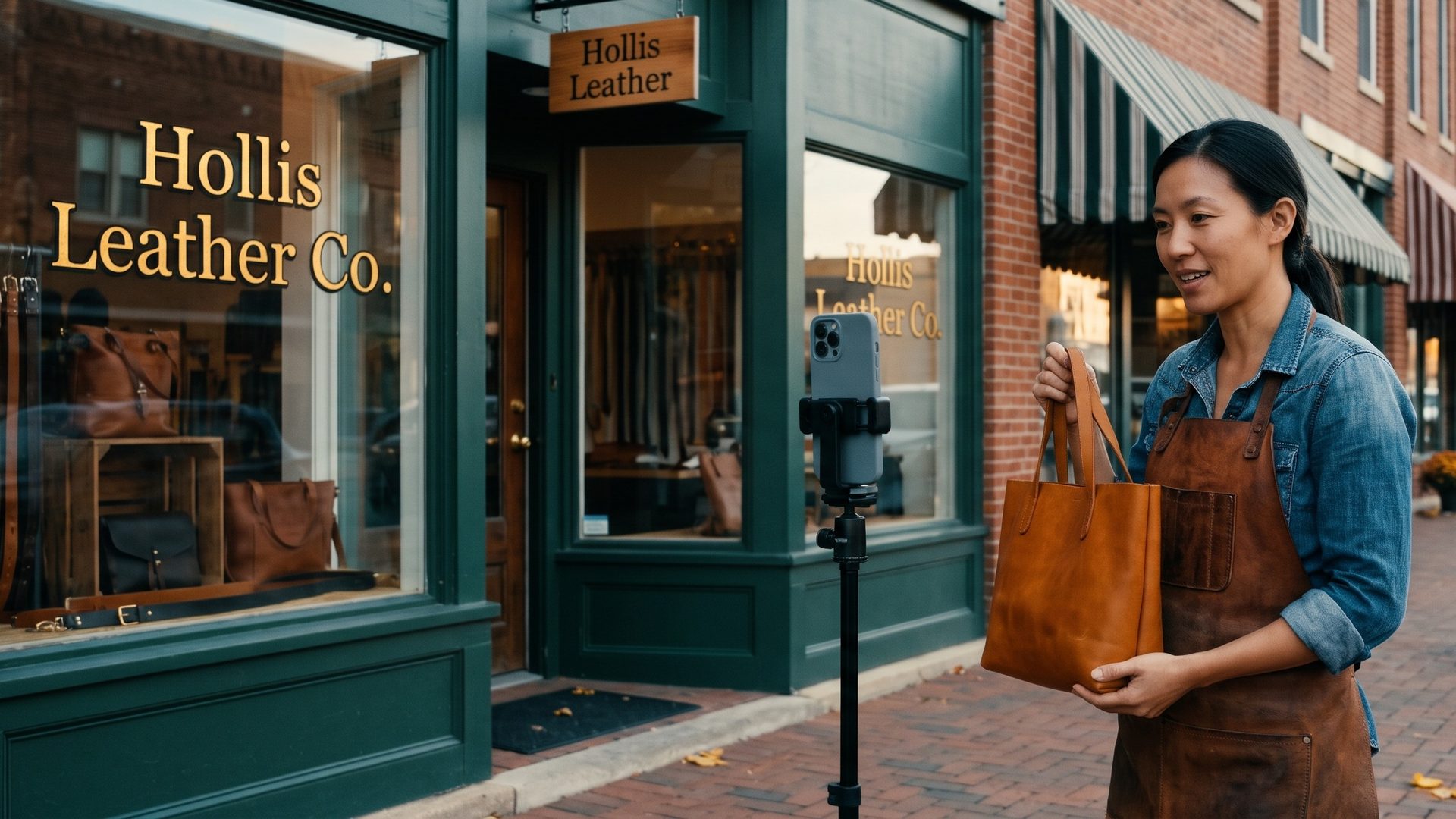
Your sign, your storefront, your truck. A scam operation has no building and no vehicles. Your name painted on a van parked in a real driveway, or your sign over a real door on a real street, is proof that costs nothing to show and cannot be generated convincingly enough to survive a second look.
The same real people, ad after ad. A scam rotates faces because the faces are rented. A real business has the same owner, the same technician, the same front-desk person showing up across months of ads. Familiarity builds. If you have been on the fence about being in your own ads, the case for it is stronger now than it has ever been; we went through when the owner belongs on camera in should you be in your own ads.
Your product in a real customer's place. A dining table in an actual dining room with a dog bed in the corner. A finished roof on a house with a basketball hoop in the driveway. Real environments are slightly messy, and the mess is the proof.
Local detail. Name the town. Show the landmark people drive past, the high school colors, the snow on the ground in February. A scam ad has to work in every market at once, so it can never be local. You can be nothing but.
A real price. "80% off today only" is the scam's price. "$189, installed" is a business's price. A specific, ordinary number signals that someone has done the math and expects to stand behind it.
Details a shopper could check. A street address. A license number in the caption. A review that names a person and a job. Every one of these hands the skeptical viewer something to verify, and a scam ad never does that, because a scam cannot survive verification.
Small also works in your favor here. Being a local business with a real owner is the one thing the big chain and the scam operation have in common: neither can claim it. We made a similar case against the chain down the road in you're smaller than the chain, put that in your ad. Against the scam, the argument is even simpler. You exist, and you can show it.
Every Scam Ad Runs the Same Script. Most Sale Ads Quote It Word for Word.
The visuals are only half of it. Scam ads also share a vocabulary, and a lot of honest sale ads use it without realizing who else is talking that way.
The phrases to retire, or at least to use with care:
- "Farewell sale," "closing our doors," "retiring after 40 years." This is the single most copied scam story right now. If you are genuinely closing, say so with specifics a customer could confirm, like the real closing date and where the shop is.
- "Once they're gone, they're gone." Viewers have heard it under too many brand names to believe it from anyone.
- Countdown timers that reset. Shoppers have learned to reload the page and watch the clock start over.
- "Don't walk, run." And its cousins: "the internet is obsessed," "everyone is buying this."
- Wild discounts with no reason. 70% or 80% off a product nobody has heard of reads as a markup to begin with.
- History nobody can check. "Handcrafted for 33 years" from a Page that is two months old is not a claim. It is a confession.
None of this means you cannot run a sale or use urgency. It means the urgency has to come with a reason a real business would have. "We overbought cedar for the spring and need the yard space back by March 15" is urgency with a reason. "Prices go back up Sunday because the supplier increase takes effect Monday" is urgency with a reason. The specific reason is what separates you from the script.
If you want one technique that cuts against the scam's tone directly, admit something. Scam ads never concede a single weakness, because they are selling a fantasy. A real business saying "we are not the cheapest, and here is why" is instantly believable, which is the effect we broke down in admit the flaw in your ad.
Paid Actors Posing as Customers Break Federal Law
One part of the scam playbook is not just bad strategy for a real business. It is illegal.
The FTC's rule on consumer reviews and testimonials, in effect since October 21, 2024, prohibits fake consumer reviews and testimonials, including ones that misrepresent the person giving them as a real customer. The FTC said plainly in the rule that AI-generated reviews are covered. And the rule lets courts impose civil penalties for knowing violations, currently up to $53,088 per violation.
For a small business, the practical line is simple. Hiring an actor to appear in your ad is fine. Hiring an actor and presenting them as a satisfied customer is not. An AI-generated "customer" saying your product changed their life is not either. If the person in the testimonial did not buy from you and say those things, it does not belong in your ad.
The good news is that the real thing works better anyway. A thirty-second phone video of an actual customer standing in their actual kitchen beats a polished actor, for all the reasons above. We covered the proof formats that persuade in your testimonials aren't working, and the paperwork you need before you put a customer's video in an ad in you don't own the testimonial video in your ad.
A Dead Facebook Page and No Address Look Exactly Like a Scam
Your ad sends people to your Page and your website, and the checks from earlier happen there. You do not need a big presence. You need one that does not contradict the ad. A quick audit:
- The Page name matches the business name on your sign, your website and your reviews.
- The Page has visible history. If you have an old Page, keep it rather than starting fresh or renaming it into something new. A long-standing Page with real posts is an asset, and a fresh name change shows up in the transparency panel.
- The managers are where a shopper would expect. If an agency or a contractor overseas helps run your Page, know that the countries can show up in Page transparency, and make sure the rest of your Page makes the local business obvious.
- Your website lists a real address and a phone number that someone answers.
- Reviews get replies, including the bad ones.
We went deep on the Page side of this in people check your Facebook Page before they trust your Meta ad, and on the store side, where a new shopper has never heard of you, in a stranger won't believe your store. The short version: the ad makes a promise, and the Page and site are where the shopper checks whether you can keep it.
Real Footage Is the One Thing a Scam Ad Cannot Buy
The scam ad has every advantage except one. It can produce endless versions, it can test faster than you, and it can copy any story you tell. What it cannot produce is your building, your truck, your people and your town, in a video a stranger could check against the real world.
That is the cheapest proof you own, and most small businesses leave it out of their ads because they think it looks too ordinary. In a feed full of perfect fakes, ordinary and real is exactly what stands out.
If you want help turning that into ads, our creative production team plans and shoots real footage of real businesses, the people, places and work that a scam ad never could. And if you would rather shoot it yourself, start with your phone, your storefront and the next customer who is happy to say why they came back.