
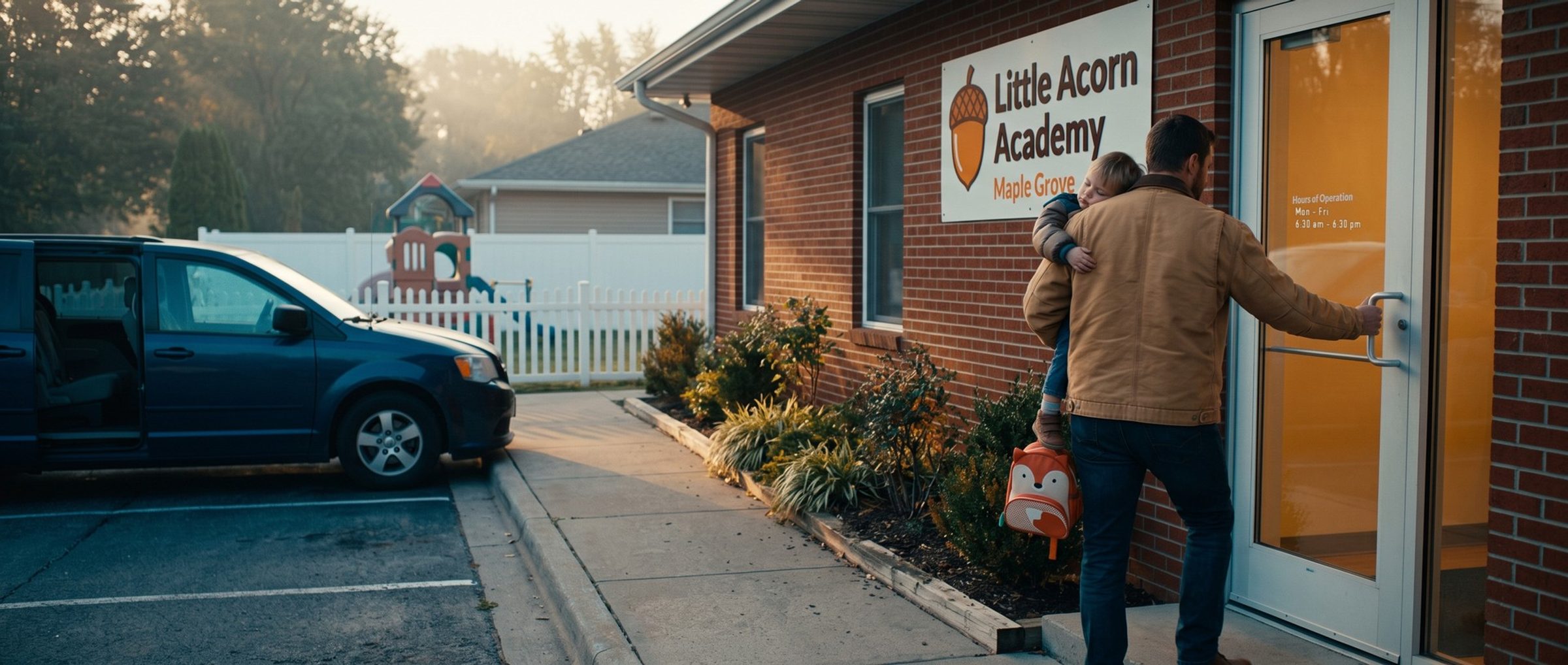
The most valuable search a franchise location can win has no town in it. "Chiropractor near me." "Daycare near me." "Electrician near me." The person typing it isn't comparing brands or reading reviews yet. They want the closest one that can help, and they want it now.
Those searches are where a new location's money should go first, and how you buy them matters. This chapter covers which near-me searches to start with, why exact match comes before broad match, where the long tail of smaller searches fits, and how a franchise keeps two of its own locations from paying for the same customer. The search volumes come from Keyword Planner in one example market, Orlando. Your market's numbers will differ. The order of buying won't.
A Near Me Search Has No Town in It, So Location Targeting Decides Which Franchisee Shows Up
A search like "electrician orlando" tells Google where the customer wants help. "Electrician near me" doesn't. For that search, the only location in play is where the person is standing, and that's what Google's location targeting checks against.
With the targeting set to people in or regularly in an area, which Google calls "Presence," a location's ad can show to near-me searchers inside the area its campaign covers. Google spells out the same order for an optional locations-of-interest setting in AI Max campaigns, which we keep off at launch: "the location mentioned in the user's query is considered first and if there's no mention of a location in the query, the user's location of presence is taken into account."
For a franchise, that has a practical consequence. Every location in a market competes for the same handful of near-me phrases. Which location's ad appears depends on whose campaign covers the spot where the searcher is. The keyword list barely matters for that question. The map matters a lot, and Chapter 9 covers drawing it.
A New Franchise Location Should Buy Its Biggest Near Me Searches in Exact Match Before Anything Else
A new location's opening campaign is the one BrandRocket calls Isolation. It runs exact match only, every bid is typed in by hand, and it buys nothing but searches that predictably come from buyers. For a franchise location, the near-me searches for its main service sit at the top of that list.
In the example market, the big ones are easy to spot. Chiropractic's biggest is "chiropractor near me," at roughly 12,100 searches a month. Child care's is "daycare near me," at roughly 8,100. Electricians' is "electricians near me," at roughly 6,600, and Keyword Planner lists several close versions at that same figure, which means one pool of searchers, not several. Kids' tutoring is smaller: "tutoring near me" runs near 590.
Each franchise type's short list looks a little different. A home-services location adds its urgent searches, such as "emergency electrician near me" (about 170 a month in the example market), and its trade searches, such as "electrical contractors near me" (about 880). A fitness studio's list leads with class searches like "workout classes near me" (about 880). A wax center's leads with its most-booked service, "brazilian wax near me" (about 2,900). An early-education academy's is dominated by "daycare near me." Pick the handful that describe what the location actually sells, and leave everything else for later.
Exact match keeps the budget on exactly those searches. The ad shows when someone types the phrase or a close variant of it, not when Google decides something nearby is related. That gives a new location clean results to judge, and it gives Google's bidding a clear first picture of who becomes a customer.
We build from the inside out. The known, predictable searches come first, because they're the ones most likely to turn into booked customers right away.
At Every Location We Checked, Fewer Than 40 Near Me Keywords Topped 50 Searches a Month. Broad Match Catches the Hundreds of Smaller Ones.
Look past the top of a location's near-me list and it changes shape fast. At every location we checked, fewer than 40 near-me keywords drew more than 50 searches a month. Everything else was small.
The electrician location's page returned 329 near-me ideas. Only 12 drew more than 50 searches a month; the other 317 drew 50 or fewer. The fitness studio had 411 near-me ideas, and 378 of them were that small. The early-education academy had 516, and 477 of them were. The smallest page, a tutoring location, returned only 15 near-me ideas, and none topped 50.
Nobody builds hundreds of tiny exact-match keywords by hand, and nobody should. Keyword Planner shows the tail adding real demand on top of the head, and broad match reaches further still, into searches no keyword tool lists. In our experience that's where a location grows once the basics work. That's the job of broad match, in the stage we call Exploration, and it comes later.
Customers Who Type the Brand Name Plus Near Me Have Already Chosen the Brand. Only the Location Is Still Open.
One kind of near-me search is different. In the example market, "european wax center near me" draws about 1,600 searches a month, "kumon near me" about 590 and "f45 near me" about 390. These people already picked the brand. They only need the nearest door.
Those searches are brand searches, and Chapter 2 put brand searches in one campaign, usually the franchisor's. That campaign has a job the location campaigns don't: it has to send each searcher to the nearest location's page, not the brand's home page. Location assets, which pull each location's address and phone number from its Google Business Profile, are how it does that. Chapter 12 covers them.
A location's own list keeps the service near-me searches. The brand name plus near me stays with the brand campaign, so the franchise isn't buying the same click twice.
A Location Isn't Ready for Broad Match Until It Logs About 30 Quality Conversions a Month
Exploration, BrandRocket's second stage, takes a location's proven winners from the first campaign, usually three to five of them, and lets Google stretch each one with broad match into searches nobody listed. The bidding switches to the Maximize conversions strategy, with a ceiling: a target cost per acquisition, so a lead never gets bought at any price. Set that target from the location's actual cost per acquisition in Isolation, checked against the ceiling Chapter 3 worked out, not from a system-wide average. Broad match lets Google find the long tail. The target keeps it from spending freely to get there.
Timing is the part people rush. The green light for Exploration is volume: roughly 30 quality conversions a month from the location. Most new accounts reach that around months two to three, which is the usual pace rather than a rule. A busy location, or a franchisor pooling several locations' data, can get there sooner; a small one may take longer.
Pooling deserves a sentence of its own, because it's a franchise advantage. A single small location may take months to reach 30 conversions alone. When a franchisor runs several nearby locations from a manager account, the Search campaigns in those accounts can share one portfolio bid strategy with one target, which pools their conversions. The trade-off is that single shared target, and a location's campaigns stop if its account is ever unlinked from the manager account. It doesn't change what each location bids on or who owns its territory. It can shorten the wait. Chapter 7 covers the bidding side in detail.
Once broad match is live, the location's search terms report gets read daily for a month, and every off-target phrase that shows up goes straight onto the negative list. After that, the two campaigns balance each other. Isolation can be paused once Exploration carries the location, and switched back on when a key search needs its position back.
Two Franchise Locations Shouldn't Pay to Win the Same Near Me Search, So Each Campaign Stops at Its Own ZIP Codes
Near-me searches create a problem a single business never has. A searcher standing near the border between two franchisees' areas matches both locations' campaigns if both campaigns cover that spot. The brand ends up bidding against itself for one customer.
Google's rule against one advertiser showing several ads in the same spot doesn't say how it treats separate franchisees of one brand. Our reading: don't rely on Google to sort it out. Set each location's campaign to its own ZIP codes, exclude the neighbor's, and let the territory agreement decide who owns the border. Chapter 9 covers exactly how.
Targeting is never perfect at the edges, so some near-me calls will still reach the wrong location. Plan for it rather than argue about it. At least one large system, as a franchisee there describes it, passes a lead to whichever franchisee owns the caller's territory. Write the rule down for yours. When calls run through a call tracking tool, the system can route by the caller's area automatically; when they don't, a simple written rule and a shared log keep the peace. Either way, the owner who paid for the click should see the lead in their reports, and the owner whose territory it was should get the customer.
Our Google Ads for Local Businesses guide covers near-me searches for a business with one location and no neighbors of its own brand.
Next: Manual Bids Protect a New Franchise Location
With the right searches chosen, Chapter 7 covers what to pay for them: why a new location starts with bids set by hand, and when it makes sense to share budgets and bidding across locations.
All sixteen chapters, from tracking and territories to who runs the ads and franchise development, are on the guide's home page.
Every new franchise location in our Google Ads management launches with its biggest near-me searches in exact match and nothing broader. Running a location? Ask whoever runs your account to preview your core service plus "near me" set to your own address in Google's Ad Preview tool, and see which location of your brand shows up.


