
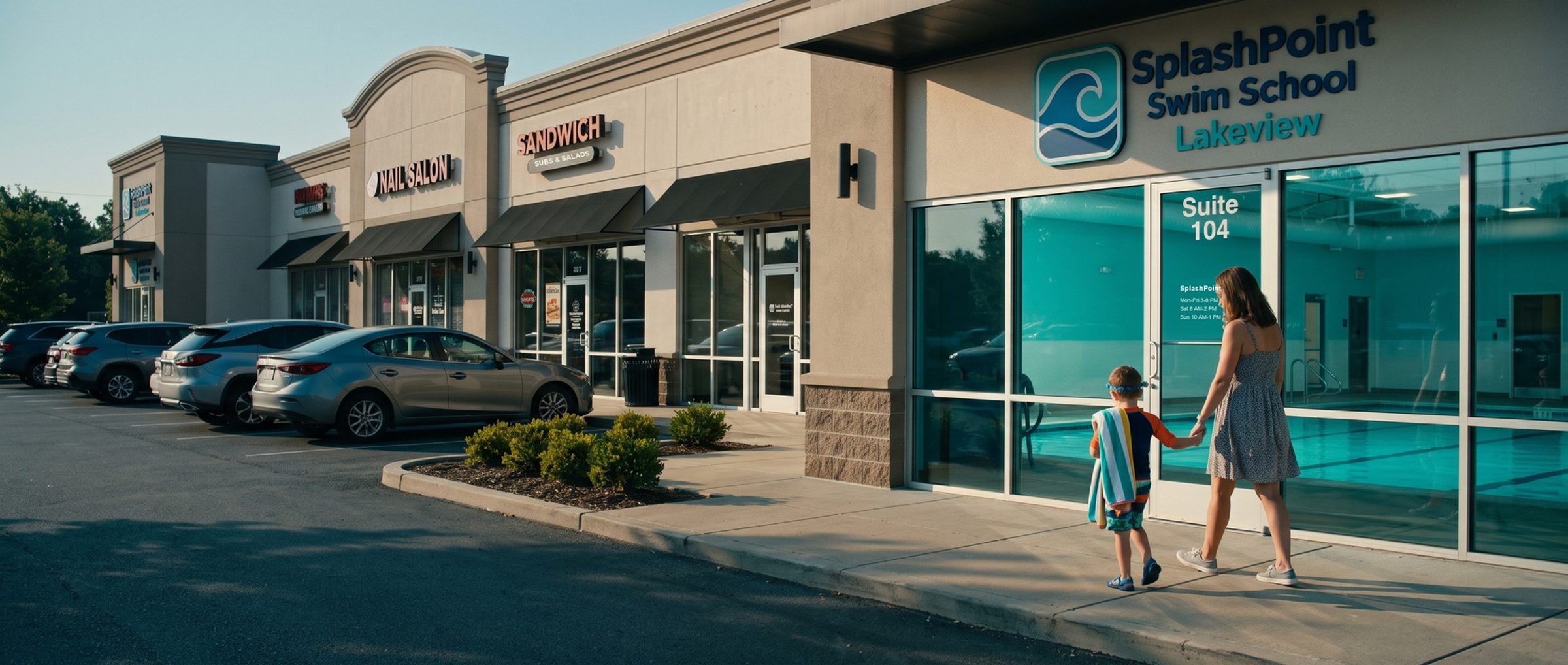
A parent types "math tutor near me," sees an ad for a well-known tutoring brand and taps it. The page that loads is the brand's national home page: a hero photo, a mission statement, a box that says "Find a center near you." The parent types a ZIP code, picks from a list of centers, opens one and starts looking for the phone number. Some parents finish that trip. Many go back to the search results.
That trip costs the franchise twice. It loses customers who give up, and a page that makes people search again is the kind Google rates lower on landing page experience, which can make every click more expensive.
Below: how Google decides which ad shows first, what Quality Score does and doesn't measure, and why a franchise ad belongs on the location page instead of the brand home page or the locator. The examples come from nine franchise locations we studied in one example market, Orlando. Your pages will look different. The rules Google applies are the same.
A Bigger Franchise Brand Doesn't Buy a Better Ad Position. Google Ranks the Ad and the Page Behind It.
Each search starts a fresh auction for the ad spots on the page, and Google orders the ads by what it calls Ad Rank. Google's list has six items. Two are about money: your bid, and how hard rivals are bidding in that auction. One is a gate, a quality minimum the ad has to pass to appear at all. One is the person: their location, their device, the time. One is the ad's extras, meaning how much sitelinks, call buttons and other assets should help. And one is fit: how well the ad and its page match, judged the moment the search happens.
Notice what isn't on the list. The size of the brand, the number of locations and the national ad budget don't appear. Each location's ad competes on its own bid and its own quality.
Quality pays twice. Google says "Higher quality ads can often lead to lower CPCs," and better Ad Rank means a higher position, where more people click. A franchise location that matches the search well can outrank a rival that simply bids more.
A Quality Score of 3 Out of 10 Is a Warning Light. Its Three Labels Say Whether the Ad or the Page Is to Blame.
Inside the account, every keyword shows a number from 1 to 10 called Quality Score, and it's worth reading once you know what it is. Google calls it "a diagnostic tool" and is blunt that "Quality Score is not an input in the ad auction." Think of it as the dashboard light, not the engine. Three readings feed it:
- Expected clickthrough rate, the odds of a click when the ad appears for that keyword. Google strips out position and assets when it estimates this, so a higher bid won't move it.
- Ad relevance, the fit between the ad and the intent behind the search.
- Landing page experience, Google's view of whether the page gives the clicker what they came for.
Each of the three comes back as one of three labels: above average, average or below average. For a franchise location, the useful habit is reading Quality Score campaign by campaign, location by location. When one keyword scores 3 in one location and 7 in another with the same ads, check which of the three labels differs. If only landing page experience drops, the page is the problem.
Ad relevance is the reading a location can move fastest, and it's set by how the account is organized. More on that below.
Most Franchise Location Ads We Read Showed the Brand's Web Address, Not the Location's
Every one of the nine locations we studied in the example market had its own page. Seven sat on the brand's corporate template, one on a brand subdomain, and one franchisee ran its own website alongside the brand's pages for its area. The pages exist. Having a page and sending ads to it turned out to be different things.
We read the ads each location was running in Google's Ads Transparency Center. Seven of the nine had text ads we could read. Four of those seven showed only a brand-level address: the brand's home page or a generic path on the brand's site. Three showed a location address. The other two locations ran their ads as map-style location cards.
A caution about that count: the web address an ad displays is not always where the click goes. Advertisers can set the displayed path separately from the page the click opens. So the four locations' ads may have landed on location pages after all. What the ads showed the searcher, though, was the brand, not the location down the street.
A Store Locator Makes a Ready Customer Find the Location Twice
Practitioners who run franchise accounts agree on one rule more than almost any other: never send local ad clicks to the corporate home page or the store locator. Build one location page template centrally and send each location's ads to its own page.
The reason is simple. By the time someone clicks an ad for "tutoring near me," Google already knows roughly where they are and which location the ad was for. A store locator throws that away and asks the visitor to do the search again: type a ZIP code, scan a list, pick one, click again. Every extra step loses people who were ready a moment earlier.
In the example market, one location ad's displayed path, when we opened it, redirected to the brand's locator home rather than the location's page. It's a small thing that is easy to miss when a brand runs hundreds of location ads from one template.
A locator has its place. It is the right page for someone searching the brand name with no location in mind. It is the wrong page for a location ad.
A Math Tutoring Ad Should Land on the Center's Math Page, Not Its Home Page
Here is the lever that matters most for ad relevance. Build the account in small, tight ad groups, each about one service, with five or six closely related keywords, and give each group an ad and a landing page about that same service.
For a franchise, that structure sits inside each location's campaign. One campaign per location. Inside it, an ad group for each service the location sells. Each ad group's ads send people to that location's page for that service.
One of the two tutoring centers in our example market already has the pages to do this. Alongside its main location page, its location site has a math program page and a reading program page. A search for "math tutor near me" belongs in a math ad group whose ad talks about math tutoring and lands on the center's math page. A search for "reading tutor" goes to the reading group and the reading page. Search, ad and page all about math tutoring leave Google nothing to mark down on fit.
Many brand templates don't give each location its own service pages. Then the location page is the floor, and a service section on it is the next step up. That's usually a request to the franchisor, since the template belongs to the brand. The Google Ads for Education guide shows the same one-page-per-program approach for schools.
A Location Page With the Address, Phone, Staff and Prices Beats Another Copy of the Brand's Home Page
A page Google rates well is one that is useful to the person who clicked. For a franchise location, that means the details the national site can't give.
The nine location pages we checked all carried the location's address and a phone number. Beyond that they varied. The home-services pages had long sections of local copy and frequently asked questions about the area they serve. The fitness studio and the math-and-reading center listed local prices and schedules. The chiropractic clinic named its doctors. Six of the nine showed reviews or a rating on the page, and four showed prices.
What an owner can change depends on the system. Brand templates usually lock the layout and leave a set of location fields open: hours, staff, photos, local offers, sometimes a block of local text. Fill every one of them. The franchisor decides the template, but the location decides whether its page looks like a real place with real people.
The same goes for offers. A national promotion on the page is fine, but a location's own offer, with its own expiry date, gives a nearby searcher a reason to pick this location over the one across town. If the system lets locations post their own offers, keep them current; an expired coupon on a landing page tells both the customer and Google that nobody is minding the page.
Speed is part of the experience too. Google's PageSpeed Insights, a free test, scores how a page loads on a phone and lists the files holding it up. On a franchise site, run it on a location page, not just the brand home page. A slow corporate template tends to slow every location built on it, and only the franchisor can fix that.
Next: Point Keyword Planner at the Location Page, Not the Brand Site
With each location ad landing on a page that matches the search, Chapter 5 turns to which searches to build those ad groups around, and why Google's Keyword Planner gives a franchise a very different list depending on which page you give it.
All sixteen chapters, from tracking and territories to who runs the ads and franchise development, are on the guide's home page.
Before any franchise account we run in Google Ads management launches, we open every location ad's final URL and check that it lands on that location's page. Own a location? Ask whoever runs your account for each ad's final URL, or have them check it in Google's Ad Preview tool, which shows the ad without racking up impressions. Then open that page on your phone and count how many taps it takes to reach your phone number.


