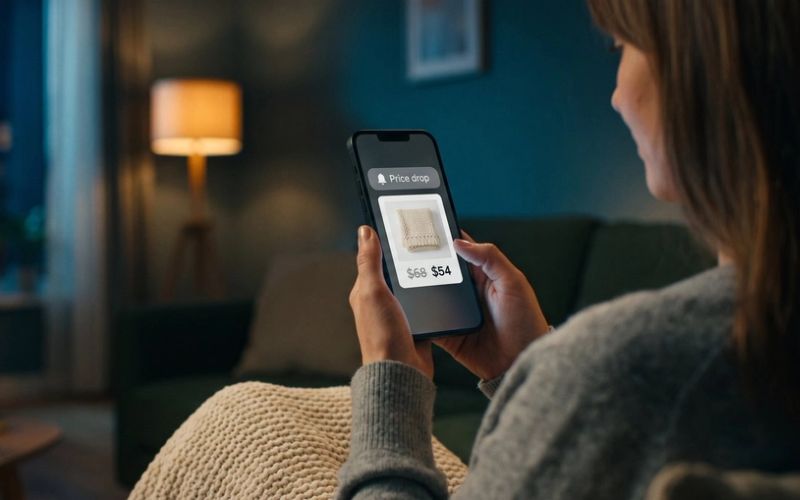

Picture someone on her lunch break in early December, buying a sweater for her father-in-law. She has met him maybe six times. She thinks he wears a large, though it could be an extra large. She has no idea whether he likes navy, and the family dinner where she has to hand it over is on the 20th.
She finds a sweater on your store that looks right. The product page tells her it is 100% merino, 12-gauge knit, with a ribbed hem and a relaxed fit. Every word of that is true, and none of it answers a single question she has. She opens a second tab, then a third. One of the other stores says, right under the price, "Not sure of his size? Swap it free until January 15." She buys there.
Nothing about your sweater lost that sale. Your page did. For most of the year the person buying from you and the person using what they buy are the same human, so a page written for the user works fine. From now until about the third week of December, a big share of your orders come from people who will never wear, drink, light or use the thing they are paying for. They need a different set of answers, and almost none of those answers are about price.
The Person Paying in December Isn't the Customer You Built Your Store For
Every online store is built around a picture of its customer. You know her age, what she cares about, what she reads, which ads she clicks. That picture is probably accurate for eleven months of the year. In the holiday season it quietly stops being true, because a large group of new buyers shows up who look nothing like her: the husband buying for his wife, the daughter buying for her dad, the coworker with a $30 limit for the office gift swap.
John Grech, head of retail partnerships at the gifting platform GiftNow, whose team had spent a decade studying gift purchases, put the mismatch plainly on a 2022 CommerceNext panel: brands are good at finding the core customer they have spent years learning to target, but in the peak gift seasons the person completing the purchase often is not that customer at all. They browse differently and they hesitate for different reasons.
That second part is the expensive one. A shopper buying for herself who leaves a cart behind is often weighing the cost, so a free-shipping offer in a retargeting ad sometimes brings her back. A gift buyer who leaves is usually stuck on something else entirely:
- "What if it's the wrong size?"
- "What if they don't like it?"
- "Will it get there in time?"
- "Can they return it without telling me?"
Grech's point was that stores spend real money retargeting gift buyers with a shipping discount that does nothing for any of those four. The offer answers a question the shopper never asked.
Find out how big your gift season actually is
Before you change anything, put a number on it, because the right amount of effort depends on whether gift orders are 8% of your December or 50% of it. You can get a decent estimate from your own order history in about twenty minutes.
Export last November and December's orders from your store admin. In Shopify that is Orders, then Export, filtered to the date range. The file has separate billing and shipping columns. Count the orders where the shipping name or address does not match the billing name or address. Each one is almost certainly a gift, sent straight to the person receiving it.
That count is a floor, not the full number, because plenty of gift buyers ship to themselves and wrap it at home. If you want the rest of the picture, a one-question survey after checkout asking whether the order was for the buyer or someone else will fill it in; we covered that approach in Your Signup Form Can Ask What Shoppers Need. But the address check alone tells you whether this article is worth an afternoon or a week.
Blue Stout, an ecommerce agency, suggests a second early signal worth watching this month: how many visits it takes the average shopper to buy, counted per person, not per session. It tends to sit still most of the year and then move sharply in the fourth quarter, up for considered products where gift buyers compare and come back, down for easy impulse gifts. Whichever way yours moves, the change is your sign that the traffic has turned over.
A Gift Guide Sorted by Product Type Makes the Buyer Do Your Job
Walk into a good independent shop in December and you will not find the shelves arranged by material. You will find a table near the door with a little sign: gifts under $25. Another one for the host. Another one for the person who has everything. The shop owner did the hard part, which is matching products to people, so the shopper only has to recognize someone on their list.
Most online stores in December still look like the stockroom. The menu says Sweaters, Scarves, Accessories. That works for a customer who knows what she wants. A gift buyer arrives with a person in mind, not a product, and a category menu forces her to translate one into the other on her own. Some of them will. Many will open another tab.
So build the table near the door:
- By recipient. For him, for her, for parents, for kids, for the host, for coworkers. Plain, boring and easy to find.
- By price band. Under $25, under $50, under $100. A price band answers the question every gift buyer is silently asking, which is "what can I get within my budget," and it is the most-used filter in almost every gift guide for a reason.
- One or two that only your store could make. If you sell coffee, "for the person who already owns every gadget" can point to your rare single-origin bags. That is the collection that makes your gift guide feel like yours.
Keep the collection names plain. Jessica Totillo Coster, a former boutique owner who teaches product sellers on the eCommerce Badassery podcast, makes the practical point that boring gift-guide category names are the ones that get found in search, so the creative angles belong in your emails, social posts and ads instead. "Gifts for Dad" will be typed into Google this month. "For the Man Who Says Don't Get Me Anything" will not, though it is a great subject line.
If your catalog is small, you do not need ten collections. Pick the three to five products you most want to sell this season, the ones with the healthiest margin or the deepest stock, and write down five different people each one would suit. Those become your gift guide, your email angles and your ad hooks for the next seven weeks, and it costs one afternoon with a notepad.
Your Product Description Explains What It Is. A Gift Buyer Needs to Know Who It's For.
Product descriptions are written by the people who know the product best, which is why they tend to describe it from the inside out: the materials, the dimensions, the process. A gift buyer reads from the outside in. Her question is not "what is this," it is "is this right for my brother," and the description almost never answers it.
The fix is one or two sentences near the top of the page, close to the price and the button, that name the person and the moment. Not "a 12-ounce double-walled tumbler" but "for the coworker who shows up to every 7 a.m. meeting holding a coffee." Not "hand-poured soy candle, 40-hour burn" but "for the friend who just moved into her first place on her own." The specifications still belong on the page. They just stop being the first thing a hurried gift buyer has to get through.
Blue Stout's guidance on speed is worth borrowing: aim for a line or two a skimming shopper can take in within about three seconds. A gift buyer in December is not reading your page the way a fan reads it in June. She has a list of eleven people and twelve tabs open.
Swap the review in the buy box for the season. Most product pages show star ratings near the top and the actual review text far below. For the next two months, pull one short review written by someone who bought the product as a gift and put it right under the price. "My brother-in-law hasn't taken it off since Christmas morning" does more for a nervous gift buyer than a 4.8 average, because it answers the question she actually has, which is whether it went over well with someone like the person she is buying for. In January, swap it back to a review from someone who bought it for themselves.
Every Gift Comes With Four Worries. Answer Them Next to the Buy Button.
The four questions from the start of this article are the whole job. Answer each of them where the shopper is deciding, which means near the button, not in a policy page three clicks away.
"What if it's the wrong size?" For anything with sizing, a gift buyer is guessing on someone else's behalf, which is the hardest version of the sizing problem. Give her a fit note in plain language ("runs roomy, if he's between sizes, go down"), and make the free exchange visible. If some of your products cannot get the size wrong, like a scarf, a beanie or an adjustable bracelet, say so on those pages and tag them in your gift guide. "No sizing needed" is one of the most reassuring phrases a gift buyer can read.
"What if they don't like it?" You cannot make someone like a gift, but you can make it painless when they don't. An exchange for a different color or style, with no awkward call to the person who gave it, takes most of the risk out of the purchase.
"Will it get there in time?" Put an order-by date for holiday delivery right next to the button, and update it as the carrier cutoffs approach. A specific date beats "ships in 3-5 business days" every time, and we covered how to work yours out in "Ships in 3-5 Business Days" Makes Shoppers Do Math. Keep in mind that the holiday is not always the 25th. Office parties, early family gatherings and Hanukkah all land earlier, so the order-by date is a promise the shopper plans around, not a countdown to one day.
"Can they return it?" This is the one stores most often get wrong, because a standard 30-day return window quietly stops working for gifts. Something bought on November 28th and opened on December 25th has days left. Extend it, and say so in words a shopper can't miss: "Bought it for someone else? They can exchange it until January 15." We made the case for putting that line on the product page itself in Your Black Friday Sale Can Look Like a Clearance Bin or Like Your Brand.
If you are on Shopify, the mechanics need one bit of care. Return windows there are counted in days from delivery, not to a calendar date, so "until January 15" is something you set up rather than a single switch. You have two options. You can raise your default window before the season starts (changes apply only to orders placed after you make them, so lowering it again in January doesn't touch holiday orders). Or you can use return window overrides, which Shopify added in September, to give your gift collection a longer window than the rest of the store. Find both under Settings, then Policies, then Return and cancellation rules. One catch with overrides: if a product sits in two collections with different overrides, Shopify applies the shorter window, so check your best sellers after you set it.
Then add the gift receipt: a way for the recipient to exchange or get store credit without the original price on the paperwork and without the buyer finding out. Most return apps support it, and it is the quiet detail that makes a nervous gift buyer comfortable spending a little more.
A Gift Buyer Who Can't Hide the Price Doesn't Check Out
Baymard Institute, which runs large-scale usability testing on ecommerce checkouts, found that on 46% of the stores it benchmarked where gift orders are a reasonable thing to expect, there is no way to mark an order as a gift at all. In its testing, the two things gift senders wanted most were to keep the price off the paperwork and to include a personal message. When they couldn't mark the order as a gift, some of them abandoned it.
Think about what the shopper is left with in that case. She can send it straight to her father-in-law with an invoice inside showing exactly what she paid and no note saying who it's from. Or she can ship it to herself, wrap it, and post it again. Neither is appealing, and the second one turns your free shipping into her trip to the post office.
The fixes are small:
- A gift option at checkout. A checkbox or a short section that says "This is a gift" and reveals a message field. Several Shopify apps add this, and some themes include a gift note box in the cart that flows through to the order.
- No prices in the box. Print a packing slip for a test gift order and look at it. If a price appears, edit your packing slip template (in Shopify, Settings, then Shipping and delivery, then the Documents section) so gift orders ship without one.
- The message actually printed. A gift note that the customer typed and your team never saw is worse than no field at all. Make sure the note reaches whoever packs the order, on the packing slip or a printed card.
- Gift wrap as a paid add-on. Plenty of gift buyers will pay a few dollars to skip wrapping, and it is margin you were not earning before.
While you are in the cart, change one more thing. The "you may also like" add-on that works the rest of the year reads differently in December when it is framed as finishing the gift: a card, a matching small item, a gift box. Keep it to one low-priced item the shopper can add with a single click without leaving the cart, and keep the cart to one or two offers in total. Every extra offer is another decision standing between her and the checkout button, and a cart full of them can cost more orders than it adds. We covered what earns a place in the cart in You Don't Need More Traffic. You Need a Bigger Cart.
Your Ads Are Still Selling Free Shipping to Someone Worried About the Size
Most store owners write their holiday ads the same way they write them in June, with one change: a bigger discount. The gift buyer is barely in them.
Three changes cost almost nothing and fit the shopper you actually have this season:
Lead with the person, not the product. An ad that opens with "For the dad who already has a grill" gets a gift buyer's attention in a way that "Premium stainless steel BBQ tools" never will. Your gift guide work above already wrote these lines. Use the recipient angles as ad hooks, a different one each week, and let the results tell you which people your product is most bought for.
Send gift traffic to the gift collection. An ad about gifts for the host that lands on your homepage makes the shopper start the search over. Point it at the matching collection, the one sorted by person and price, so the click continues the thought the ad started.
Change what the retargeting offers. Blue Stout splits holiday offers by who the shopper is, and it is a good rule for a small store. For gift buyers, convenience usually beats a discount: gift-ready packaging, a gift set that removes the guesswork, a clear arrival date. For customers who have bought from you before, early access to the sale or a new release rewards them without teaching them to wait for a markdown. The first-order discount belongs with new shoppers buying for themselves, which is the only group it was built for. Before you add a free-shipping message to every retargeting ad this month, ask which of those three shoppers it is actually for.
This is a big part of what we do with online stores' advertising in the fourth quarter: matching the message and the landing page to the shopper who actually shows up in December, rather than the one the account was built around in the spring.
The Recipient Is a Customer You Didn't Pay to Find
Every gift order that ships to a different address puts your product into the hands of someone who has never been to your store, did not click an ad and cost you nothing to reach. It is the cheapest new customer you will get all year, and most stores do nothing with them.
Talk to the recipient in the box. The insert is the only message you can send that person, so make it count: what the product is, how to care for it, how easy the exchange is, and a reason to come and look at the rest of the store, with a code for their own first order. We covered what belongs in that box in Every Customer Opens the Box. If you can't be sure what someone would like, a gift card is the one present that cannot be the wrong size, and it brings the recipient to your store to choose; A Gift Card Is a Customer You Have Not Met Yet covers how to sell one without discounting it.
Don't market the gift back to the buyer. The woman who bought the merino sweater for her father-in-law does not want a January email suggesting matching socks in his size. Tag gift orders in your store, using the address mismatch or a gift checkbox at checkout, and keep those buyers out of the "complete your look" follow-ups meant for people who bought for themselves.
Remind them next year. Chip Malt, CEO of the cookware brand Made In, said on the same panel that gift buyers behave unlike normal customers in one useful way: when they love a product, they come back and buy the exact same thing again for somebody else. A self-buyer who owns your frying pan rarely needs a second one. A gift buyer who saw how well it went over may want three. A note to last year's gift buyers in early November, reminding them what they sent and that it is in stock, is one of the easiest emails of the season to write.
The First Three Fixes Take an Afternoon. Do Them Before Black Friday.
Black Friday is November 27th, so there is still time to do all of this. In order of effort:
An afternoon:
- Export last November and December's orders and count the ones shipped to a different address than they were billed to. That is your gift share, at minimum.
- Pick your three to five gift products and write five "who it's for" lines for each.
- Print a test packing slip for a gift order and check for prices.
A day:
- Build gift collections by recipient and by price band, with plain names.
- Add a "who it's for" line and a gift-buyer review near the top of your top product pages.
- Put the order-by date and the holiday return date next to the button.
- Extend your return window for holiday orders, using a longer default or an override on your gift collection.
A week, if you have it:
- Add a gift option at checkout with a message that actually gets printed, plus paid gift wrap.
- Rewrite your holiday ads around recipients, point them at the matching collections, and split your retargeting offers by who the shopper is.
- Write a card for the box that talks to the recipient, and tag gift orders so January's emails go to the right people.
None of this requires a redesign or a bigger budget. It requires remembering that for the next seven weeks, a lot of your customers are shopping for someone they love and are terrified of getting it wrong. The store that makes them feel sure gets the sale, and often gets the recipient too.
If you would like a second pair of eyes on how your store and your ads are set up for the gift season, this is the kind of work we do with online stores every fall, and we are happy to help. If you would rather work through the list yourself, start with the export. The number will tell you how much of December you have been talking past.