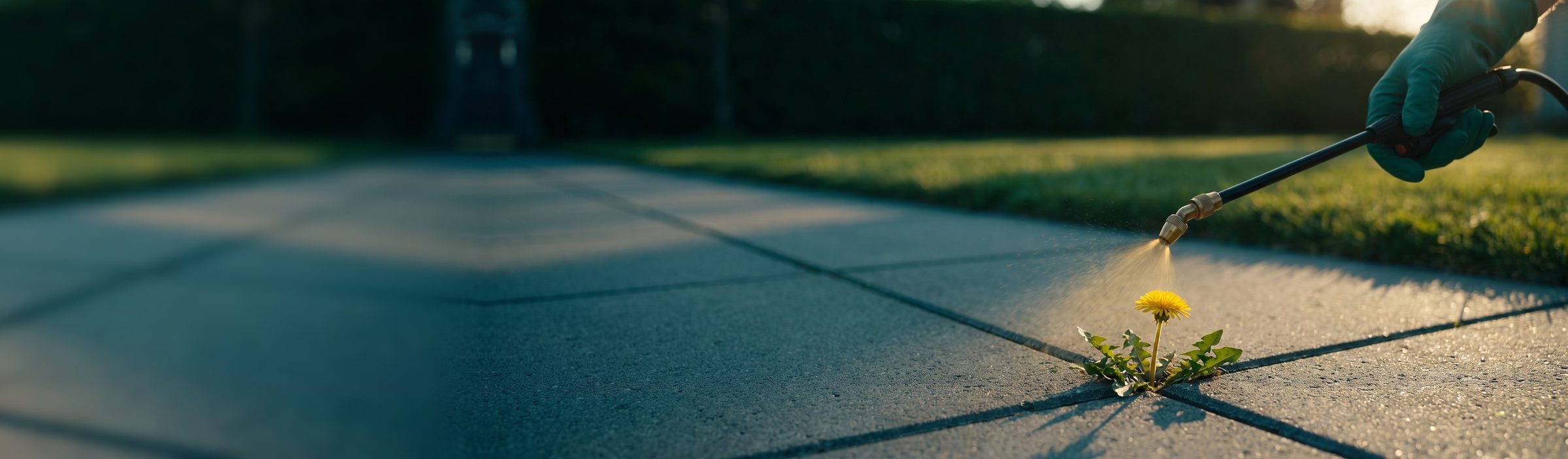
A landscaper can mow lawns in most of the country with a truck, a mower and a business registration. Add weed control and the rules change. Add sprinkler repair, retaining walls or tree removal and they change again, differently in each state. A company that sells five services may need five different licenses, or none, depending on where it works.
That matters for Google Ads because an ad group is a public offer. In some states, the law treats advertising a regulated service the same as performing it, so the ad itself needs the license behind it. This chapter walks through the service lines that carry licenses in the seven states we checked: California, Texas, Florida, New York, Illinois, Arizona and North Carolina. These are examples side by side, not a complete list, and none of it is legal advice. Check your own state's agency before you build the ad group.
California, Florida and Arizona Write "Advertise" Into the Pest Control Business License.
Weed control is the service that surprises most landscapers, because in several states it's pest control. Three of the seven states we checked go further and make advertising the service part of what needs a license.
California. The Food and Agricultural Code says it's "unlawful for a person to advertise, solicit, or operate as a pest control business" without a pest control business license from the state Department of Pesticide Regulation. The state has a license built for landscapers who treat as a side line, the Maintenance Gardener Pest Control Business license, which still requires a qualified, certified person behind it.
Florida. State law defines pest control to include controlling pests on a "lawn, or ornamental," and it includes "the advertisement of" that work. A narrower certificate, Limited Commercial Landscape Maintenance, lets landscapers treat weeds in beds, driveways and patios, but the statute says it does not authorize "Application of pesticides to turf" or "Operation of a pest control business."
Arizona. The state's pest management division counts weeds and ornamental pests "in lawns" as structural pest control, and says "anyone engaging in, offering to engage in, advertising for, soliciting, or performing pest management needs a business license."
Our reading: in those three states, a "weed control" or "lawn treatment" ad group is itself the regulated act. Building it before the license is in hand isn't a paperwork gap. It's advertising a licensed service without the license.
The demand is there, which is why the question comes up. Across the US, "weed control service" draws about 720 searches a month on average and about 2,400 in July, with top-of-page bids up to about $18.86, more than twice the top bid we saw for "lawn fertilization." A company that wants those searches has a straightforward choice in the states that license advertising: get the license first, or leave weed control out of the account and add the searches to the negative list from Chapter 5.
Spraying Weeds for Hire Needs a License in Texas, New York, Illinois and North Carolina. Check Fertilizer Separately.
The other four states we checked tie the license to applying products for hire rather than naming advertising, but they cover the same lawn work.
In Texas, the Department of Agriculture says anyone who applies "any pesticide (regardless of classification and including general-use)" to lawns, weeds, trees or ornamental plants for hire must be licensed. Then it draws a line many landscapers miss: "Applicators who apply only fertilizer do not need to be licensed." A Texas company that sells fertilizer-only programs can advertise them without a pesticide license; the same company adding weed control can't.
New York requires commercial applicator certification for lawn work, in the category for ornamentals, shade trees and turf, and says a business that offers pesticide services for hire "must be registered" with the state. Illinois requires a licensed commercial applicator to run a business applying pesticides for hire, general use included, and its lawn care notice law adds that an applicator for hire must place a lawn marker after each application. North Carolina requires a pesticide license "for commercial applicators applying any type of pesticide for compensation," with a category that covers home lawns.
Fertilizer isn't free of rules everywhere, though. Florida runs the other way from Texas: since 2014, anyone applying commercial fertilizer to an urban landscape must hold a limited state certification. The same "fertilizer program" ad group can be license-free in one state and licensed in the next, so the license check runs per service and per state, every time the account expands into a new one.
Nine of 12 Landscaping Sites Sell Lawn Treatment. Two Print a Pesticide Registration Number.
In the example market, around New York, 9 of the 12 landscaping companies we profiled sell lawn or pest treatments. Two of those nine print a pesticide registration number on their sites, and one of the two prints it without a label saying what it is. Only 3 of the 12 print any license number at all.
That doesn't mean the other seven lack licenses. It means a homeowner, or a regulator, can't tell from the website. Chapter 8 covered the states that require a license number in the ad itself; this is the step before that: knowing which licenses the ad depends on.
Google's own policy points the same way. Its rules on unacceptable business practices don't allow advertisers to offer products or services they don't have or can't deliver, "including not having the right licenses or qualifications." So before a lawn treatment ad group goes live, we check three things: does the state license pesticide application for hire, does it license advertising it, and does the company hold the right license for the services in that ad group? If the answer to the last one is no, the ad group waits, or it's rebuilt around services the company can legally sell, such as fertilizer-only programs where the state allows them.
California Ends the Under-$1,000 Exemption for Anyone Who Advertises. An Ad Can Make You a Contractor.
Hardscape and installation work runs into contractor licensing, and California has the sharpest version of the advertising rule. Landscaping contractors there hold a C-27 license. Small jobs under $1,000, with no building permit, are exempt. But the exemption in the state's contractor law doesn't apply to anyone who "advertises or puts out a sign or card or other device that might indicate to the public that the person is a contractor."
Our reading: a California handyman-landscaper who builds small walkways under $1,000 and runs a Google ad for "paver walkway installation" has advertised as a contractor, and the small-job exemption no longer protects them.
Thresholds elsewhere vary widely. Arizona requires a contractor license from its Registrar of Contractors when labor and materials exceed $1,000 or a permit is needed, under classifications for hardscaping and irrigation that cover patios, walkways, pavers, garden walls, fences up to six feet, retaining walls up to three feet, landscape lighting and water features. North Carolina's landscape contractor license applies to work of $30,000 or more per job site in a 12-month period. Texas, Florida, New York and Illinois had no state landscape contractor license we could find, though cities and counties may require their own.
A Lawn Treatment Campaign That Crosses a State Line Needs a License in Both States.
Landscaping service areas don't stop at state borders, and the example market shows how often they cross. Of the 12 companies we profiled around New York, five list New Jersey addresses, one is based in Connecticut, and the rest work from New York, with several national brands covering all three. A company in northern New Jersey that also takes jobs in Rockland County, New York, is selling into two licensing systems from one ad account.
Google's location targeting makes this manageable. Chapter 9 drew the campaign map around where crews work; the license check adds a second filter. If the company holds a pesticide license in one state but not the next, the lawn treatment campaign targets only the licensed state, while mowing and cleanup campaigns can still cover both. The same goes for irrigation, where one state may require a license and its neighbor may not. Split the map by service, not just by distance. For a northern New Jersey crew that also mows in Rockland County, that looks like a mowing campaign drawn across both states and a weed control campaign drawn only where the pesticide license is valid, each with its own budget and page.
We didn't research New Jersey or Connecticut rules for this guide, so we're not stating them here. The point is the method: for every state inside a campaign's map, check the license for that campaign's service before it runs there.
Sprinkler Repair Needs an Irrigator License in Texas and North Carolina. California Licenses Tree Removal.
Irrigation has its own rules in more states than landscaping does. Texas requires a license from its environmental agency for anyone who "sells, designs, installs, maintains, alters, repairs, or services an irrigation system." That's the same state whose irrigation advertising rule, covered in Chapter 8, requires the irrigator's license number on every ad. North Carolina has an irrigation contractors' licensing board, with an exemption for work under $2,500 per job site. Illinois licenses lawn irrigation contractors through its public health department, under the state plumbing law. In Arizona, irrigation sits inside the contractor classifications for hardscaping and irrigation.
Tree work is the opposite. Of the seven states, only California has a state license aimed at it: the C-49 Tree and Palm Contractor classification, for those who plant, maintain and remove trees and palms. We found no state tree license in the other six, though some cities license tree work and arborist certification is a common trust signal.
Put it together and the rule for the account is simple: license checks follow the service line, so they follow the ad groups. Chapter 4 split the account by service. Before each service's ad group goes live, check that service's license in each state you advertise in, the same way Chapter 9 drew the campaign map around where the crews can actually work. Our Google Ads management runs that check for every service line before launch, and builds the account around what each client is licensed to sell.
Next: Commercial Landscaping Clicks Top Out Near $32, More Than Any Other Landscaping Search We Checked. Businesses Pay 48% of the Industry's Revenue.
The last chapter turns to a different customer altogether. Chapter 16 covers commercial landscaping: the property managers and businesses that pay for nearly half the industry's work, and the highest click prices in the guide.
Every chapter is on the guide's home page.