Read the orthodontic Search ads running in one large US market and you start to hear the same few words. You'll learn a lot about financing and very little about the practices. Affordable braces. Low monthly payments. Free consultation. Five stars. Swap the logos around and nobody would notice.
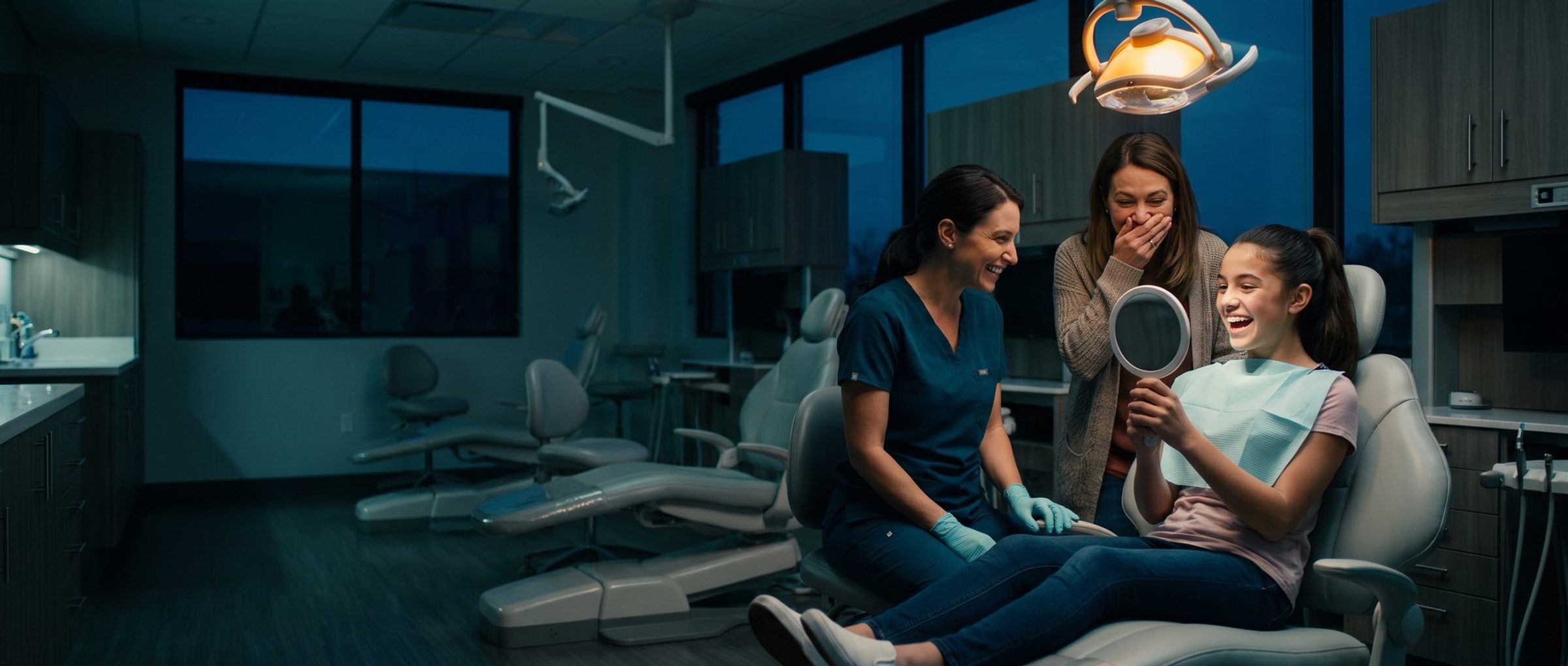
Then read what a practice's happiest patients wrote about it. They almost never mention the payment plan. They write about the person at the front desk who remembered their kid's name, the orthodontist who explained every step, the appointment that started on time.
This chapter is about closing that gap. The examples come from one example market, Detroit: 162 orthodontic Search ads from Google's Ads Transparency Center and 817 Google reviews from 21 orthodontic listings. Your town's ads will read differently. The method for writing better ones won't.
Orthodontic Ads Lead With "Affordable." 65 of 162 Ads in Our Example Market Said It or Something Like It.
We read every orthodontic Search ad we could find for 27 practice and brand websites in the example market, 162 ads in all. Here's what they talked about.
Sixty-five of them sold affordability: "affordable," "low cost," "best price" or close cousins, from 16 different sites. Fifty showed a star rating or a review count. Forty-five talked about financing or payment plans. Twenty-six offered a free consultation, and 28 mentioned kids or teens.
Then the quieter numbers. Seventeen ads, from 12 sites, said anything at all about the people: a friendly team, a caring staff, a gentle doctor. And not one of the 162 said the practice runs on time, sees patients after school or opens on Saturday.
There's nothing wrong with affordable. Price matters to families, and a later chapter covers how to advertise it honestly. The problem is that when 16 practices all say it, the word stops doing any work. A parent scanning four ads that all promise affordable braces has learned nothing about which office to call.
Happy Patients Write About the People. 243 of 582 Reviews Called the Office Friendly, Kind or Caring.
Now the other side of the page. Of the 817 Google reviews with text, 582 gave four or five stars. In 243 of those, the reviewer used one of a handful of plain words about how they were treated: friendly, kind, welcoming, caring, polite or warm. That pattern showed up at all 21 listings, not just a few charming ones.
The praise gets specific fast. Sixty happy reviews, at 15 listings, said the office explained things or answered every question. One patient at Masri Orthodontics wrote that the practice "is very detailed, and explains everything that happens." Fifty, at 17 listings, praised being on time or not waiting. At McQueen Orthodontic Specialists a reviewer wrote that "they're always on time and offer different payment options to get you serviced." Notice which half of that sentence came first.
Parents of nervous kids write the most heartfelt ones. Another McQueen reviewer described a child who "has a difficult time at the dentist" and said the staff "helped my child be at ease."
That's the copy. It's already written, by the people with the most credibility, in words a stranger believes. An ad headline that says "On Time, Every Visit" or "We Explain Every Step" is just a happy review with a character limit, and in our example market it would be the only one of its kind.
Mining your own reviews takes an afternoon. Export or copy the last year of four- and five-star reviews into one document. Read them with a highlighter and mark every phrase that describes the experience rather than the result: on time, explained, patient with my son, answered the phone, fit us in. Count which ones repeat. The phrases that show up five or ten times are your headlines. The ones that show up once are your descriptions. Keep the patients' wording wherever it fits in 30 characters, because "they always explain" sounds like a person and "comprehensive patient education" sounds like a brochure.
Parents Wrote 124 of the Happy Reviews. A Braces Ad for a 13-Year-Old Is Read by the Parent.
Who writes the praise matters as much as what it says. Among the happy reviews, 124 were written by a parent about a child and 80 by a patient about their own treatment. The rest didn't say.
That split should shape the ad groups from Chapter 4. The teen and children's groups are speaking to an adult who will drive to every appointment, sign the contract and pay the bill. Their headlines should answer a parent's questions: will my kid be comfortable, will someone explain what's happening, can we come after school. Google also won't show personalized ads to people it knows are under 18, so the words in the ad are what reach the right reader.
The adult groups are a different conversation. A 35-year-old considering Invisalign wants to know how long it takes, whether anyone will notice, and whether appointments fit around work. One low-star review in our sample put it bluntly: the office needed "to open up at 7am so adults can still get to work on time." If your practice does open early, that's a headline. If it doesn't, don't write it.
Your Own Treatment Pages and Your Rivals' Ads Are the First Drafts, and Both Are Free.
Before writing a single headline, open two sources.
The first is your own landing page. Chapter 4 gave every treatment its own page, and those pages already describe the treatment the way your practice explains it in the chair. Ad copy that echoes the page it sends people to keeps the promise consistent from the search results to the screen they land on, and Google's quality ratings reward that consistency.
The second is your competition. Google keeps a public record of who advertises and what they ran, called the Ads Transparency Center, and it costs nothing to search. Type in every orthodontist within a reasonable drive and read what they're running on Search. In about an hour you'll know what every ad in your market says, which means you'll know what none of them say.
That gap is the opportunity. If every competitor leads with price and financing, the practice that leads with "Seen on time" or "Your child's first visit, explained" stands out on a page full of identical ads. Then check the claim against your own reviews. If your happy patients don't mention it, your ad shouldn't either.
Google Takes 15 Headlines and 4 Descriptions and Tests the Mix. Pin Nothing at Launch.
The ad format itself rewards variety. Google's responsive search ads accept up to 15 headlines of up to 30 characters each, and up to 4 descriptions of up to 90. Google assembles them into different combinations for different searches, tests them, and leans toward the ones that perform.
So give it real choices. A strong orthodontic ad group might carry three or four headlines drawn from reviews (on time, explains every step, great with nervous kids), a few naming the treatment and the town, a couple about the free consultation or payment options, and one with the practice name. The descriptions can do the longer work: the 90 characters it takes to say what happens at the first visit.
Here's what that could look like for an adult Invisalign ad group, as an example only, with every claim checked against the practice's own reviews first. Headlines: "Invisalign for Busy Adults" (26 characters), "Early Morning Appointments" (26), "We Explain Every Step" (21), "On Time, Every Visit" (20), "Free Invisalign Consultation" (28). A description (89 characters): "See your plan and timeline at the first visit. Every question answered before you decide." If the front desk can't book a 7 a.m. Invisalign check, cut that headline before launch.
Then leave the headlines free to move. Pinning locks a headline into one slot. Google's responsive search ad page warns that a locked slot shrinks the pool of headlines it can match to each search, and steers most advertisers away from it. Lock a line in place only when a state board says every orthodontic ad must carry it. Fee and discount disclosures and the rules on the word "specialist" vary by state; Chapters 14 and 15 cover them.
A word on Ad Strength, the "Poor" to "Excellent" rating Google shows while you write. It's feedback on how varied your headlines and descriptions are. Google says it doesn't directly decide whether the ad shows. Fifteen distinct headlines will usually satisfy it. Fifteen distinct headlines that all say "affordable" will satisfy it too, and that tells you how much weight to give it.
Low-Star Reviews Show What Not to Promise: 75 of 181 Were About Waits, Scheduling and Phones.
The happy reviews tell you what to say. The unhappy ones tell you what you'd better be able to deliver.
We read 181 low-star reviews about orthodontic care in full. Most came from a deliberate pull of each listing's lowest-rated reviews, so treat them as a list of patterns, not a rate of anything. Seventy-five were about the office: sitting in the waiting room, waiting weeks for an appointment, or calling and calling with nobody picking up. Fifty-seven were about money in some form.
"I sat in the waiting room for a full clock hour waiting to get my braces tightened," one reviewer wrote. Another described calling "every morning since the end of June."
Read that list next to your draft headlines. "No waiting" is a wonderful promise for a practice whose schedule runs on time and a refund request for one whose doesn't. "A real person answers the phone" only works if one does. An ad that over-promises doesn't just waste the click. It hands the patient the first line of their review.
Once the ads are live, keep the strongest and replace the rest on a regular schedule. Judge them by booked exams, not by clicks or by Ad Strength. A headline that draws clicks but never books is a good-looking billboard for the wrong practice. When you replace one, go back to the reviews for the next draft. Your patients will have written something new by then.
An orthodontic practice that would rather have someone write, test and rewrite those ads from its own reviews can see what our Google Ads management includes.
Next: New Campaigns Switch On AI Max and Search Partners by Default. Chapter 9 Turns Them Off.
The ads now sound like your practice. Chapter 7 set the bids behind them. Chapter 9 goes through the settings Google switches on in every new campaign, and which ones an orthodontic launch should switch off before the first dollar is spent.
This chapter is part of Google Ads for Orthodontists, our sixteen-chapter guide for orthodontic practices anywhere in the US.