
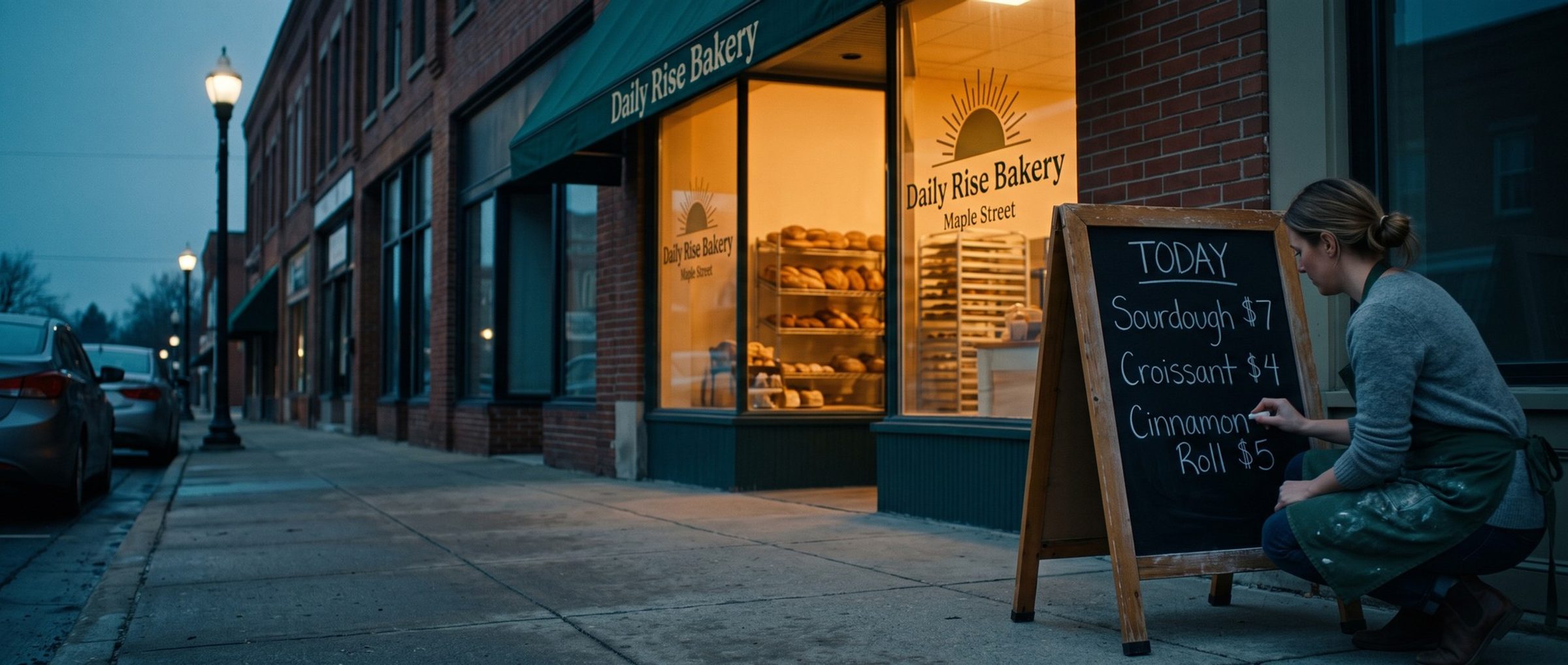
A new franchise location opens its Google Ads account with a list of near-me searches and a budget the owner agreed to. What it doesn't have is a single conversion. Google's conversion-based bidding strategies learn from conversions, and on day one a new location has none worth learning from.
That's why the first bids get typed in by a person. This chapter covers how to set them, how to tell whether they're high enough, why a shared budget is a bad idea when each location has its own owner, and when it's time to hand the bidding to Google. The bid ranges come from Keyword Planner in one example market, Orlando. Your market's prices will differ. The order of steps won't.
A New Franchise Location Opens With Zero Conversions for Smart Bidding to Use. Set the First Bids by Hand.
A location's opening campaign is the one BrandRocket calls Isolation: exact match, the known ready-to-buy searches, and Manual CPC bidding. With Manual CPC, Google's own description is that you set "max. CPC amounts that you're comfortable with, see how many clicks your ads begin to accrue, and whether those clicks lead to business results."
Google gives two ways to place those bids. An ad group default bid applies one maximum to every keyword in the group. Keyword bids let you pay more for a keyword you know is worth more. Google's example is a bakery that bids more for "apple fritters" than "donuts" because the fritter searchers tend to buy more.
Our bids live on the ad group. Chapter 5's small, single-service groups are what make that work: the emergency group and the outlet group each get the price their own searches deserve. In our experience, a new location should bid firmly in its first weeks. Its ads have no track record yet, and a timid bid on a brand-new campaign buys very few clicks to learn from. As the ads build a record, the bids can come down.
Keyword Planner's Top Estimate for a Near Me Click: $7 at a Fitness Studio, $73 at an Electrician. One Bid Can't Cover Both.
For each search, Keyword Planner gives a pair of top-of-page bids, a low one and a high one. By Google's definition, the high one sits near the 80th percentile of those past top-of-page bids in the area you picked. It's a guide, not a ceiling: real clicks can cost more. We looked at that high estimate for the biggest near-me search on each franchise location's page in the example market.
"Electrician near me" came in at $73.05. "Tutoring near me" was $22.41, "home cleaning company near me" $19.66, "daycare near me" $16.94 and "chiropractor near me" $12.16. At the low end, "brazilian wax near me" was $7.75 and "workout classes near me" $6.68.
Across seven franchise categories in one metro area, the high estimate varies elevenfold. No one bid rule fits every kind of location, and an agency or franchisor that runs several brands with one starting bid will overpay in some and barely show up in others. Within one brand, the price also moves with each location's own competitors, which is why every location gets its own Keyword Planner pull.
So each location's starting bids come from its own Keyword Planner ranges, for its own searches, set to its own area. In our experience those ranges are a fair guide if you treat them as plus or minus 30%, as Chapter 5 described. They give the opening bid. The location's own results set every bid after that.
Searches Lost to a Rival's Ad Never Ring the Front Desk. Google Ads Still Tracks How Often It Happens.
An owner sees the calls that came in. Nobody sees the searches where a rival's ad showed and theirs didn't. Google Ads does, in the impression share columns.
Search top impression share compares how often a location's ad showed among the top ads, the group Google places at the top of the results, with how often it was eligible to. For a franchise location, the searches to watch are its biggest near-me and service searches, and our goal on those is 75% to 90%. Below that, a location is leaving a large share of its best searches to someone else.
Two more columns say why. Search lost top impression share (rank), in Google's words, "estimates how often your ad didn't show anywhere among top ads due to poor Ad Rank." Ad Rank, as Chapter 4 covered, weighs the bid and the ad's quality together. Its sibling, Search lost top impression share (budget), covers the times the ad missed the top because the budget was too low. With one campaign per location, both give each owner numbers of their own.
The auction insights report adds names. It compares your results with "other advertisers who are participating in the same auctions," including how often their ads showed above yours. It stays blank when a campaign's impression share is under 10%.
Winning every auction isn't the goal. If keeping the top spot on a search means paying more per customer than the customer is worth, as Chapter 3 worked out, the right move is to bid lower and let someone else overpay for it.
Google Lets One Shared Budget Flow Between Campaigns. Across Franchise Owners, That's Someone Else's Money.
Google describes a shared budget as "a single average daily budget that's shared by multiple campaigns in an account." The selling point, in Google's words, is to "allow your overall marketing budget to freely distribute between campaigns."
For a single business, that can be handy. For a franchise account where each location's campaign is paid for by a different owner, it's a problem. Put five locations' campaigns on one shared budget, and the money no longer belongs to any one of them. One practitioner, describing three locations combined into one campaign with one budget, put it plainly: "the chips will fall where they may based on search volume." A shared budget does the same thing across separate campaigns. A busy location's campaign can spend money a quieter location's owner paid in.
A shared budget has a place in a franchise system: where one payer funds every campaign it covers. The brand fund's own campaigns, such as the brand-name campaign from Chapter 2, can share a budget without anyone's money crossing a line. Shared budgets also don't work with Performance Max, and Google describes them inside one account. We found nothing that shares a budget across accounts.
The rule we follow: one budget per location campaign whenever the money comes from different owners.
We Wait for About 30 Conversions a Month Before Smart Bidding. A Franchisor Can Pool Small Locations to Get There.
Once a location has a track record, Exploration takes over the growth work, BrandRocket's broad match stage from Chapter 6. Its bidding is Target CPA, which Google relabeled in June 2026 from "Maximize conversions with a Target CPA." Google sets each bid automatically, aiming for as many conversions as it can at the cost per conversion you ask for, on average.
Google allows Target CPA from the start, even with no conversion history. Its suggested target is the campaign's average cost per conversion over the past month, and it advises judging the strategy on a 30-day stretch that holds at least 30 conversions. We use that same number as our point to switch: about 30 quality conversions a month. In our experience, most new accounts get there around months two to three; a busy location can get there sooner, and a quiet one later.
A small location may take a long time to log 30 a month alone. A franchise has a way around that. When a franchisor manages locations' accounts under one manager account, Google lets it build a cross-account bid strategy for Search campaigns, "providing more conversion volume/value at the same overall target across campaigns in multiple Customer Ids by merging them together into a single portfolio." Several small locations' conversions then teach one strategy together.
Practitioners argue about how far to take this. One practitioner on Reddit said they went "from 40+ campaigns down to 6 metro clusters" and that cost per acquisition dropped about 30%. Others keep a campaign per location, because every owner needs their own numbers. Our reading: pool the bidding, not the campaigns or the budgets. Every owner still sees a campaign, a budget and a report that belong to their location alone. Only the learning is shared.
Two cautions. A pooled strategy has one target for everyone in it. And if a location's account is ever unlinked from the manager account, Google says its campaigns on that cross-account strategy are marked as having an invalid bid strategy and stop showing ads until a new bid strategy is chosen. That's something to plan for before a franchisee sells or leaves.
Franchise Locations Don't Share a Cost per Lead. Set Every Location's Target CPA From Its Own Number.
Two locations of the same brand rarely buy leads at the same price. One practitioner who runs franchise accounts put it this way: "a location's cost per lead depends on local competition, not on the brand." An electrician location in a crowded suburb and one in a quiet town can run identical ads and pay very different amounts.
So each location's Target CPA starts from its own cost per lead in its Isolation campaign, the same way Google builds its suggested target from that campaign's own recent month. Then check it against the most that location can pay for a customer, from Chapter 3. A system average would set the cheap market's target too high and the expensive market's too low.
That's also why only locations with similar costs belong in one pooled strategy. A pool that mixes a $30 market with a $120 market gives both of them one target that fits neither.
Before trusting any cost per lead, listen to the calls. A location can show a cheap cost per lead that's mostly wrong numbers, job seekers and sales pitches. In our experience, a monthly review of a sample of each location's tracked calls catches that before the bidding learns from it. Judge each location by what its leads turn into, not by the cost per lead alone.
Next: A Franchise Location's Reviews Belong in Its Ads
With the bids set, Chapter 8 turns to what the ads say: why customers praise the local team, not the brand, and how a location's reviews belong in its ad copy.
All sixteen chapters, from tracking and territories to who runs the ads and franchise development, are on the guide's home page.
Every franchise location in our Google Ads management launches on bids set by hand and its own budget, and moves to Target CPA only on its own numbers. Own a location? Ask whoever runs your account two questions this week: is your campaign on a shared budget, and what was its Search top impression share last month?


