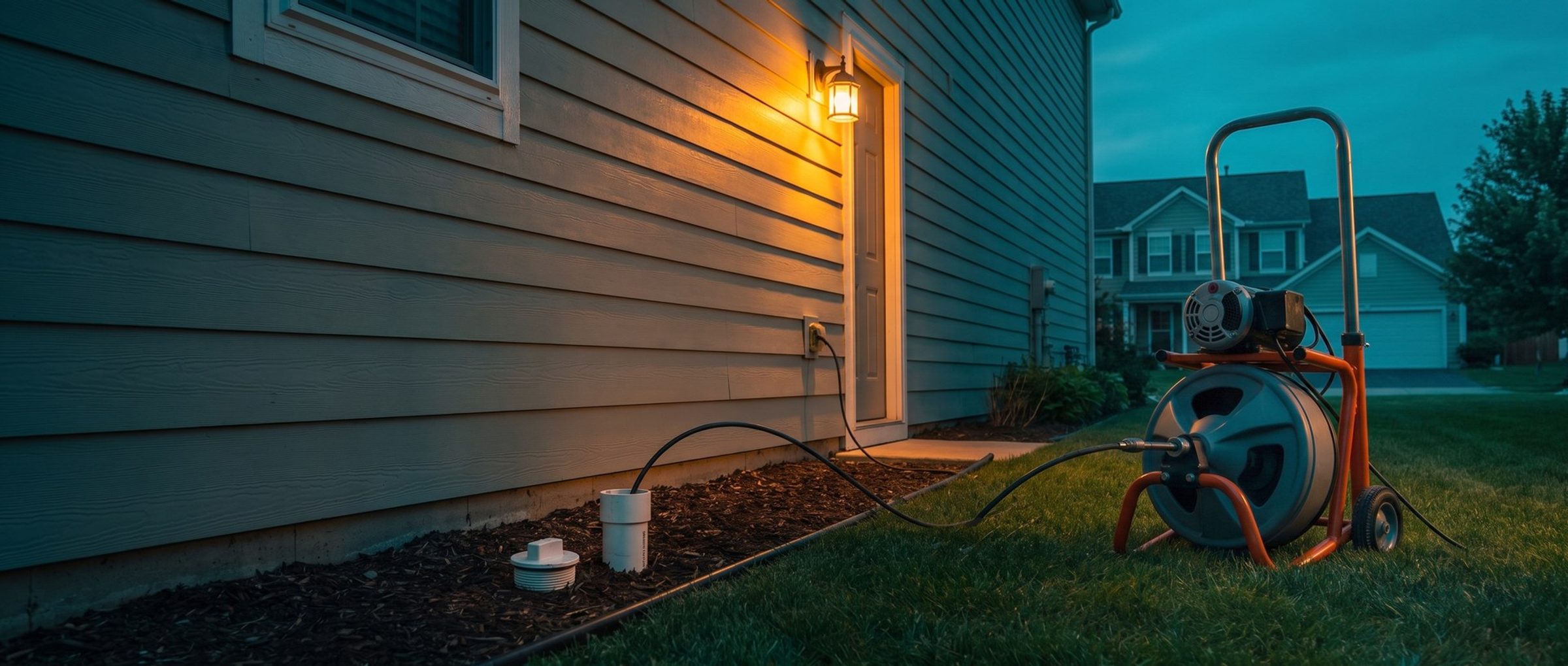
Ask a plumbing owner what a drain call is worth and most will quote the ticket: the drain special, maybe a camera inspection on top. Roto-Rooter's annual report gives a different answer, and it is the most useful number a plumbing company can borrow before setting a Google Ads budget.
Before a plumbing account sets a single bid, it needs a ceiling: the most one click can be worth to the shop. The honest answer starts with what a customer is worth, not with what the first visit costs.
Roto-Rooter's Biggest Revenue Line Is Excavation, and Its Filing Says Drain Calls Sell It
Roto-Rooter is owned by Chemed, a public company, so it reports its revenue by job type every year. In 2025, Roto-Rooter booked $937.9 million in gross revenue. The four largest lines:
- Excavation: $238.4 million
- Drain cleaning: $231.8 million
- Water restoration: $190.2 million
- Plumbing: $182.7 million
Excavation, the digging that comes with sewer line repairs and replacements, was the largest line of all. And Chemed's filing explains where it comes from: "Excavation and water restoration jobs are generally sold as a result of initial calls from customers regarding drain cleaning issues."
Read that again with your ad account in mind. The homeowner who calls about a slow kitchen drain is, often enough to show up in a national company's books, the start of a sewer job or a water cleanup worth many times the drain call.
One caution before you borrow it. These are one national company's books, with its own crews, equipment and sales process. The same filing ties those bigger jobs to plumbing calls as well as drain calls. Your shop's ratio will be different, and the only place to find it is your own invoices.
In One Vendor's Data, a Paying Plumbing Customer Cost About Twice What a Lead Did
The budget math for any service business is a chain of five numbers, and plumbing is no exception:
- Cost per click: the price of one tap on your plumbing ad.
- Conversion rate: out of every hundred taps, how many end in a call, a form or a booking.
- Cost per lead: the click price spread across the clicks it took to get one call or form.
- Close rate: the share of leads that become paying jobs.
- Cost per paying customer: cost per lead divided by close rate.
Start with clicks. In our example market, San Antonio, Keyword Planner estimates top-of-page bids for "plumber near me" between $24.64 and $105.83, for "drain cleaning near me" between $19.00 and $91.78, and for "emergency plumber near me" between $52.80 and $144.33. Your city will price differently, so pull your own before you set anything.
For the rest of the chain, the most useful published figures we found come from SearchLight, a company that tracks calls and revenue for home service contractors. Its data covered 524 plumbing companies running Google Ads from January through March 2026. On non-branded Search campaigns, the median cost per lead was $168. Drain and sewer leads ran $166. Water heater leads ran $256. The median cost per paying customer was $333.
Lead prices quoted for Local Services Ads, Google's pay-per-lead plumbing listings, look far lower. The same company put plumbing leads there at $57 in February 2026, and a related report put them at $69.26 in May. Those leads are bought differently, ranked differently and counted differently, so don't drop them into this chain as if they were Search leads. Chapter 12 covers them.
Those are vendor figures, not an industry census, and we label them that way. Our own arithmetic on them: the median paying customer cost about twice the median lead. Because the two medians come from different accounts, treat that as a rough ratio, not as anyone's actual close rate.
A $246 Drain Call Can't Carry a $333 Customer. The Sewer Line Behind It Can.
Now put job values next to that $333. Consumer cost guides, which are run by lead marketplaces and are rough by nature, put an average drain cleaning around $246. A tank water heater installed runs $600 to $3,100. Most homeowners who replace a sewer line spend about $3,319.
On the drain ticket alone, a drain campaign looks like a money pit. You pay $333 to win a customer who spends $246. An owner who runs that math once could reasonably cut the drain budget and pour it into water heater replacements.
That is the mistake Roto-Rooter's filing warns against. The drain call is the front door. Some of those homeowners need a camera inspection, and some of the camera inspections find a collapsed or root-filled sewer line. Judge the drain campaign by everything the drain calls eventually turn into, and it can be the best-performing campaign in the account.
This is why Chapter 1 insisted on sending the value of every completed job back to Google Ads, with the job tied to the click that started it. Without that, Google sees a $246 conversion and a $3,319 conversion as the same thing, and so do you.
Here is what that looks like with numbers. These are example inputs, so swap in your own. Say your drain leads cost $166, SearchLight's median for drain and sewer, and half of them turn into paying jobs. Each paying drain customer then costs you $332.
Now say your invoices show those drain customers paying you $700 on average over the following year, counting the camera inspections and the occasional sewer repair, and you keep 40 cents of each dollar after labor, parts and truck costs. Each customer leaves you $280. You paid $332 to get them, so the campaign loses money.
Change one input. If those same customers pay you $1,200 on average because a few of them needed a new sewer line, each one leaves $480 after costs. Now every paying customer clears $148 more than it cost to win. Same clicks, same leads, same crew. The only thing that changed is how much of the customer's value you counted.
Here is how to set your own ceiling. Pull last year's invoices for customers whose first job was a drain call. Add up everything those customers paid you: the drain call, the camera inspection, the sewer repair, the water heater they called you about six months later. Divide by the number of customers. That average is what a drain customer is worth to your shop, and it is the number your cost per paying customer has to stay under, with room left for your margin.
The Phone Decides the Close Rate Before the Plumber Ever Arrives
Close rate is the number plumbing owners control most directly, and the reviews show where it leaks. We read every one of the 210 low-star reviews about plumbing jobs from 18 listings in the example market. Thirty-two describe a company that never called back, never sent a quote or went silent. Twenty-three describe a no-show or a canceled appointment. Eighteen are about the office itself: the phone, the dispatcher, the answering service.
Every one of those started as a lead someone paid for. A missed call, a voicemail nobody returns until Monday, a quote that never goes out: each turns a lead you already bought into a lead you threw away.
The vendor data points the same direction. ServiceTitan, the field-service software many plumbing shops run on, reported in its June 2022 numbers that plumbing shops booked about 43% of their calls on average. If your shop books a third of its calls instead of half, every paying customer costs you half again as much, before you change a single bid.
Google's own Local Services Ads say the same thing in policy language. Its help page on how those ads rank lists responsiveness as a factor and warns that "missed calls may negatively affect your responsiveness." Google is grading your phone too.
After-hours calls are where most plumbing shops leak. A burst pipe at 9 p.m. doesn't wait for the office to open, and a homeowner who reaches voicemail can simply call the next plumber in the results. Fourteen of the low-star reviews describe exactly that kind of emergency going unanswered. If nobody answers after hours, either route the calls to someone who will or schedule the ads to stop when the phones do. Chapter 9 and Chapter 14 come back to both.
That makes the phone part of your ad budget. Before you raise bids to get more leads, check how many of the leads you already have are reaching a person who books them.
A Plan Member Is a Plumbing Customer You Don't Have to Buy Twice
A customer's value doesn't stop at the first invoice. Across the 794 example-market reviews, 32 talk about a customer who keeps calling the same plumber back, and 10 credit a referral. Those are keyword counts, so treat them as a floor. A plumber who fixes the water heater well is the plumber who gets the call when the sewer backs up, and the one the neighbor hears about.
Maintenance plans make that repeat value explicit. Eight of the 12 example plumbing sites we checked sell a plan or membership, and seven publish a price, from $12.95 to $29.99 a month across their tiers. A member paying even the lowest of those monthly prices is a customer who stays on the books between emergencies, and whose next call doesn't need an ad to find you.
Reviews earn money a second way, inside the ads themselves. Stars sell plumbing ads: 203 of the 446 San Antonio plumbing ads we read put a rating or a review tally in front of the searcher. Today's five-star drain customer ends up printed in tomorrow's ad, right where a stranger with a backed-up sink decides whom to call.
Put those into your customer value number: repeat jobs, plan revenue, referrals. Each one raises what you can afford to pay for the first click.
One more thing decides how many of those clicks become customers: where the click lands. A drain click should land on a page about drain cleaning, not on your home page with a hero photo of a water heater. Chapter 4 builds that match.
If you would rather have someone run this math against your own invoices and set the account up around it, that is the work our Google Ads management team does.
Next: Ad Rank Grades the Page Behind the Ad
The ceiling on a plumbing click is set. Chapter 4 explains how Google decides what you actually pay and where your ad shows, and why the page behind a plumbing ad matters as much as the bid.
This chapter is part of Google Ads for Plumbers, our sixteen-chapter guide for plumbing companies anywhere in the US.