
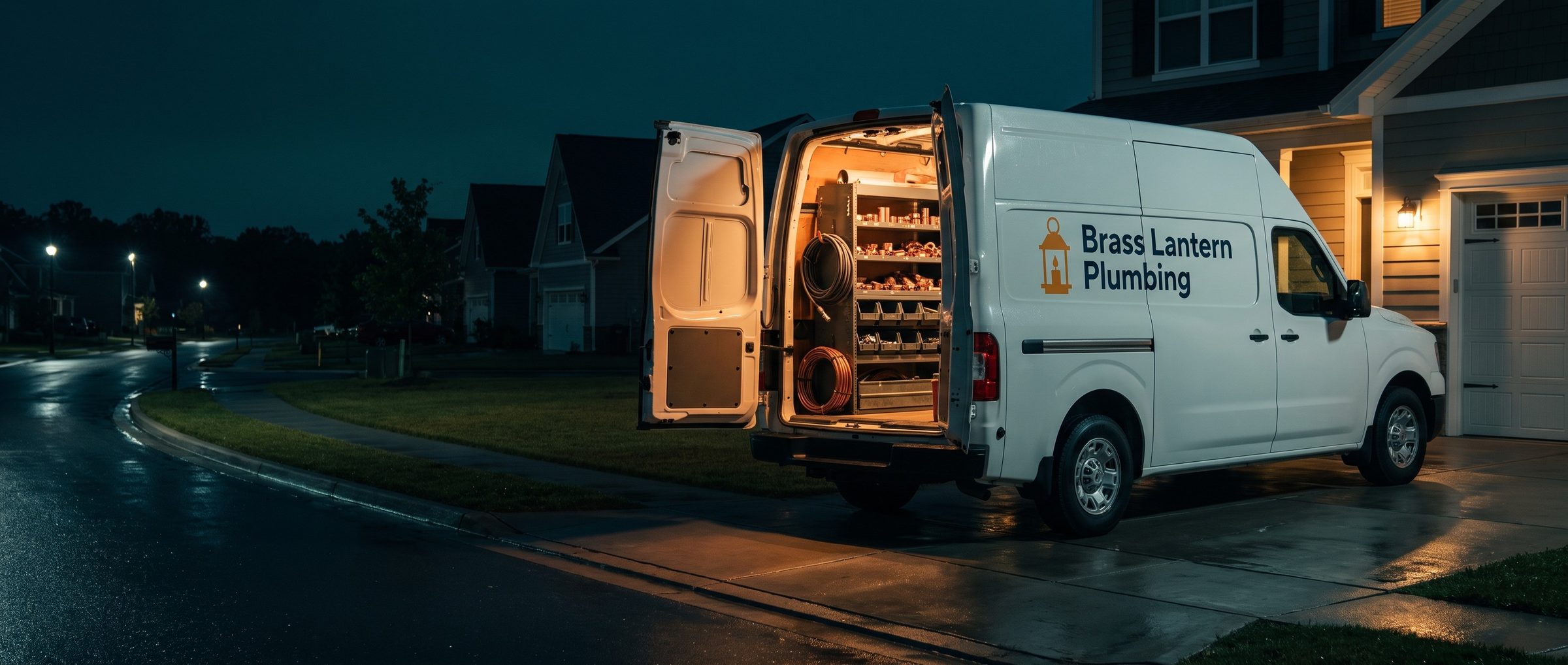
A pipe lets go under the kitchen sink at 10:40 on a Saturday night. The homeowner searches "emergency plumber," taps the first ad that says 24/7 and calls. Whoever answers is about to be asked two questions before anything else: can you come tonight, and what's it going to cost me just to walk in the door?
Most plumbing ads answer the first question loudly and the second one not at all. Google has a rule about that second question, and it's stricter than most plumbers realize. This chapter covers the rule, what our example market's websites actually say, and how to run emergency ads so the fee, the hours and the phone all match the promise.
Google Says an Emergency Plumber Must Show the Call-Out Fee in the Ad or on the Page
Google's advertising policy on dishonest pricing practices has a note written for businesses like yours. Urgent, on-site services with variable pricing, "like emergency repairs," must "clearly and prominently disclose in their ads or on their landing pages all applicable fees, such as call-out charges, emergency hour surcharges, and whether their estimates are binding."
That's three separate disclosures, and a plumber running emergency ads owes all of them:
- The call-out charge. Whatever you charge to show up, whether you call it a trip fee, a dispatch fee, a service call or a diagnostic fee.
- The emergency hour surcharge. If a 2 a.m. call costs more than a 2 p.m. call, the difference.
- Whether the estimate is binding. If the price you quote on site can change once the wall is open, say so.
So the fee can sit in the ad, on the page or both. Leaving it out isn't one of the options. "Fees may apply" in small type at the bottom of the page isn't clear or prominent, and it doesn't disclose a fee. It admits one exists.
8 of 12 Plumbing Sites We Read Didn't Put a Number on the Fee. 11 of 12 Promise 24/7.
In our example market, San Antonio, we read the websites of 12 plumbing and multi-trade companies, looking for the three things Google names. Here's what the fee looked like:
- 3 of 12 publish a fee amount. One lists a $79 service call, one an $89 residential and $150 commercial service fee, and one shows $100, $60 and $69 on different pages.
- 1 says the visit and the estimate are free.
- 6 mention a fee without the amount. A dispatch fee waived if you hire them, a service call fee excluded from a coupon, a trip charge named with no number beside it.
- 2 say nothing about a fee at all.
So 8 of the 12 leave a homeowner guessing. Now the hours. 11 of the 12 promise 24/7 or around-the-clock service somewhere on the site. None of the 12 states an after-hours surcharge amount. Six hint at one without a number: "additional charges may apply," a weekend "higher fee," coupons that aren't valid after hours, a membership perk that waives after-hours rates without saying what they are. One site promises emergency calls "around the clock" while its footer posts hours of 8 to 6.
The cleanest disclosure in the sample came from the biggest brand. Roto-Rooter's page for the example market says "No hidden or extra charge for plumbing or drain service on holidays, nights, and weekends." That's an emergency hour surcharge disclosed as zero, in plain words, where a homeowner will see it.
The reviews show why this matters. We hand-coded 210 low-star Google reviews of plumbing jobs in the example market. 21 of them are complaints about the fee to come out, and the amounts reviewers name run from $29 to $487. Six more say they couldn't get a price on the phone at all. Two complain about an after-hours or weekend fee. The shape of the complaint is almost always the same: the number showed up after the homeowner had already said yes.
One reviewer was told on the phone that the plumber couldn't give a price "but could come out and charge me an $89 service fee to then determine what the charge would be." Another put it more sharply: "What's the point of having flat fees if you won't share them until after I agree to pay to have you come out?" A third was told on the phone that a technician would check the water heater "for 19.99," then "gave me a price of 94.95 before touching the water heater!"
The fix is short. Put the number where the homeowner reads it before calling:
- In the ad. A callout asset like "$89 Service Call" or "Night Calls, Day Prices" fits in Google's 25-character callout limit. Use the second one only if it's true.
- On the emergency landing page, near the top. The call-out charge, the night and weekend surcharge (or a plain "nights cost the same," if that's your policy), and one plain sentence on whether the price you quote on site is final.
- On the phone. Whoever answers says the same number the page says. Chapter 8 covered pricing in your regular ads; the emergency call is where a missing number costs the most.
Emergency Searches Get Their Own Campaign, Budget and Hours
An emergency search is the most expensive click in a plumbing account. Chapter 7 found "emergency plumber near me" topping out at $144.33 a click in the example market, the most of any plumbing search it priced. A click that expensive shouldn't share a budget with drain cleaning, where a slow morning can let emergency clicks eat the day's money before the routine calls come in.
So emergency searches get a campaign of their own, built the same way as Isolation: exact match keywords, a bid a person sets, and one job group. Chapter 5 already put the emergency searches in their own ad group ("emergency plumber," "emergency plumber near me," "24 hour plumber"). Moving that group into its own campaign gives it three things an ad group can't have:
- Its own budget. Emergency spend can't crowd out the drain and water heater campaigns, and they can't starve it on the night a freeze hits.
- Its own schedule. Chapter 9 matched Isolation's schedule to office hours. The emergency campaign runs during the hours someone can actually dispatch a truck, which may be every hour, or may be until 10 p.m. and all weekend. Google lets you add bid adjustments by day and time, so if night calls book well, raise the night bid. If they don't book, lower it or switch the night off.
- Its own landing page. Not the home page. A page that says emergency service, gives the fee and the surcharge, gives an arrival window you actually keep, and puts the phone number that rings the on-call technician at the top.
Measure it on booked jobs, like everything else. An emergency campaign with a high cost per click can still be the cheapest job source in the account if the calls book. It can also be the most expensive one if the calls reach voicemail.
An Emergency Ad That Rings an Empty Phone Buys a Bad Review
The reviews in our example market are blunt about this. Of the 210 low-star plumbing reviews, 14 describe an emergency that wasn't served, 18 were written by someone without water or hot water, and 18 blame the office, the dispatcher or an answering service. Two call out the 24/7 promise directly. "Advertises 24/7 service, only has plumber available from 8am-8pm," one wrote. Another: "We had a pipe break in the night and this place said they provided 24 hour service. We called and they said they could not come until 8 am."
The other side shows up in the reviews too. "He came out at 11pm for an emergency call to stop a water leak then back out the next morning with parts to finish the repair," one Roto-Rooter customer wrote. And from a small shop, Bolin Plumbing: "Had to make an emergency call on a Saturday, they called back w/in 30 minutes and their on-call technician was here within approximately an hour."
That leaves three honest options for every hour the emergency campaign might run:
- Answer it. A dispatcher or an on-call technician who can say the fee and give an arrival time.
- Route it. A plumbing answering service can cover the night, but only if it can do more than take a message. Reviewers notice the difference: "every time you call they take your name, address, number," one wrote, about an emergency call that went through three plumbers and several hours. If the answering service can't reach the on-call tech and confirm a time, the homeowner is still waiting.
- Switch it off. Schedule the campaign off for the hours nobody can dispatch. Losing the night is cheaper than paying for the click and the review.
Local Services Ads follow the same logic, with a billing twist. Google's help page on how Local Services leads work lists the leads it won't credit, and the first one is "A valid lead was received outside of your business hours." Short listed hours don't protect you from paying for a night lead, and listing "Open 24 hours" without someone to answer means paying for calls that go nowhere. Chapter 12 found all eight Local Services slots in our example market showing "Open 24 hours." If you test Local Services, the hours you list are a promise to answer, the same as the ad.
Plumbing companies setting up a separate emergency campaign, with the fee on the page and the schedule matched to who answers, can see how our Google Ads management team builds one.
Next: Water Heaters Show Up in More Plumbing Reviews Than Any Other Job
Water heaters are the biggest service line in our example market's reviews, and the job where repair-or-replace decides the bill. Chapter 15 covers water heater ads, from the leaking tank at midnight to the planned replacement.
This chapter is part of Google Ads for Plumbers, our sixteen-chapter guide for plumbing companies anywhere in the US.