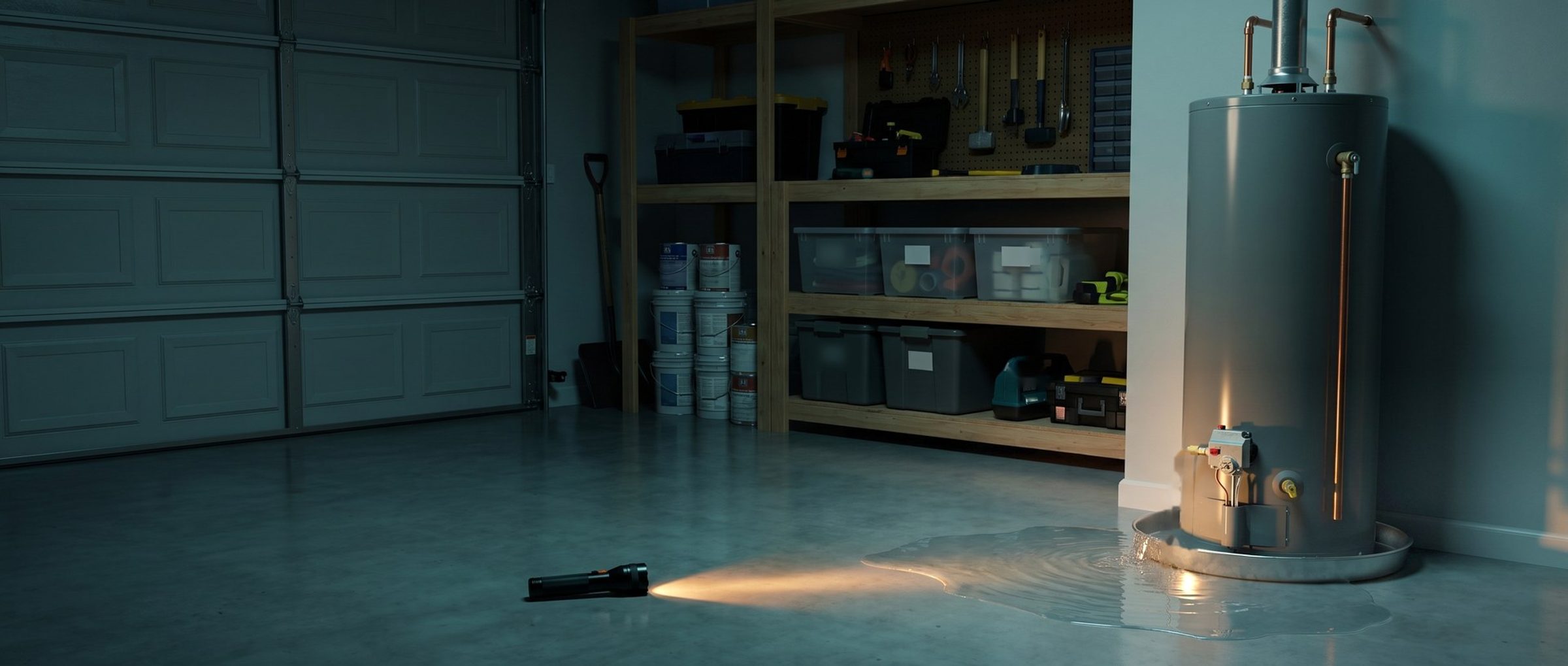
It is Saturday, a little after eight, and two homeowners reach for their phones. One finds a puddle spreading out from under the water heater and types "water heater leaking." The other has listened to the upstairs toilet hiss for a week and finally types "toilet keeps running." Both have a plumbing problem. Only one of them needs a plumber before lunch.
Google Ads can tell those two people apart better than most plumbing companies give it credit for. Advertisers bidding on "water heater leaking" have pushed its top-of-page bids as high as $60.00 a click in the US. The ceiling for "toilet keeps running" is $8.61. That gap is the whole lesson of this chapter: a new plumbing account should start spending where the problem can't wait, and work backward from there.
This is the order we build every account in, and it runs against most marketing instinct. Traditional advertising starts at the top, making people aware and hoping they remember you later. A new Google Ads account starts at the bottom, with the searches closest to a booked job, because those are the conversions that teach Google what a customer looks like (Chapter 1 set up the counting). The growth comes later, as the account works its way back up.
Plumbing Searches Start at a High Water Bill. Only the Last Two Stages Ask for a Plumber.
Marketers describe five stages a customer passes through on the way to buying. Plumbing has its own searches for each one. The figures that follow are searches per month across the US, from a Keyword Planner pull we ran for this guide.
Unaware. The homeowner doesn't know there's a problem yet, only a symptom of one. "Why is my water bill so high" gets 1,600 searches a month. Many of those people have a leak they haven't found. The marketing goal here is simply to be noticed.
Problem aware. Now they can see it. "Water heater leaking" gets 14,800 searches, "toilet keeps running" 9,900, "low water pressure in house" 5,400 and "sewer smell in house" 3,600. The goal is to earn their interest by explaining what's going on.
Solution aware. They know what fixes it and want to know what it costs. "Water heater replacement cost" draws 40,500 searches a month, "tankless vs tank water heater" 9,900 and "sewer line replacement cost" 4,400. The goal is to influence the decision they are already weighing.
Service aware. They have decided to hire someone. "Plumber near me" gets 823,000 searches a month, "emergency plumber near me" 110,000, and "water heater repair near me" and "drain cleaning near me" 90,500 each. The goal is the phone call.
Most aware. They know whom they want and type the name. "Roto rooter" draws 135,000 searches a month and "benjamin franklin plumbing" 27,100. For your own company, these are the cheapest, warmest clicks you will buy. Rivals' names are a different story, and Chapter 5 explains why they belong on your negative list rather than in a new account.
In our example market, San Antonio, the volumes are a fraction of those national figures: "plumber near me" runs about 6,600 a month and "emergency plumber near me" 880. Your own city's numbers will be different again. The order of the stages won't.
A Leaking Water Heater Can't Wait. A Running Toilet Can, and the Bids Show It.
Two searches can sit in the same stage and still belong to completely different customers. That is plumbing's twist on the funnel, and the bids make it obvious.
On "water heater leaking," the planner's top-of-page estimate runs from $11.87 up to $60.00. "Toilet keeps running" sits at $0.02 to $8.61. "How to fix a running toilet," with 14,800 searches a month, runs from two cents to five. "How to unclog a toilet," at 74,000 searches, tops out at $1.65.
Those ranges are Keyword Planner's estimates, and they are loose. Google builds them from broad match data, so treat them as a weather vane, not a price list. But a weather vane is enough here. Advertisers bid where clicks turn into paid jobs, and they don't bid much where they don't.
The reasons aren't mysterious. A leaking tank means water on the floor, no hot water, and a homeowner who wants it handled today. A running toilet is usually a worn part in the tank and a how-to video. Some homeowners skip the plumber altogether: in the 210 low-star reviews of plumbing jobs we read from the example market, 16 customers mention doing the job themselves after the plumber left. Google's own results page reflects the same instinct. On 8 of the 23 example-market plumbing searches we checked, the "People also ask" box carried a do-it-yourself question.
None of this means a problem-stage search is worthless. "Water heater leaking" behaves like a hiring search wearing a symptom's clothes, and it belongs near the front of the line. The rule for a new account is to sort problem searches by urgency, not by stage label. The same Keyword Planner pull makes the sorting easy, because the urgent ones carry service-level bids:
- "Burst pipe repair": 1,600 searches a month, top-of-page bids up to $80.00
- "Burst pipe": 2,400 a month, up to $65.00
- "Sewage backing up into tub": 390 a month, up to $54.96
- "Slab leak": 3,600 a month, up to $51.80
- "Water heater not working": 1,900 a month, up to $46.23
- "No hot water": 4,400 a month, up to $36.59
Those belong in the first campaign next to the "near me" searches. Slow drips, running toilets and low water pressure wait. Their bids show how little the advertisers already in that auction will pay for them.
Seasons move the line too. "Frozen pipes" gets 8,100 searches a month on average, but our seasonality pull for this guide found 40,500 in January against about 1,000 in June and July. A plumber in a cold-winter state who leaves that search off the January list misses the month when it runs five times its yearly average.
823,000 Searches a Month Already Want a Plumber. A New Account Starts There.
"Plumber near me" alone gets 823,000 searches a month in the US. Add "emergency plumber near me" at 110,000 and the service-specific "near me" searches, and the bottom of the plumbing funnel is not a thin trickle. It is the deepest part of the pipe.
That is where a new account spends its first dollars. The first campaign in this guide, which we call Isolation (BrandRocket's name, not a Google setting), runs exact match on searches like these, with a person setting each bid. They sit closest to a booked job, so the account collects real bookings soonest, and every booking teaches Google's bidding a little more about what a plumbing customer looks like.
Once Search is booking jobs steadily, the account works its way up: cost-research searches like "water heater replacement cost," then campaign types that reach homeowners before they search at all. That order is the counterintuitive part of this method. The scaling happens on the way up the funnel, not at the start.
The usual pace looks like this. Isolation and the brand campaign launch in month one. Exploration comes next, usually in month two or three. That is our label for a broad match campaign that goes looking for the plumbing searches no one would have written down in advance. Performance Max typically arrives around months six or seven. Those months are the common pace, not the rule. What actually opens each door is volume: we want 30 or more quality conversions a month first. A busy shop with a healthy budget reaches that early. A slow one takes longer, and that is fine.
Skipping the order is how plumbing budgets disappear. An account that opens with broad cost-research searches pays for thousands of people pricing a tankless heater they may buy next year, while the homeowner with sewage in the tub calls whoever showed up first.
There is one exception. A company with a large budget can afford to run more than one stage at once, paying to be known early while the bottom of the funnel pays the bills. Most plumbing shops starting out don't have that luxury, and they shouldn't spend as if they do.
Search Answers Today's Burst Pipe. YouTube Reaches the Homeowner Whose Pipe Hasn't Burst Yet.
Each Google channel is built for a different moment.
Search answers people who are typing, which makes it the home of the service-aware stage and the urgent problems. Search also holds the brand campaign, which catches people typing your company's name, kept apart from everything else. Search goes first.
Performance Max is one campaign that Google steers toward your goal across nearly everything it sells: the search results, YouTube, Gmail, Maps and its display and discovery feeds. It spreads across several stages at once and leans on conversion data to know where to spend, so it comes after Search has produced plenty of it. Chapter 10 covers when.
Demand Gen runs video and image ads where homeowners scroll rather than search, on YouTube, in Gmail and across Google's other feeds. That fits the unaware and problem-aware stages: the homeowner whose water heater is twelve years old and hasn't failed yet. Chapter 11 covers it.
Local Services Ads charge per lead rather than per click and carry Google's verification badge. They target the hiring stage too. In this guide they come later, as a test that runs alongside Search once Search is already booking jobs. Chapter 12 explains why.
Think of it as stocking the truck. You don't load the trailer with tankless units before you have the fittings for Monday's service calls. You start with what gets used today, and you add inventory as the work justifies it.
Plumbing shops that would rather hand off the stocking can see how our Google Ads management works.
Next: A $99 Drain Call Can Be Worth Far More Than $99
Knowing which searches to buy is half the budget question. The other half is the price ceiling: what one click can be worth to a plumbing company. Chapter 3 shows how a plumbing company works out what a click can cost, starting from the value of the customer behind it rather than the price of the first job.
This chapter is part of Google Ads for Plumbers, our sixteen-chapter guide for plumbing companies anywhere in the US.