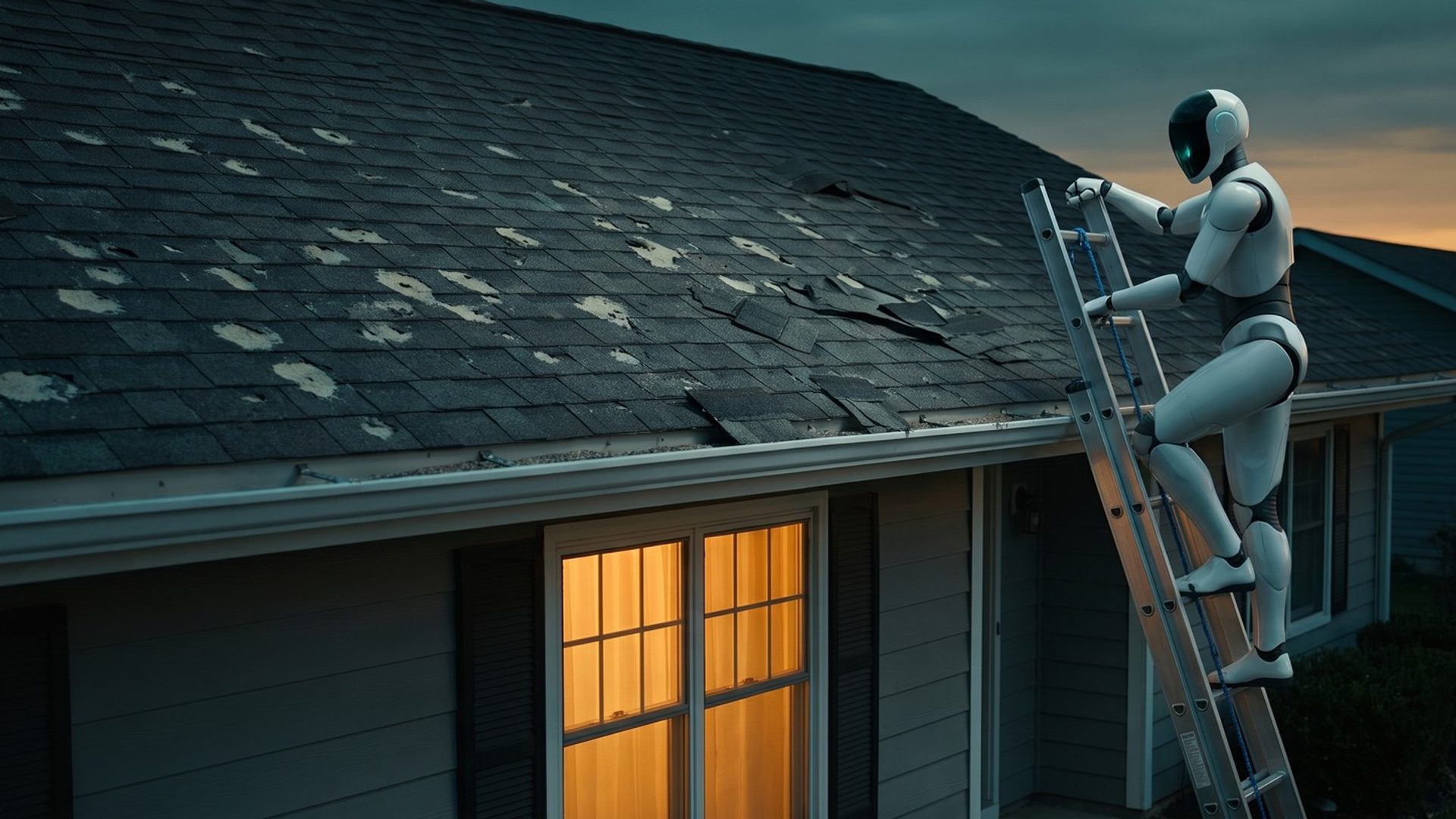
Plenty of roofing companies have a line somewhere on their website that the owner wouldn't say out loud to a state attorney general. Maybe it sits on a storm page written three hail seasons ago: "We work directly with your insurance company." "We'll fight your adjuster for you." "Ask about our deductible assistance."
Most homeowners never find that page. AI Max can. Google's newest Search feature writes ad text from your website, and it doesn't know which lines were written by a careful owner and which ones were pasted in by a storm-season salesperson. For a roofer, that's not a style problem. In several states, the promises roofers are most tempted to make are illegal to advertise.
This chapter covers when AI Max earns its place in a roofing account, and how to fence it so it never says what you can't.
AI Max Is Broad Match for Roofers With a New Name, So It Comes Last
Start with what AI Max actually is. It isn't a new campaign type. Google's help page describes it as a set of features you switch on inside an existing Search campaign, and the main one is search term matching, which uses broad match and what Google calls keywordless technology to find searches you didn't list. Google has also folded the old broad match campaign setting into AI Max.
In other words, AI Max is broad match for roofers with a new name and a few extra powers. That's why our method puts it at the very end of the rollout. Chapter 6 explained the order: exact match first, broad match once the account books about 30 roofing leads a month. AI Max waits even longer, until the Exploration campaign has proven that Google's bidding knows what a booked inspection looks like. Google's setup page ties the matching and the ad-writing to bidding that learns from conversions, which a young roofing account hasn't built yet. Without that history, AI Max is guessing on a much bigger scale.
That's also why Chapter 9 switched it off when the campaigns were built. Every new roofing Search campaign arrives with AI Max already checked, and in our method that box stays empty until the booked inspections say otherwise.
AI Max Can Turn an Old Line on a Roofer's Website Into Tomorrow's Ad
The part of AI Max that worries us most for roofers is text customization. It writes fresh headlines and descriptions by reading your site, the pages your ads point to, the ads you already run and the keywords in the ad group.
For most businesses that's a convenience. For a roofer it's a liability, because roofing websites tend to collect claims over the years. A storm page from a busy hail season. An FAQ someone wrote in a hurry. A blog post promising to "take care of the insurance side." Text customization can pull any of it into an ad, and the homeowner who reads the ad has no idea whether you'd stand behind it today.
Before switching it on, walk your roofing site page by page as if you were the machine looking for ad copy. Every page, including the ones nobody has opened in years. Anything you wouldn't want in an ad has to come off the site, not just out of the ads.
Four States Ban Advertising the Deductible Deal Storm Roofers Love to Promise
After a hailstorm, the pitch that moves homeowners fastest is the one about money: we'll cover your deductible, your new roof won't cost you a thing, we'll handle the insurance company. Several states have made that pitch illegal to advertise. Four examples, each read at the state's own statute:
- Texas (Business and Commerce Code 27.02) makes it an offense to advertise or promise to pay, waive or rebate a homeowner's insurance deductible on a job paid from a property insurance claim, without the insurer's consent.
- Colorado (C.R.S. 6-22-105) says a roofing contractor paid from insurance proceeds shall not advertise or promise to pay, waive or rebate any part of the deductible. It also bars roofers from claiming to be, or acting as, a public insurance adjuster.
- Minnesota (Minn. Stat. 325E.66), home of our example market, bars contractors paid from insurance from advertising or promising to pay the deductible, and from offering homeowners compensation for things like letting the contractor inspect the property or filing a claim.
- Florida (F.S. 489.147) bars offering a waived deductible, a gift card, cash or anything else of value in exchange for a roof inspection or an insurance claim. It also restricts advertising that encourages homeowners to call about a roof insurance claim unless it carries specific disclosures.
These are examples, not a complete list. Other states have similar laws, Florida alone has rewritten its roofing statute several times lately, and everything here is our reading of the statutes for a roofing guide. It isn't legal advice. Have your own counsel review your ads and pages for every state you work in.
There's a safe line in Colorado's statute worth knowing. It says nothing in the public-adjuster ban stops a roofer from discussing the scope of repairs with the insurer on the homeowner's behalf, once there's a valid contract. "We'll meet your adjuster to go over the damage" describes real, legal help. "We'll handle your claim" and "we'll get you a free roof" are the lines that get roofers in trouble.
A "Free Roof Through Insurance" Ad Can Break Google's Rules Before Any State Steps In
Google's own ad policies point the same direction, even in states without a roofing law. Its misrepresentation policy covers several things a storm-season roofing ad can trip over:
- Unreliable claims. Google's policy rejects ads that sell an unlikely outcome as the normal one. No Google policy page names roofing or a "free roof," so this part is our interpretation: "Get a free roof through insurance" presents a covered claim, which the insurer decides, as the expected result.
- Unavailable offers. An offer in the ad has to be easy to find on the landing page. If the ad says "free inspection," the page has to say it too.
- Implied affiliation. Google treats making it seem you're affiliated with a brand, organization or government entity when you're not as one of its most serious violations, and it says accounts can be suspended without warning. "Insurance-approved contractor" or anything implying FEMA backing falls here if the relationship doesn't exist.
- Disaster photos. Google's clickbait rules name real-life accident or disaster photos used to push a sale. A tree through a neighbor's roof in an image ad is a risk. Your own inspection photos of hail hits are a different thing, but test them before scaling.
When AI Max writes the ad, it still runs under your name and your account. Policy doesn't care that a machine wrote the line.
A Roofer Can Ban 25 Words From AI Max's Ads, and "Deductible" Goes First
Say the test earns AI Max a spot. Only after that test do the guardrails go up, and Google's version of them is still a beta:
- Term exclusions (part of what Google calls text guidelines): a banned list, 25 entries at most, that no machine-written roofing headline or description may use. Capital letters don't matter, but an English exclusion won't catch the Spanish version of the word.
- Messaging restrictions: as many as 40 rules written in plain English, covering ideas and tone the generated ads must stay away from. Google says they work best with an example, like "Avoid mention of any prices, e.g. $45/night or $4,567."
One detail matters for roofers who quote prices carefully. Google says a "{{BODY}}quot; term exclusion won't stop generated assets that mention prices. Google points to one exact rule for prices instead: "Don't generate assets with prices."
A starting fence for a roofing campaign:
- Term exclusions: deductible, free roof, no cost, $0, insurance approved, FEMA, adjuster, claim guaranteed
- Messaging restrictions: "Don't promise to pay, waive or cover an insurance deductible, e.g. 'We cover your deductible.'" "Don't say we handle or file insurance claims, e.g. 'We handle your claim.'" "Don't generate assets with prices." "Don't claim government or insurer approval, e.g. 'FEMA approved.'"
A fence isn't a guarantee. Google itself warns the feature is an experiment and has limits. Read what AI Max actually generated in the first weeks, and remove anything that crosses a line. Then add the phrase that slipped through to the fence.
AI Max Buys Searches a Roofer Never Listed. Brand and Location Controls Are the Fence.
Search term matching is the reach half of AI Max, and it needs its own controls. Google's help page lists them:
- Brand settings. Brand inclusions and exclusions decide which brands your ads can be associated with. A roofer can keep AI Max from chasing searches for a shingle manufacturer or a competitor's name.
- Locations of interest. An ad group-level control that reaches people based on the location in their search, even in keywordless matches. Set it to your real service area, the same towns from Chapter 9.
- URL exclusions. If Final URL expansion is on, fence the careers page, the blog and the old storm pages exactly as Chapter 10 did for Performance Max.
Keep the negative keyword list you've been building since Chapter 5 on the campaign, and add every junk search AI Max finds to it.
AI Max Has to Win One Roofing Campaign Before It Gets the Whole Account
Flipping AI Max on for every roofing campaign at once is how a bad week becomes a bad month. Our method tests it on one campaign first, using Google's AI Max experiment. Google's help page says it diverts part of the campaign's traffic and budget to AI Max inside the existing campaign, instead of building a copy, so you can compare the two.
Pick a campaign with steady volume, like the roof replacement campaign, not the hail campaign that swings with the weather. Give it long enough to cover a few weeks of real leads, and judge it the way you judge everything else in this guide: booked inspections and signed roofs, not clicks.
While it runs, read the search terms report every morning, the same habit Chapter 6 built for broad match. Google's help page says AI Max searches show up there with their own "AI Max" match type, along with the headline and landing page each one used. That's where you'll see a gutter-cleaning search or an insurance-claim question before it eats a week of budget.
If AI Max beats the control on booked inspections at a cost you can live with, expand it one campaign at a time. If it doesn't, turn it off. Nothing in this guide depends on it.
Next: Insurance Jobs vs Cash Jobs
The deductible laws in this chapter point at a bigger truth: an insurance job and a cash job are two different businesses. Different keywords, different pages, different promises, different time to get paid. Chapter 14 covers how to split them in the account so each one is judged on its own numbers.
The full guide is on the roofers guide home, and when a roofing company wants someone else fencing AI Max before it runs, that's part of our Google Ads management.