
Most local businesses lean on their star rating. A restaurant, a dentist or a roofer with 4.8 stars puts it in the ad, on the map and on the website. A private K-12 school can't. Google stopped showing reviews on K-12 school profiles, so a parent comparing three private schools on Google Maps sees no stars at all.
This chapter covers who lost reviews and who kept them, how a school's Business Profile feeds its ads anyway, why the schools that do have reviews should answer them, and why the campus visit has to carry the weight that stars carry for everyone else.
Google Removed Reviews From K-12 School Profiles. Colleges, Trade Schools and Day Cares Kept Theirs.
Google's Business Profile help page states the rule directly: "reviews and ratings will be removed and disabled for Google Business Profiles primarily categorized as educational institutions for students aged 6 to 18." It also names who isn't affected: schools that don't offer general education to children aged 6 to 18, with universities, day care centers and swim schools as its examples. Google's page doesn't give a date for the change.
Two details matter. The rule follows the profile's primary category, the main label the school picked for itself. And it's about general education for school-age children, so a preschool listed as a day care, a community college, a beauty school and a CDL school all keep their reviews.
Our twelve example schools in the Salt Lake City market show the line clearly. The three private K-12 schools, listed as "Private educational institution" or "High school," show no rating and no reviews. The other nine all show stars:
- Colleges: 4.5 from 274 reviews at the private college, 4.5 from 1,747 at the public university, 4.2 from 768 at the community college.
- Trade schools: 4.6 at both technical college campuses, 4.8 from 2,504 at the beauty school, 4.6 from 140 at the CDL school.
- Online programs: 4.7 from 2,225 at the online career school, 3.4 from 571 at the online university's local listing and 3.2 from 70 at the online nursing college.
Early-education centers sit near the line. Google names day care centers as unaffected, so a preschool or child care center whose primary category is day care keeps its reviews. A school that runs both a preschool and a K-8 program on one profile should check how that profile is categorized, because the primary category decides which side of the rule it falls on.
For a private K-12 school, that means no stars to put in an ad and none on the map. Parents still read reviews; they just read them somewhere else. As Chapter 8 found, Niche was the only review source for the three private schools in our example market, and parents trade opinions on Reddit and in local parent groups.
Linking a School's Business Profile Adds Its Address and a Directions Button to Its Ads. Do It Before Launch.
A school's Business Profile does more than sit on Google Maps. Linked to the Google Ads account, it supplies location assets: the address, distance and a directions link shown with the school's ads. Google's location assets page describes linking a Google Ads account to a Business Profile and showing the profile's locations in the ads. If a location is marked closed in the profile, its location asset stops showing.
We saw both sides in the example market. One private K-12 school ran location-style ads whose templates carried slots for a rating, a category and open hours; with no reviews on its profile, the rating slot has nothing to fill. The beauty school, which has reviews, showed its "4.8" rating and review count in its ads.
Schools with more than one campus need a profile for each. The technical college in our example market has two campus listings, each with its own rating, address and phone. Link them all, so an ad shown to a family in one town shows the campus in that town, not the one across the valley.
The profile also produces a kind of conversion. Google counts "local actions" when someone taps the Call or Directions button for a business location, whether in the ad or later on the school's Business Profile after an ad interaction. A parent who taps Directions to the school on a Saturday morning may well be headed to an open house. Track these, and watch them by campus. But keep the bidding on the quality inquiry (Chapter 7). A directions tap is a strong sign, not an inquiry admissions can follow up on.
Before launch, check the profile itself:
- Primary category. The label that decides how Google treats the school, reviews included. Pick the one that honestly describes it.
- Hours. Office hours a parent can call, not just bell times.
- A tour link. The page where a family books a visit, from the profile's website or appointment field.
- Photos. Real classrooms with classes in session, the front entrance a family will walk through and the parking lot they'll use.
Our Three Example Colleges Answered None of Their Google Reviews. The CDL School Answered 40 of 41.
For schools that keep their reviews, the reviews travel with the ad. In our example market, the beauty school's ads showed its 4.8 rating and review count, and prospective students read what's behind a number like that.
Some read the bad ones first. In the reviews we read, one reviewer told applicants to do exactly that: "Please pay close attention to the negative reviews before submitting your application," one 1-star reviewer wrote. Others said the opposite, "Do not let the bad reviews stop you from getting your degree." Either way, the reviews are being read closely.
So the replies matter. We sampled the owner replies on each example school's Google listing. The CDL school had replied to 40 of the 41 reviews we sampled. The private college, the public university and the community college listings had replied to none of the 43, 52 and 81 we sampled.
Google's own advice is simple: replying to reviews shows customers you value their feedback, and you need a verified profile to reply. For a school, the reply is also the one public place to answer the most common complaint in our reading. In the 826 reviews we read, admissions and enrollment communication drew the most complaints, 136 of them, often about calls and emails that went unreturned. A short, specific reply that names an office and a phone number answers the reviewer and the next prospective student reading it.
A good reply is short and specific. For a made-up community college, answering a review that says nobody returned calls about financial aid:
"Thank you for telling us. That's not the experience we want for anyone applying. Our financial aid office answers calls weekdays from 8 to 5 at 555-0142, and you can also book a time with an advisor on our website. We'd like to help you finish your application."
It thanks the reviewer, admits the problem without arguing, names an office and a way to reach it, and says nothing about the person's file.
Two cautions. Keep student details out of every reply; a review of a school often involves a student, and the reply shouldn't confirm anything about them. And never offer anything in exchange for a review.
Without a Star Rating, the Campus Visit Does the Selling. A K-12 School's Ads Should Ask for a Tour.
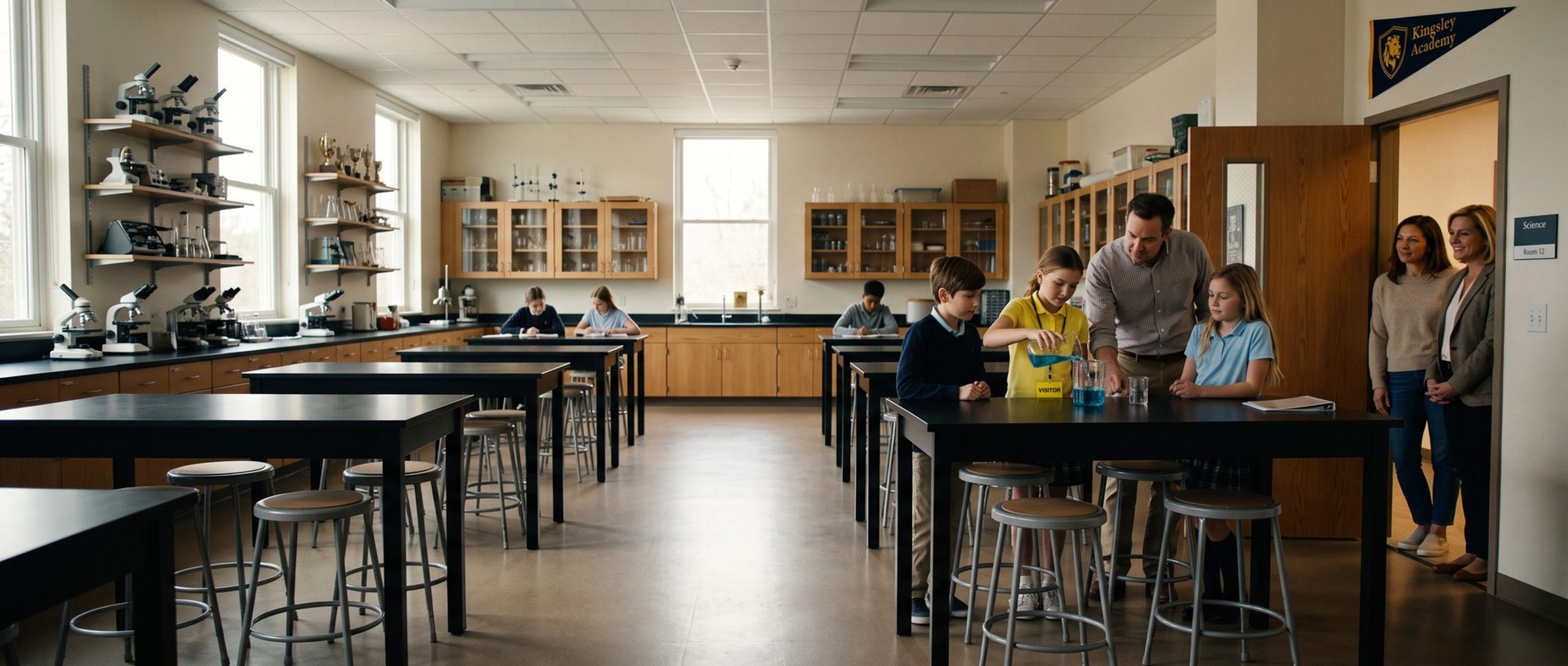
For a private K-12 school, the visit has to do the work stars do elsewhere. Chapter 11 showed how often parents decide after visiting. The ads and the profile should make the visit the obvious next step.
That starts in the ad. A tour or open house headline (Chapter 8), a sitelink straight to the visit booking page and the visit as a tracked step in the account, secondary to the inquiry as Chapter 1 set up. When the tour booking runs on a separate scheduling tool, Chapter 1 covers tracking it.
Then the visit itself. Parents in our example market describe what they want from one. Shadow days came up as standard: "I think all private schools in the valley (these two in the post as well as Judge and Juan Diego) offer student shadowing," one parent wrote. They want to see real classes and meet teachers, which is what Chapter 8's reviews praised most.
They also notice when the visit doesn't match the school. One parent's review warned: "The difference between a school tour and day to day life as a student or family here is staggering." A polished tour that shows a different school from the one families join costs more than it wins. Show an ordinary day.
Schools that keep their stars still need the visit. Trade-school students in our reading treated a visit as part of the research, and at a beauty school a student can make it without asking: book a haircut or a facial on the student salon floor and watch how the students are taught. Colleges and trade schools should offer the same open doors a K-12 school does, with the rating as a bonus rather than the whole pitch.
Put every way to visit where a family can find it: the tour, the open house, the shadow day and the virtual tour from Chapter 11, on the profile, in a sitelink and on the program page each ad points to. A family who can't see stars should never have to hunt for the way in.
Next: What AI Can and Can't Do in a School's Account
Chapter 13 covers AI: the Google features that write ads and choose searches on their own, and what the school still has to answer for. If your video tour isn't running yet, Chapter 11 covers it. All sixteen chapters are listed on the Google Ads for Education guide home. If you'd like a hand with your profile and ads, here is how our Google Ads management runs for schools.


