
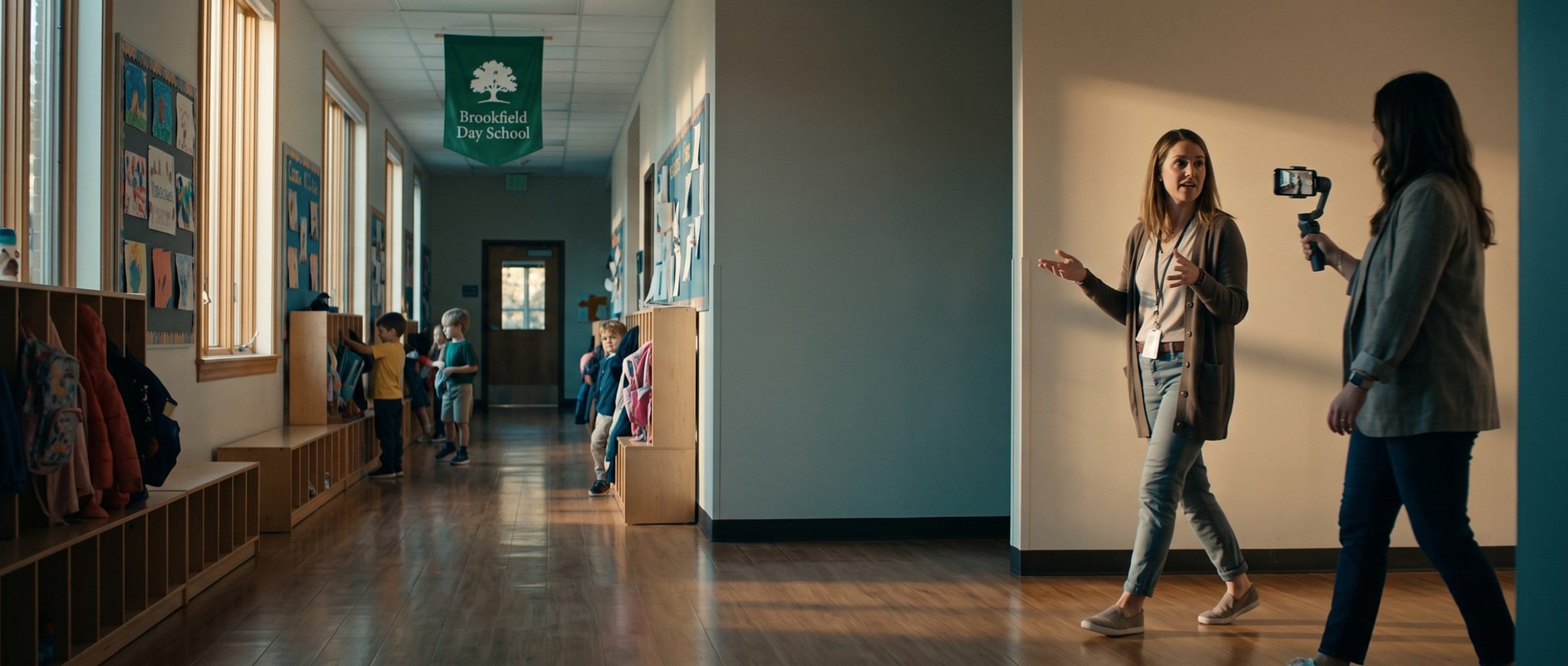
Most schools already know their best sales tool: the campus visit. A family walks the halls, sees a class in session, meets a teacher, and something settles. The problem is that a visit takes a Saturday, a drive and a decision to go. A virtual campus tour, filmed well and run as a YouTube ad, puts a version of that visit in front of families before they've committed to the drive.
This chapter covers why the visit matters, when a school is ready to pay for video, how to aim the tour at parents within Google's rules for teens, and what the video itself should look like.
A Campus Visit Changes Families' Minds. Only 4 of Our 12 Example Schools Let Them Visit Online.
When we read 703 Reddit posts and comments from families choosing a school, visiting came up again and again: in 12 of the 30 threads, including 6 of the 8 about private K-12 schools, and in 60 individual posts. The advice was concrete, from school tours to shadow days to booking a service at a beauty school as a covert visit. One parent summed it up: "Both of my kids drastically changed their minds after visiting schools."
Local parents give each other the same advice. In a Salt Lake City thread about choosing an elementary school, one wrote simply: "Definitely visit the schools and ask around on Facebook." The visit and the word of mouth travel together.
Reviews written after enrolling barely mention it. Only 12 of the 826 school reviews we read mentioned a tour, open house or visit at all. The visit happens before the review, which is exactly when the ad runs.
Then we checked the websites of our twelve example schools in the Salt Lake City market for any way to visit without coming in. Four had one: a virtual tour at one of the three private K-12 schools, a guided virtual tour at the public university, a virtual information session at the technical college and an informational webinar at the online nursing college. We found none at the other eight.
A virtual tour doesn't replace the real visit. It reaches the families who can't make one yet: a family relocating from another state, a working parent who can't take a weekday afternoon, an adult looking at an online program who will never see the campus at all. For them, the tour is the first visit, and a good one makes the real visit more likely.
Google Says a Demand Gen Budget Should Cover Ten Inquiries. Most Schools Should Pay for Search First.
The campaign type for a video tour is Demand Gen. Google describes it as a campaign that captures engagement and action across YouTube, including Shorts, along with Discover, Gmail, Maps and Display. It's built for showing something to people who aren't searching for it yet.
That reach costs money. Google's Demand Gen page ties the budget to the bid: aiming at a set cost per inquiry, a school should fund the campaign with at least ten times that cost. Chapter 3's worked private school example put a Search inquiry at about $70; if the school targets the same cost per inquiry, Google's guidance puts the Demand Gen budget at $700 or more. Google doesn't attach a time period to that line, but either way it's a lot of money next to the "$500 tops a month" one K-12 agency says is all a mid-sized private school needs.
Practitioners who recruit for schools mostly put video second. A K-12 agency told schools to "put a considerable amount 80 to 90% of your Google ads spend on search ads." Someone at a higher-education agency was blunter about YouTube itself: "you're not going to get any action from somebody watching a bunch of videos on YouTube." A tour ad builds familiarity; Search catches the family once they're ready.
So a video tour comes late in a school's account. In our rollout it follows Search and Performance Max, once the account has steady inquiries and admissions knows what one costs. Its goal is also different. A family who just watched a one-minute tour on YouTube is rarely ready to apply. The realistic goals are a tour booking, a visit to the program page and a place on the school's remarketing list, so the Search ads and later videos can find them again.
Judge it on what it was asked to do. Count tour bookings and program-page visits from the campaign, and watch whether searches for the school's own name rise in the weeks it runs. One agency claims a 30-day YouTube run before a deadline lifts branded searches by 15-25%; that's their claim, and a school's own brand campaign will show whether it happens there. In a proposal for a private school, we described YouTube remarketing to a family who had already visited the site the same way: "showing videos to that person just to stay top of mind for like 30, 60, 90 days, whatever that typical sales cycle would be."
Google Lets a School Reach the Parents of Teens on YouTube. It Won't Let the School Pick Out the Teens.
Chapter 9 covered Google's rules for anyone under 18: no personalized ads, no audience targeting and no campaign aimed only at teens. Those rules apply on YouTube too. A school can't build a Demand Gen audience of 16-year-olds, and it shouldn't try to build one through proxies like young-skewing interests.
What it can target is the parents. Google's parental status segments, from Parents of Preschoolers through Parents of Teens (13-17 years), are available in Demand Gen and Video campaigns. A high school or a college recruiting juniors aims its tour at parents of teens; a K-8 school at parents of grade-schoolers; an early-education center at parents of preschoolers.
The school's own data is the other strong audience:
- Website visitors who reached the tour or inquiry page. A school's list has to show 100 or more recent visitors over the past month before Google will use it on YouTube.
- Lookalike segments built from the school's inquiry list. Google is turning lookalikes in Demand Gen into suggestions during 2026, so the seed list acts as a signal and Google may reach people outside the similar audience.
- Customer lists of families who inquired, uploaded within Google's Customer Match rules, with parents' contact details only (Chapter 10).
A teen may still watch the parent's tour on a shared screen or search for the school after hearing about it at dinner. That's fine, and it's how plenty of school decisions start. What a school can't do is pick the teen out of the audience.
School Videos Lose Viewers in Three Seconds. A Real Walk Through Campus Holds Them Longer Than a Brochure Montage.
The usual school video is a montage: drone shots, a choir, a lab, a slow-motion graduation, a voiceover about excellence. It looks expensive and says little, and it takes too long to say what the school is.
A K-12 agency's rule for video ads is simple: "make sure that in you know that first three seconds I know what you are." In a feed full of other videos, the school's name, what kind of school it is and where it is need to show up immediately, on screen and out loud.
Then show the visit. A good tour video follows the route a family would actually walk: the front door, a classroom with class in session, the place students eat, the space that makes the school different, whether that's a welding shop, a clinical lab or a reading nook. Let a teacher talk for ten seconds about what happens in that room. Chapter 8 found that teachers are what families praise most; the video should let a family meet one.
What to film depends on the school:
- Private K-12. Morning drop-off, a lower school classroom mid-lesson, the library, recess, a teacher explaining one thing they do differently.
- Colleges. The walk from parking to the building a student would actually use, a class in session, the advising office, the student center at lunch.
- Trade schools. The shop, the lab or the salon floor with students working, and the instructor standing next to the equipment they'll learn on.
- Online programs. There's no campus to walk, so show the student's week: the course screen, a live session with a real instructor, and a graduate at work in the job the program leads to.
Google's Demand Gen specifications set the first two limits; the third is our advice:
- Shape. Horizontal 16:9 for most YouTube placements, vertical 9:16 for Shorts and square 1:1. Film so one shoot can be cut three ways.
- Length. The minimum video length is 5 seconds, and videos under 10 seconds can't run as in-stream ads, the ones that play before or during someone else's video. Google recommends 10 to 60 seconds for every shape, so a 15-to-30-second cut and a 60-second cut cover most needs; the full walkthrough can live on the school's site.
- Captions. Put the school name and the key words on screen as text, so the tour still works for anyone watching with the sound off.
End with the step the family is ready for. One higher-education agency put it plainly: "we want the CTA to not be towards enrollment." "Book a tour," "See the welding shop" or "Watch the full walkthrough" all fit. "Apply now" asks too much of someone who met the school 30 seconds ago.
Film it for real. A phone on a gimbal, a quiet weekday morning and a teacher who agreed to be on camera are enough. Stock footage and AI-generated campus scenes miss the whole point of a tour, which is to show the place as it is.
Next: The Campus Visit and the Reviews Families Read First
Chapter 12 covers what happens after the video: the Google Business Profile families check before they visit, why K-12 school profiles show no Google reviews, and how to make the in-person visit close the decision. If your Performance Max exclusions aren't set yet, Chapter 10 covers them. All sixteen chapters are listed on the Google Ads for Education guide home. If you'd like a hand with video, here is how our Google Ads management runs for schools.


