Chapter 9 covered the part of fair housing that Google enforces: which targeting settings a leasing campaign loses. That's the smaller part. The bigger one is the law itself, which cares about what a rental ad says, what its photos show and who ends up seeing it, and which holds the property manager responsible however the ad was built.
This bonus chapter is about the words and pictures in leasing ads. It covers what the Fair Housing Act reaches that Google's policy doesn't, the phrases that describe a renter instead of an apartment, what HUD's withdrawn guidance did and didn't change, the voucher rule that changes from state to state, why automated targeting doesn't move the blame, and the fair housing statement. It's general information, not legal advice; a fair housing attorney in your state is the right person for your own ads.
The Fair Housing Act Covers a Rental Ad's Words, Photos and Placement. Google's Housing Policy Covers Only the Targeting.
The federal rule fits in one sentence. A leasing ad, flyer or listing that signals "any preference, limitation, or discrimination" about who can rent is unlawful under section 3604(c) when the preference tracks a protected class: race, color, religion, sex, national origin, disability (handicap, in the statute's word) or families with children.
HUD's regulation spells out how wide that reaches. It applies to "all written or oral notices or statements," and its examples include using "words, phrases, photographs, illustrations, symbols or forms" that signal who a place is or isn't for. One example matters most for online ads: choosing where an ad runs in a way that keeps part of the market from ever learning the apartment is available, because of a protected class. In plain terms, where an ad runs and who sees it can be a violation on its own, apart from what it says.
Google's housing policy is narrower. As Chapter 9 explained, it removes targeting settings such as age, gender, family status and ZIP codes. Its housing policy pages set no housing-specific wording rule, require no logo and cite no statute. Google polices the settings; the words are yours.
For owner ads the exposure is lower. An ad selling management to the person who owns the house isn't an ad for renting that house to the viewer. The risk comes back when an owner ad lands on a page full of rental listings, which is one more reason for the owner page from Chapter 4. Leasing ads are where all of this applies.
"Perfect for a Quiet Couple" Can Read as No Children. A Rental Ad Describes the Apartment, Not the Renter.
Most fair housing mistakes in rental copy aren't slurs. They're friendly descriptions of the renter someone imagined. A fair housing attorney who trains property managers put the rule in one line in 2026: "you cannot market to exclude only to attract." Her examples were the kind leasing teams write without thinking: "perfect for a quiet couple, which could exclude uh families with children," and "executive bachelor pad," which she said could imply a preference about gender or family status.
HUD's 1995 advertising memo, which isn't on either of the 2026 lists of withdrawn HUD guidance, draws the same line from the other side. It says ads "may not contain limitations on the number or ages of children, or state a preference for adults, couples or singles." It also says describing rules for residents' conduct, such as "non-smoking" or "sober," doesn't violate the Act, and that "bachelor apartment" used as a physical description of a unit is fine. The attorney's caution and the memo's allowance meet in the same place: describe the unit and the rules, not the person who should live there.
So a one-bedroom is "a one-bedroom with a private balcony," not "perfect for a single professional." A building near a university is "a 10-minute walk to campus," not "ideal for students." A quiet building has "concrete construction between units," not "a community for mature residents."
We searched the 200 ads in our example set for a list of risky words: families, couples, singles, seniors, students, adults, children, "perfect for," "ideal for," Section 8 and vouchers. None appeared. One apartment community in our set handles the family question cleanly in its FAQ: kids live there, the answer says, because the property isn't age-restricted. No adjectives about who belongs, just the fact.
HUD Pulled Its Guidance on Online Rental Ads. A Renter Can Still Sue a Manager Within Two Years.
Two and a half years ago, HUD told landlords and managers in writing how it read the law for rental ads placed through online ad platforms. That document, dated April 29, 2024, didn't last. A notice in the Federal Register in April 2026 listed it among withdrawn fair housing guidance documents, with the withdrawal effective September 17, 2025.
Some managers read that as the rules relaxing. The same notice says otherwise. It states that "Any actions that do not comply with the text of the Fair Housing Act continue to be subject to enforcement by the Department," and it reminds readers that people who believe they were discriminated against can file a civil action in federal or state court "within two years" of the practice. The guidance was HUD's explanation of the law. The law is still there, and so is a renter's right to sue.
About 20 States Ban Turning Away Housing Vouchers. There, "No Section 8" in a Rental Ad Can Break the Law.
Source of income, including housing choice vouchers, isn't a protected class under the federal Fair Housing Act. Many states have made it one. The Poverty and Race Research Action Council keeps a running list, last updated in March 2026, of about 20 states plus Washington, DC with laws against source-of-income discrimination, and many of them reach advertising directly. California's, for instance, bars any advertisement for a rental that "indicates any preference, limitation, or discrimination based on... source of income." A few states go the other direction and bar their cities from passing such protections.
That makes voucher language the clearest example of a fair housing question whose answer depends on where the ad runs. One apartment community in our set says on its FAQ page that it doesn't participate in the voucher program. The state that community is in isn't on PRRAC's list of states with source-of-income laws. The same sentence on a listing page or in an ad in one of the states on the list could be a violation. A management company with properties in more than one state needs its own state-by-state answer, and city ordinances can add to it.
Keywords follow the same logic. Chapter 5 warned that on the leasing side, a negative keyword aimed at the kind of person searching can cross a legal line, and this is the clearest case: blocking renters who search with "section 8" in their query can work like refusing them in states that protect voucher holders, which is why it doesn't belong on a leasing negative list.
When Google's Software Picks Who Sees a Rental Ad, the Manager Still Answers for Who Got Left Out
Modern campaigns pick much of their own audience. Smart Bidding, Performance Max, Demand Gen and AI Max all decide who sees an ad based on who seems likely to convert. The fair housing attorney's warning applies directly: "AI will optimize your ads to show up more frequently to that demographic," which can leave others out even if nobody intended it. And her view of the defense is blunt: "neither HUD nor court is going to accept, well, you know, the computer did it, we didn't know, as an excuse."
Her practical advice is to "ask your ad agency or platform for a full list of all the targeting criteria used," and to avoid filters based on demographics, ZIP codes or interests that track a protected class. That's a reasonable ask of any agency running leasing ads, ours included.
There's context here, too. Meta settled a Justice Department case over its housing ad delivery in 2022 and, in 2023, rolled out a system meant to reduce the gap between who's eligible to see a housing ad and who actually does. We found no comparable system published by Google. That doesn't mean Google's delivery is skewed; it means a manager can't point to a published safeguard. Keep a record of the targeting on every leasing campaign, use the text guidelines from Chapter 13 on any copy Google writes, and look at who the ads reached in the audience reports now and then.
Google Doesn't Require an Equal Housing Opportunity Logo. Seven of the 12 Sites We Checked Show a Fair Housing Statement Anyway.
There's no box in Google Ads for a fair housing logo, and Google's housing policy pages don't ask for one. HUD's old advertising guidelines at 24 CFR part 109 have since been removed. State law may still ask more of you, so check yours.
Most of the companies in our example set show a statement anyway: an Equal Housing Opportunity logo or a fair housing line appeared on 3 of the 4 residential managers' sites and all 4 apartment communities' sites. None of the 4 association managers showed one, which fits their business, since their ads go to boards rather than renters.
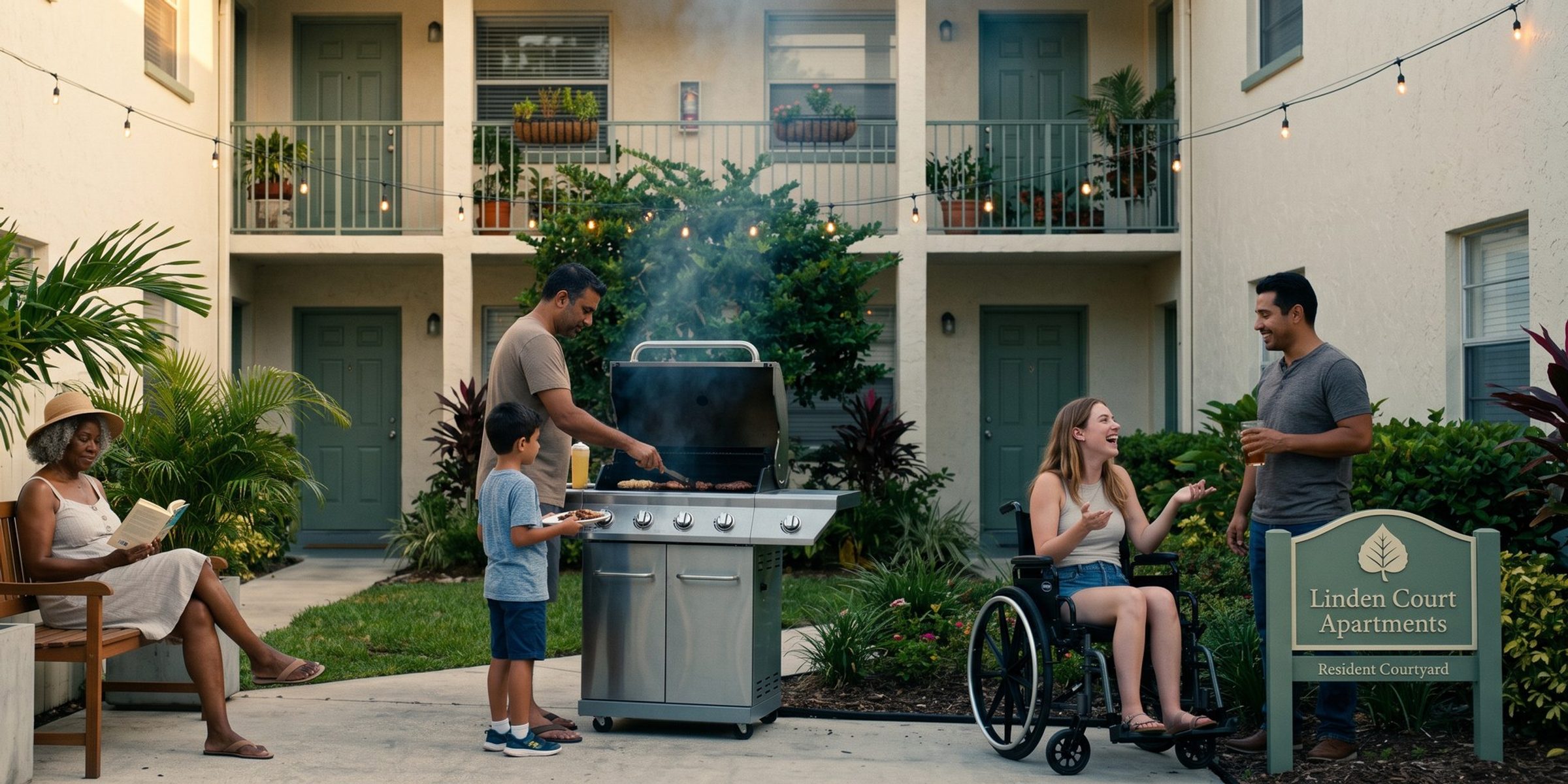
For leasing, put the statement where the ad lands: the floor plan page, the listings and the application. Photos matter as much as words. HUD's regulation lists photographs and illustrations among the ways an ad can signal a preference, so the people in a community's photos and videos should look like the full range of people who might live there, not one kind of household.
For the same rules in another housing business, see how senior living communities write ads under fair housing law.
Next: Listing Sites Against Google Ads
Chapter 15, the second bonus chapter, covers how the big rental listing sites compare with a community's own Google Ads, and when to bid on your own community's name. Earlier chapters cover Google's housing rules, Performance Max for leasing, Demand Gen for lease-ups and AI Max. The full list is on the Google Ads for Property Management guide home, and our Google Ads management page explains how we'd keep your leasing ads within the rules.