
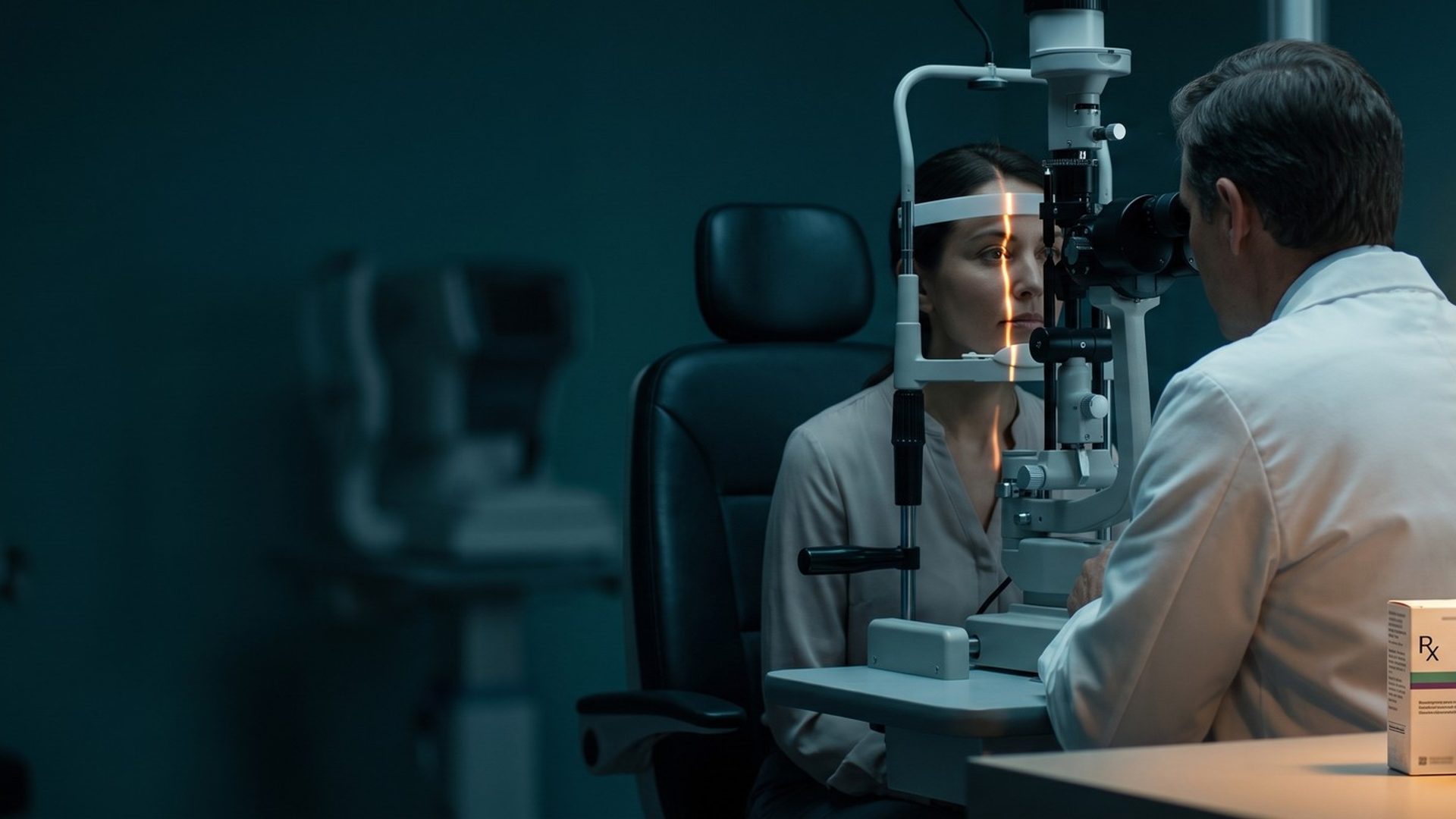
A patient with red, crusty eyelids reads about Xdemvy, the prescription drop for eyelid mites. They don't search for an optometrist. They search for the drug. And when your practice, which prescribes it, tries to bid on that search, Google won't let you.
That's the shape of medical eye care advertising. Routine exams run on a simple set of rules: bid on the search, write a true ad, send the click to a good page. Once your ads move into dry eye, eyelid disease, glaucoma or myopia control, two more rulebooks apply: Google's rules for prescription drug names, and the FDA's decisions about what each treatment is approved to do. This last chapter covers both, then closes with the whole rollout in one place.
Patients Search for the Drop Before They Search for the Doctor
Drug names draw real search volume. Across the US, Google's Keyword Planner shows about 27,100 searches a month for "restasis," 18,100 each for "xdemvy" and "xiidra," 14,800 for "miebo" and 2,400 for "vuity." Those are prescription eye drops for dry eye, eyelid mites and presbyopia, and every one of them needs a doctor to prescribe it.
The people typing those names are close to a medical visit. Many have a symptom and a treatment in mind, and some are asking whether a doctor near them prescribes it. An optometry practice that treats dry eye or blepharitis is exactly who they need. The problem is getting in front of them.
Xdemvy Can Go in Your Headline. It Can't Go in Your Keyword List.
Google's restricted drug terms policy splits the question in two. In the US, an advertiser can mention a prescription drug in ad text and on a landing page with no certification at all. Choosing that drug's name as a keyword is another matter: that takes certification.
So a practice can write "Now treating eyelid mites with Xdemvy" in an ad and explain the drug on its landing page. What it can't do, without certification, is add "xdemvy" as a keyword.
Certification isn't built for a practice like yours. Google's application lists organization types such as online pharmacies and telemedicine providers, pharmaceutical manufacturers, and a few others. There's no category for an in-person optometry practice, and Google warns applicants not to apply for a category that doesn't match their business. Our reading is that an ordinary eye care practice has no path to bidding on drug names. If you think your practice is an exception, confirm it with Google support before you build around it.
Don't rely on Google's published drug list to tell you which names are safe, either. Google says plainly that the list gives examples and doesn't cover everything. Some newer eye drops aren't on it, but they're prescription drugs all the same, and the policy treats them that way.
Blepharitis Draws 201,000 Searches a Month. Bid on the Condition.
The way around the restriction is also the better strategy: bid on the condition, and name the drug in the ad.
The condition searches are larger than the drug searches anyway. "Blepharitis" alone runs to roughly 201,000 US searches a month. "Demodex" adds 40,500, "demodex blepharitis" 27,100 and "eyelid mites" 9,900, all bid-able. "Presbyopia eye drops" is typed about 5,400 times a month, and "dry eye specialist near me" about 2,400.
Build a medical eye care campaign around those conditions, separate from the routine exam campaigns, with its own budget and its own landing pages. Then let the ad do what the keyword can't:
- Headline: the condition in the patient's words, such as "Eyelid Mites Treated Here."
- Description: the treatment by name, if your doctors prescribe it, such as a line that you treat Demodex blepharitis with prescription drops including Xdemvy.
- Landing page: a page for the condition that explains the visit, the treatment options and the insurance you bill for medical eye care (Chapter 14).
Keep the claims plain. Google's unreliable claims policy bars unproven claims of cures for incurable conditions, and chronic dry eye is managed, not cured. "Relief for chronic dry eye" is safer than "cure your dry eye."
Keyword Planner Goes Quiet on Most Dry Eye Searches
Dry eye is one of the largest medical services in optometry, and the one Google's research tool says least about. When we pulled data on September 27, 2026, Keyword Planner returned no figures at all for "dry eye," "dry eye treatment," "dry eye doctor" or "dry eye clinic," nationally or in our example market, Chicago. In the same run, "dry eye specialist near me" returned about 2,400 a month, and treatment names such as LipiFlow returned numbers too.
Google doesn't explain why some terms come back empty, so we won't guess. What it doesn't mean is that nobody searches for dry eye care; the treatment and specialist searches that do return numbers show the demand is there. The practical effect is that you can't size dry eye demand from Keyword Planner alone. Build the campaign from the terms you know patients use, run the condition keywords in Exploration's broad match (Chapter 6), and let your own search terms report show you the real volume within a few weeks.
The FDA Has Backed Two Myopia Devices. No Myopia Eye Drop Has Its Approval Yet.
Myopia control is the fastest-moving part of eye care, and parents are searching for it by name. "Orthokeratology" leads at roughly 12,100 US searches a month, then "stellest" at 8,100 and "ortho k lenses" at 6,600. "Misight" draws 1,900, "myopia control" 1,300, and "atropine eye drops for myopia" 590.
The wording in those ads has to match what the FDA has actually decided, and the decisions differ:
- MiSight 1 day contact lenses were FDA-approved in 2019 for slowing the progression of myopia in children who are 8 to 12 when treatment starts.
- Essilor Stellest eyeglass lenses were authorized by the FDA in September 2025 to slow myopia progression in children who are 6 to 12 when treatment starts.
- Orthokeratology lenses are approved for temporarily reducing myopia with overnight wear. None carries an approval for slowing its progression, so our reading is that "ortho-k slows myopia" is an off-label claim to keep out of ads.
- Low-dose atropine has no FDA approval for myopia as of this writing. An FDA advisory committee is scheduled to review one on October 30, 2026. Practices that prescribe compounded atropine shouldn't call it FDA-approved.
For an imaginary practice that fits MiSight and Stellest and also offers ortho-k, lines like these stay inside those decisions:
- "MiSight Lenses for Kids 8 to 12, FDA-Approved to Slow Myopia"
- "Stellest Glasses Lenses for Kids 6 to 12"
- "Ortho-K Overnight Lenses: Clear Daytime Vision Without Glasses"
The ortho-k line sells what the lens is approved to do, which is plenty. It doesn't promise to slow anything.
Match each ad to the product it names, and the age range to the one the FDA gave. Chapter 11 covered how myopia ads fit into back-to-school season. (This isn't legal advice; have counsel review medical claims.)
Condition Pages Lose the Audiences Routine Exam Pages Keep
Medical eye care changes one more thing: which audiences you can use. As Chapter 10 covered, Google's personalized advertising policy treats chronic health conditions and their treatments as sensitive. Pages about dry eye disease, glaucoma or myopia management are likely to fall inside it; routine exam and eyewear pages likely don't.
In practice, that means the medical campaign runs on keywords, not remarketing lists or uploaded patient lists. Search targeting by keyword isn't affected, which is one more reason the condition keywords above do the heavy lifting. Keep the medical campaign's landing pages separate from the routine exam pages, so a policy flag on one doesn't limit the other.
A condition page that works for Google and for patients usually covers the same few things:
- The condition in plain words, with the symptoms a patient would recognize.
- What the visit involves, including any testing, and how long it takes.
- The treatments you offer, named accurately, with no promise of a cure.
- Which insurance applies, since most of these visits bill medical coverage.
- Who treats it, by name and designation.
That's the same structure Chapter 4 used for exam pages, applied to medical care.
The Whole Rollout, From the First Booked Exam to the Last Setting
That's the guide. Here's the order it adds up to.
Start with measurement: count booked exams, requests and real calls, and keep contact lens reorders out of the conversion count (Chapter 1). Map the searches by stage, from symptoms to "eye exam near me" (Chapter 2), and set the budget from what a new patient is worth, glasses and all (Chapter 3). Build a page for each kind of visit so Quality Score starts high (Chapter 4), and sort the keyword list into exam searches, eyewear searches and the ones to cut (Chapter 5).
Launch with exact match in Isolation, then add Exploration's broad match once the bookings are real (Chapter 6). Set bids and budgets ahead of January's rush (Chapter 7), write ads that sell the doctor in patients' own words (Chapter 8), and change the settings Google fills in for you, AI Max's text writing first (Chapter 9).
The next four campaigns hand Google more of the decisions, so each waits until the account has a season of booked exams to learn from. Performance Max comes first, pointed at people who browse the optical chains' websites (Chapter 10). Demand Gen follows, reaching parents in July and August before school eye exams are due (Chapter 11). Local Services Ads are a test worth running only if your phones are answered and your Google reviews are strong (Chapter 12). AI Max goes on last, in Exploration only, with the store and reorder pages fenced off (Chapter 13).
Throughout, name the insurance you take for both kinds of visit (Chapter 14), answer the chains' bundles by selling the exam (Chapter 15), and keep medical claims within the drug and device rules in this chapter.
All sixteen chapters sit on the guide's home page, in the order you'd build them. None of it is complicated on its own. The hard part is doing it in order and resisting the automated features until the bookings justify them. If you'd like help with that, the team behind this guide runs Google Ads management for eye care practices, and every account starts where Chapter 1 does: counting the exams that actually get booked.