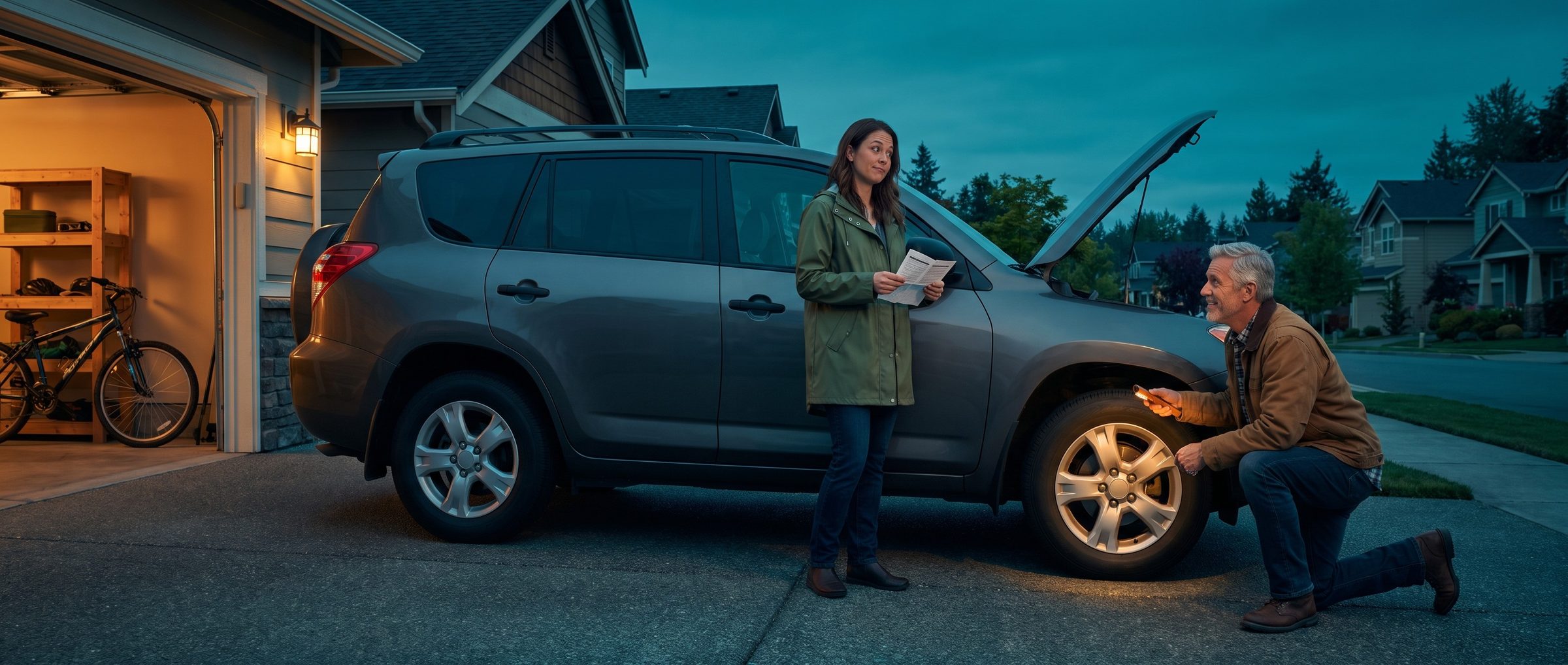
One driver broke down, had a van towed to the nearest shop and was quoted $2,200 for a rear differential. A second shop found "just a loose caliper bolt that had fallen out and jammed my wheel."
That review isn't rare. We read 389 low-star Google reviews about repair jobs at 28 Portland-area shops, a sample chosen to lean negative. In 75 of them, about one in five, the customer said the shop told them the car needed work it didn't need, or pushed an upsell.
That fear walks into every repair search. The driver typing "brake repair near me" isn't only shopping for brakes. They're shopping for a shop that won't sell them four things when they need one. Then look at the ads. Among the 229 local shop ads we read in Google's Ads Transparency Center, one shop, Green Drop Garage, promised "No Upsells," in 2 of them. Almost nobody else spoke to the fear at all.
This chapter writes the ad. Chapter 7 priced each click; here is what the driver reads before deciding whether to tap it.
Your Brake Page Already Holds Half the Lines Your Ad Needs
Start with the page, not a blank ad. Chapter 4 sent every service and make ad group to its own page: brakes to the brake page, Subaru to the Subaru page. Most of the ad is sitting on that page already: how the shop describes a brake job, the warranty, how long it's been on the corner, which makes its mechanics like working on, and the button that books a bay. The ad's job is to make a promise the page keeps the moment it loads.
The local shops in our example market, Portland, Oregon, mostly do this already. Of their 229 ads, 121 showed a star rating or review count, 87 named a car make, an origin like "German," or a vehicle type, and 47 mentioned family ownership or years in business. Those are trust ads, and they should be. A local shop can't win a price fight with a national chain's coupon, so it doesn't try.
So before writing a single headline, open the landing page and copy out every line a driver would care about: the warranty terms, the free inspection if there is one, the makes, the hours, the booking button's wording. That list is the raw material. Everything after this point is about which of those lines go first.
Drivers Wrote "Honest" in 118 Portland Reviews. Only 24 Local Ads Said Anything Like It.
The second source is the one most shops skip: how their own customers talk. Google reviews are the obvious place, and for repair shops they're where the language lives. Yelp and Nextdoor add a little. The front counter adds the rest. Write down what callers ask before they book.
Across 994 Google reviews of Portland-area shops, the patterns are clear:
- "Honest" showed up in 118 reviews, not counting "dishonest" or the Honest-1 brand name. Only 24 of 229 local ads used honest, transparent or upfront wording.
- "Quote" beat "estimate," 79 reviews to 38. Drivers ask for a quote. Many ads offer an estimate.
- "Shop" and "mechanic" came up far more often than "technician" or "tech." Drivers don't talk about technicians. They talk about their mechanic.
Customer language does double duty in an ad. It reads as familiar to the driver, and it matches what they typed, which is part of what Chapter 4's relevance reading checks. A headline that says "An Honest Quote, Before Work" uses three words drivers already use. "Transparent Estimates by Certified Technicians" uses none.
No Driver in 994 Reviews Mentioned ASE. 18 Local Ads Advertised It Anyway.
The gap runs the other way too. Of those 994 reviews, not one mentioned ASE certification. "Certified" or "certification" came up twice. OEM parts came up 7 times. Meanwhile 18 local ads advertised ASE or certified technicians.
That doesn't make certification worthless. It's real, it matters, and it belongs in the ad somewhere, often in a description or a sitelink. It just isn't what drivers think about when they pick a shop, so it shouldn't take the headline slot that "honest" or "no work without your OK" could fill.
The test for any line is simple: would a driver ever say it? Customers write things like "didn't try to upsell, just realistic options and pricing." They don't say "they had certified technicians." Write the first headline in the first voice.
Half the Upsell Complaints Say Another Shop Disagreed. Put the Second Opinion in the Ad.
Back to the 75 upsell complaints. In 38 of them, the driver says a second shop, a dealer or their own mechanic disagreed with the first diagnosis or did the job for far less. One driver quoted $1,300 for pads, rotors, sensors and calipers went to a dealer instead and was charged $100 for pads. The other shop, the review says, "took video and showed me all the measurements."
That's the ad, almost word for word. Drivers who've been burned want proof they can see and a say before any work starts. A shop that already works this way can say so in under 30 characters, the limit for a Google headline:
- See Photos Before We Fix (24)
- No Work Without Your OK (23)
- An Honest Quote, Before Work (28)
- We Explain Every Repair (23)
- Second Opinions Welcome (23)
Only write the ones that are true. And keep every line on the side of proof, not of putting work off. Brakes, tires and steering are safety repairs. An ad that sounds like the shop will talk drivers out of fixing things invites the wrong customer, and if a part the shop waved off fails on the road, the ad is the first thing anyone reads back.
The same honesty test applies to fees. Promise a second look and then bill $150 to pop the hood, and the headline turns into the next 1-star review. Paying to be told something was its own complaint in our sample, in 48 of the 389 bad reviews. If your shop credits the fee toward the repair, put that in a description. It answers the next worry before the driver asks.
The Transparency Center Shows Your Rivals' Ads, Even the Ones Their Marketing Vendor Runs
Before finalizing anything, look at what the shops around you are running. Google's Ads Transparency Center shows the recent ads of any advertiser. Search a rival's name and read through its recent Search ads.
One catch matters a lot in auto repair. In our example market, 14 of the 30 local shops we found ran their ads through an account named for a marketing vendor rather than the shop itself. Kukui, a marketing platform built for repair shops, held seven of them. Search the shop's name and you may find nothing. Search the vendor and you'll find the shop's ads alongside other clients'.
What you'll see in most markets matches ours. Chains price the oil change and the tires. Local shops sell ratings, makes and family history. Very few say anything about what the driver fears most. That's the open lane.
Then run your brake and make searches through the preview tool from Chapter 5 to see which of those rivals actually turn up on a Portland phone. AI writing tools come last: useful for checking length or spotting a stiff phrase, never for the first draft. A first draft from AI sounds like every other shop's ad, which is the one thing this ad can't afford to be.
Fifteen Unpinned Headlines Let Google Test What a Driver Responds To. Pin Only a Proven Winner.
Google builds each Search ad on the fly from parts you hand it: as many as 15 headlines, 30 characters apiece, and 4 descriptions of 90. Use every slot. A brake ad group might fill its 15 like this, three lines apiece on the questions a nervous driver brings to the counter:
- Can you fix my car? Brake repair, pads and rotors, and the make, if it's a make group.
- Why you? The star rating, the years on the same corner, the warranty.
- Will you upsell me? No work without your OK, an honest quote, second opinions welcome.
- Can I see it? Photos of the worn parts, a free brake check, a written quote.
- When can I come in? Book online, call now, openings today.
Descriptions are where the shop gets a whole sentence, four of them, 90 characters each. Use one for the no-surprises promise in full ("Photos of every worn part and a written quote before we touch a wrench"), one for the warranty in plain terms, one for the diagnostic fee and whether it counts toward the repair, and one for how to book. Ninety characters is about one honest sentence. Write it the way a service advisor would say it at the counter.
Launch with nothing pinned. Pinning forces a headline into one position every time. Google's own help page says that because pinning "reduces the overall number of headlines or descriptions that can be matched to a potential customer's search, pinning isn't recommended for most advertisers." Unpinned, Google can learn which lines get drivers to tap. Pin only a headline the shop already knows works, from an earlier account or from data this one has earned.
Ignore the Ad Strength meter's nagging, too. That meter scores variety, not persuasion, and Google says outright that it never touches the auction. A month in, check which headlines Google keeps choosing and which it benches, and swap out the benchwarmers. The ad is never finished. It just gets less wrong every month.
Writing ads from a shop's own reviews and pages is where our Google Ads management team starts every new repair account.
Next: A Shop That Books Online Can Run Ads After Closing. Its Call Button Should Go Dark When the Phones Do.
The ad is written. Chapter 9 decides when and where it runs: the shop's real service area, the hours its phones are answered, and why online booking lets the ads keep working after the bay doors close.
This chapter is part of Google Ads for Auto Repair, a sixteen-chapter guide for independent repair shops in every state.