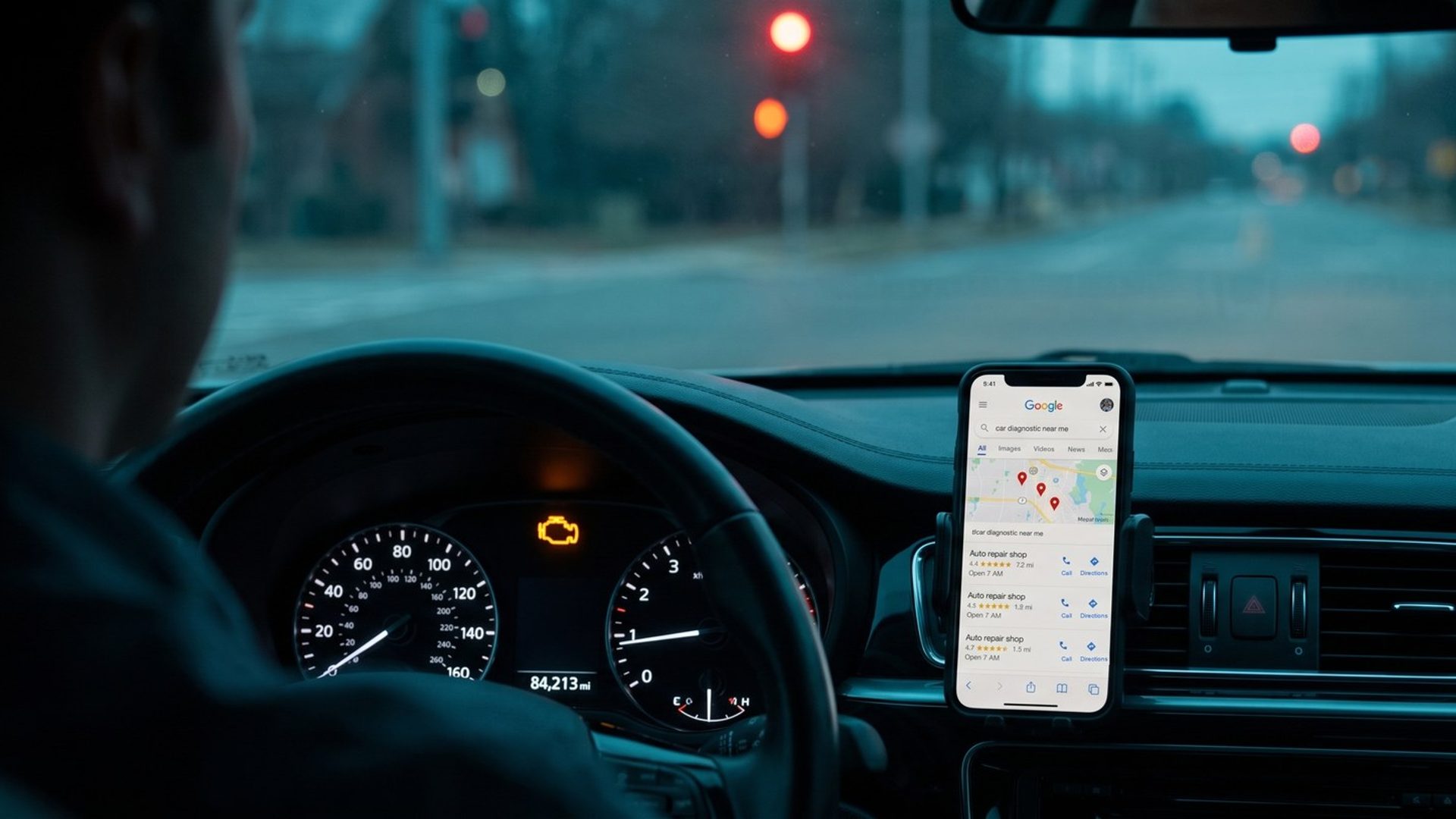
At 7:10 on a Monday morning, the little engine symbol on a commuter's dashboard starts blinking. At the next red light she types the first thing in her head: "check engine light flashing." She reads that it can mean a misfire and that she shouldn't drive far. Forty minutes later, parked outside her office, she types something else: "car diagnostic near me."
Same driver, same car, same morning. The first search is a question. The second is a driver holding her keys, ready to hand them to somebody. Google Ads will happily sell you a click on either one, and in the US the question gets nearly three times as many searches every month: 33,100 for "check engine light flashing" against 12,100 for "car diagnostic near me," according to Google's Keyword Planner.
The bigger number is the wrong place to start. Below, the searches line up from homework to keys-in-hand, and the first dollar of a new account lands at the keys-in-hand end. In Chapter 1 we set up the counting, so every booking, call and form can tell Google which of these searches pays.
A Driver Looking Up an Oil Change Schedule Isn't Booking One Yet. A Driver Typing Your Shop's Name Is.
Every repair a shop sells sits at the end of a short trip through Google. That trip has five stops. Each stop has searches of its own and asks something different of your ads. The volumes below are monthly US searches from Keyword Planner.
- Unaware, or not yet worried. The car runs fine and the driver is doing homework: "car maintenance schedule" (27,100) or "how often should i change my oil" (14,800). Marketing here builds awareness, and it rarely books a bay this week.
- Problem aware. Something feels or sounds wrong: "check engine light flashing" (33,100), "grinding noise when braking" (8,100). The goal is interest. The driver wants to know what the noise means.
- Solution aware. The driver knows it's a repair and starts pricing it: "brake repair cost" (2,900), "check engine light diagnostic cost" (260). Your job is to influence the decision.
- Service aware. The driver wants a shop: "brake repair near me" (74,000), "car diagnostic near me" (12,100), "mechanic near me" (673,000). This is the stage that compels action.
- Most aware. The driver types your shop's name. They already chose you, and your ad's job is to make the booking easy.
Most marketing plans begin at stop one and push down. We build repair accounts from stop five upward. We start at the bottom, where the driver is already holding the keys, and let real bookings teach the account before it reaches up.
Google Answers the Warning Light Before Any Shop Gets a Word In
The top half of the ladder has a problem for any shop paying for clicks: Google answers those searches itself.
In our example market, Portland, Oregon, we ran 23 repair searches through a results-page scraper. Google's AI Overview on "check engine light portland" told the driver they could get a free code scan at local auto parts stores, naming two national chains before it named any repair shop. People Also Ask, the box of related questions, carried a repair cost or price question on 20 of the 23 searches. A Reddit post from a driver with the same light on puts it bluntly in its headline: "Just found out autozone reads check engine lights for free and it saved me from a $150 dealer fee."
Your city's results will look different, and Google's answers change week to week. The pattern underneath is steady. A driver with a fresh warning light can learn the code, the likely cause and a price range without talking to anyone. If your ad shows up there, you're competing with a free scan in a parts store parking lot, and the click doesn't buy you a car in the bay.
There's a second reason to wait. A question search asks your landing page to answer a question first and sell a repair second. A repair shop's booking page answers nothing; it asks for a date and a phone number, so the driver who wanted an explanation leaves. Answering those questions belongs on your website as plain articles, where Google can show them in search results for free. The paid budget follows the booking.
That doesn't make the question searches worthless forever. It makes them a later stage of the account, after the bottom of the ladder has proved what a booked car is worth.
"Grinding Noise When Braking" Bids Almost as High as "Brake Repair Near Me." A Flashing Check Engine Light Starts at 2 Cents.
Keyword Planner shows a range for each search, the low and high end of what advertisers have recently paid to reach the top of the page. The ranges tell you which questions advertisers already treat as buyers.
For "check engine light flashing," advertisers have paid anywhere from two cents to $5.56 for a top spot. Our reading of that two-cent floor: some advertisers reach the top of the page for pennies because few are fighting over it. The driver is learning, not shopping.
"Grinding noise when braking" runs from $1.54 to $8.11. Compare "brake repair near me" at $2.40 to $8.50. A symptom that points at one repair is already halfway into a work order, and the bids show advertisers treating it that way.
Volume doesn't always favor the question, either. "Brake repair near me" draws 74,000 searches a month, about nine times the grinding search. The warning-light searches are the case where the question is bigger, which is exactly why they tempt new advertisers.
Some of those buyer-symptom searches will come to you later through broad match. Our second campaign, which we call Exploration, runs broad match with Google's automated bidding and finds phrasings no one would think to list. It stays parked until bookings and calls reach about 30 a month. Broad match only knows what your tracked bookings show it, and fewer than that is too thin a diet.
Search Ads Wait for the Driver With a Problem. YouTube Reaches the One Whose Oil Change Is Due.
Google sells a campaign type for every stage, and a repair account switches them on from the bottom up.
- Search, month one. The opening campaign is Isolation: "brake repair near me," "car diagnostic near me" and the other near-me repair searches, each on exact match with a bid a person sets. Drivers who type your shop's name get a brand campaign of their own. Isolation and Exploration are BrandRocket's names, not Google settings.
- Search, broad match. Exploration reaches up into the long tail of problem and solution searches. Most shops get there around months two or three, once tracked conversions reach about 30 a month; busier accounts get there sooner.
- Performance Max. One budget, every Google surface: the brake shop's ad can turn up on YouTube, Gmail or a Maps listing as easily as on Search. For most shops that's somewhere around month six or seven, and only once the account has held about 30 quality conversions a month.
- Demand Gen. For drivers who aren't searching at all, Demand Gen shows ads on YouTube, including Shorts, plus Discover, Gmail, Maps and the Display Network. That's the unaware stage: the driver whose car is due for service and hasn't thought about it. It waits for the same signal as Performance Max: bookings and calls holding at roughly 30 a month.
The brand campaign deserves its own line in that first month. A driver who types your shop's name has finished the trip, and the clicks are usually cheap because the search matches your page better than anyone else's. Keeping it in a campaign of its own keeps those easy bookings from making the Isolation numbers look better than they are. Our rollout also starts general retargeting on Meta in the same month, reminding recent site visitors to book.
In our experience, each step up the ladder costs more per booked car, because the driver has further to travel before booking. The bottom pays for the climb.
"Mechanic Near Me" Draws 673,000 Searches a Month. A Small Shop's First Dollar Goes There.
A small shop doesn't need to own the whole ladder. It needs the bottom rungs, and the bottom rungs are huge. "Mechanic near me" draws 673,000 US searches a month and "auto repair near me" 450,000, with top-of-page bids under $8 for both. Add the service searches, "brake repair near me," "transmission repair near me" and "car diagnostic near me," and the bottom of the ladder is where most of the ready-to-book volume sits.
Local numbers make the point sharper. In our example market, Portland, Keyword Planner counts about 9,900 searches a month for "mechanic near me," 6,600 for "auto repair near me," 1,000 for "brake repair near me" and 90 for "car diagnostic near me," 17,590 between them. The six question searches from the top of the ladder, from "car maintenance schedule" to "check engine light diagnostic cost," add up to about 900. Even there, the flashing light outsearches "car diagnostic near me," 260 to 90, and both are tiny next to "mechanic near me" and "auto repair near me." Your market's numbers will differ. The shape usually won't: a city's repair demand piles up at the bottom of the ladder, where a driver names the service and asks for a shop nearby.
So the first campaign stays there. Exact match, hand-set bids, the services your bays actually do, your own name in a separate campaign. When those searches book cars and the conversion count climbs, the account earns the right to reach up the ladder for the question searches. A shop with a large budget can start higher, and it should still know what a bottom-rung booking costs first.
If you'd rather have someone else map your shop's searches before the first dollar goes out, that's where our Google Ads management starts.
Next: A $24.95 Oil Change Ad Can Pay Nearly $7 for the Click
Picking the right searches tells you where to spend. It doesn't tell you how much a click can cost before the shop loses money on it. Chapter 3 works through the math, starting from a chain's $24.95 oil change ad, and shows why the price of a click should follow the car, not the coupon.
This chapter is part of Google Ads for Auto Repair, a sixteen-chapter guide for independent repair shops in every state.