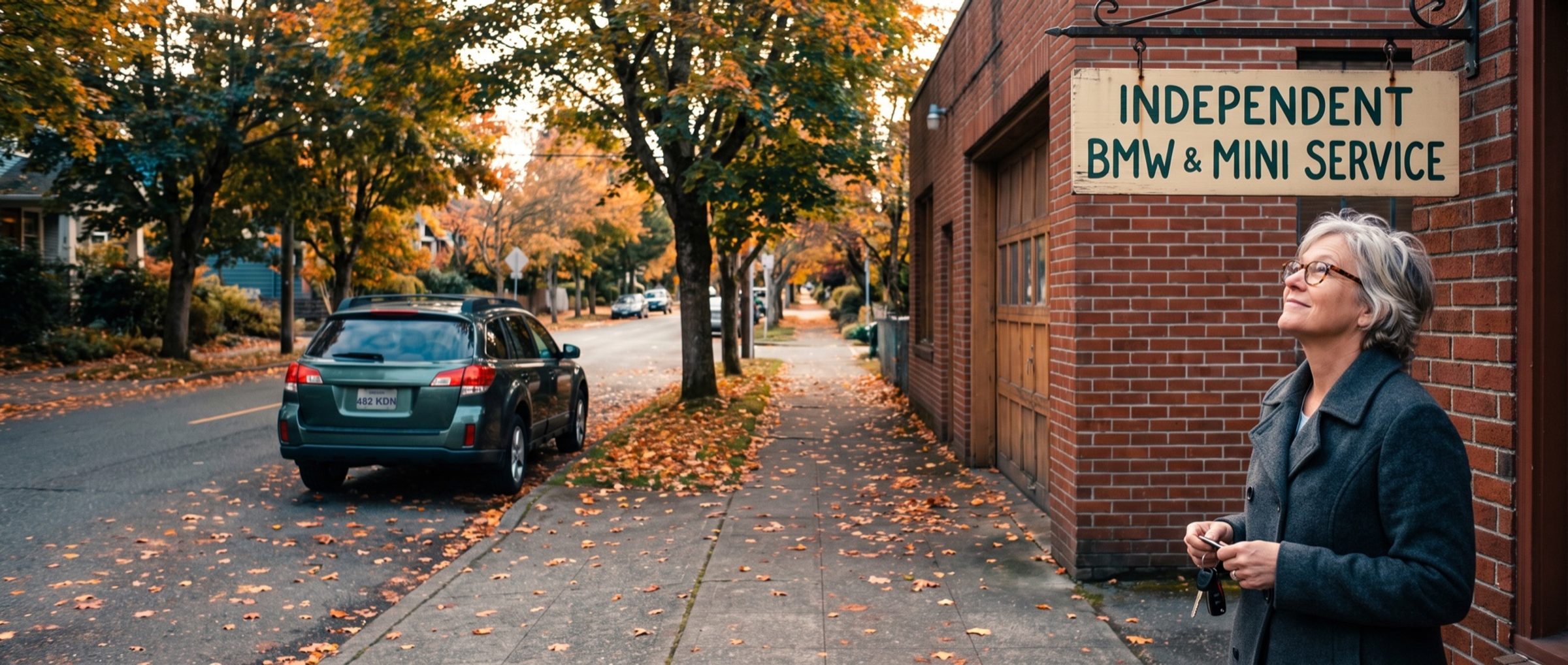
A driver with an out-of-warranty BMW types "bmw independent shop near me" into Google. About 590 people a month in the US type that exact phrase. The word "independent" is theirs, not a shop's. They already know they don't want the dealer, and they're asking Google to find the other kind of shop.
Most repair ads in our sample don't use that word back. Chapter 15 covered the fee that surprises drivers at the counter. This last bonus chapter covers the car brands in a repair shop's ads: what Google lets an independent shop do with "Subaru" and "BMW," where the line is, and the one word that keeps an ad on the right side of it.
This chapter explains Google's policy for an educational guide. It isn't legal advice about trademark law. If a carmaker or dealer contacts you about your ads, talk to a lawyer.
Google Won't Restrict Car Brand Names as Keywords. It Will Restrict an Ad That Uses Them in a Misleading Way.
Google's trademark policy starts with a permission: "Advertisers may use trademarks that belong to others in certain situations as described below, like when identifying a product for sale." For a repair shop, the car brand is the product it works on.
Keywords are the easy part. Car brand names typed into a keyword list sit on the policy's "will not restrict" list. A shop can bid on "subaru repair," "bmw mechanic" or "independent toyota mechanic near me" without asking anyone.
Ad text is where the policy has teeth, and even there it works on complaints. "If a trademark owner submits a complaint to Google about the use of their trademark in Google Ads and Display & Video 360 ads, we'll review it and may restrict use of the trademark." When Google reviews a complaint, the brand has to appear in the ad itself: "The trademark must be used in the ad, not only on the ad's landing page."
What Google restricts after a complaint is specific. It lists "Ads that use the trademark in a confusing, deceptive, or misleading way," along with brand names used in an ad by a direct competitor. A repair shop isn't a carmaker's competitor in the way a rival brand is, but an ad that blurs the two invites the first rule. What it doesn't restrict is just as specific. Google won't restrict an ad on these grounds when its landing page is "primarily dedicated to selling or clearly facilitating the sale of products or services, components, replacement parts, or compatible products or services corresponding to the trademark." The page also "must clearly provide a way to purchase the products or services and display commercial information about them, such as rates or prices," and "The ad and landing page must be clear as to whether the advertiser is a reseller or informational site."
Read those together and a repair shop's line is clear. Naming the car it fixes is fine. Looking like the carmaker or its dealer isn't. And a restriction tends to stick: it will "generally be applied on an ongoing basis in any ads that use the same second-level domain in their final URL." Google does say a violation won't mean an instant suspension: "A warning will be issued at least 7 days prior to any suspension of your account."
60 of 229 Local Repair Ads Named a Car Brand. Only One Said the Shop Was Independently Owned.
Of the 229 readable Search ads from local shops in our sample, 60 named a car brand, from 15 different shops. That count is stricter than the one in Chapter 4, which also counted words like "German," "European" and "Import." Here only brand names count: Subaru, BMW, Land Rover, Audi, Honda, Toyota, Volvo, MINI and the rest.
Most of them read the way a dealer's ad would. Forty-one of the 60 put the brand straight in front of "Repair" or "Service": "Subaru Repair & Service," "Audi Repair & Service," "Honda Repair & Service." Nothing wrong with any of that under Google's policy. But a driver scanning the page sees "Subaru Service" in an ad from a shop they've never heard of, and has to work out whether it's the dealer.
The dealers in the same sample show why that matters. Their ads named a brand too: 42 of the 45 dealer ads we could read named a make or vehicle type. On a search for "subaru repair," a driver can see a dealer's ad and an independent shop's ad that both lead with "Subaru," with nothing in either one to tell them apart.
Only one of the 60 answered that question in the ad. A MINI ad from a shop in Bend, Oregon, said it in the description: "Independently-owned Repair Shop. Factory-trained and Ex-dealership Technicians." That's the whole pitch in two short sentences, and it's the line drivers are searching for.
Drivers Put "Independent" in the Search Themselves. "BMW Independent Shop Near Me" Gets 590 Searches a Month.
Google's Keyword Planner shows how often drivers ask for an independent shop by name, US-wide, per month:
- "independent auto repair": 2,400
- "independent mechanic near me": 1,300
- "bmw independent shop near me": 590
- "independent bmw mechanic near me": 390
- "independent subaru mechanic near me": 320
- "independent mercedes mechanic near me": 320
- "independent toyota mechanic near me": 260
Keyword Planner's related ideas for those searches returned 248 phrases containing "independent," together about 25,000 searches a month. Most are small, one make and one city at a time. They aren't cheap, either: Keyword Planner's top-of-page bids for "bmw independent shop near me" reach about $11.84, against about $6.40 for "independent mechanic near me." Advertisers bid more for the driver who names the make. Most come from drivers who have already decided against the dealer; a few are still weighing the dealer against an independent shop.
Those searches fit the account this guide built. In the exact match campaign from Chapter 6, give each make the shop really services its own ad group, with the "independent" searches inside it next to the plain make searches. The headline says the word back: "Independent BMW Specialist" is 26 characters. The ad lands on that make's page, and the bid follows the same rule as every other ad group: what each booked car costs, from the shop's repair orders.
"Land Rover Repair Specialist - Official" Looks Like a Dealer Ad. It Ran for an Independent Portland Shop.
One Portland shop that works on Land Rovers and Sprinter vans ran ads in our sample like this one: "Land Rover Repair Specialist - [shop name] - Official." Five of its ads put "Official" right after the shop's name, three of them in a headline that starts with Land Rover or Range Rover.
The shop is independent, and its ads name it. Our reading is that "Official" was meant to mark the shop's own website. But a driver reads headlines in pieces. "Land Rover Repair Specialist" plus "Official" adds up, at a glance, to the carmaker's own service network. That's the kind of confusion Google's policy names.
The fix costs nothing and sells better. Pair the brand with the word drivers are already searching for:
- "Independent Land Rover Shop" (27 characters)
- "Not Affiliated With Land Rover" (30 characters, the exact limit)
- In a description: "Independent Land Rover and Sprinter shop. Factory-trained techs and dealer-level work." (86 of 90 characters)
None of this means hiding the brand. A Land Rover owner wants to see "Land Rover" in the ad. The shop just has to make it plain whose ad it is.
Google's Trademark Policy Names Two Things a BMW Repair Page Needs: Posted Prices and a Way to Book the Work
Google's rules look at the page as well as the ad. The policy describes the kind of page (one dedicated to the services for that brand), names two things it needs, and we add two more:
- What the shop does for that car. Services for BMWs, listed plainly. This is the page "primarily dedicated to selling" those services.
- A way to buy. A booking button and a phone number near the top: "a way to purchase the products or services."
- Prices or rates. The policy asks for "commercial information... such as rates or prices." A posted diagnostic fee from Chapter 15 or an hourly labor rate counts.
- The word "independent" (our addition). One sentence near the top, saying the shop is independently owned and not affiliated with the carmaker or its dealers.
- The shop's own name and logo, never the carmaker's (our addition). The brand name appears in text. The badge stays off the page.
Chapter 4 built these make pages for Ad Rank. The same pages, with these five things added, give a shop's brand ads the clearest footing we know of under the policy. And Chapter 14's warranty line belongs here too: a driver choosing between "independent" and the dealer wants to know the factory warranty stays in effect.
Using car brands to reach the drivers who want an independent shop, without borrowing the dealer's identity, is how our Google Ads management team handles make-specific campaigns for repair shops.
Next: All 16 Chapters in Order, From Counting Booked Cars to Turning On AI Max Last
That's the full guide. In order, it builds one account:
- Count the booking widget: track booked cars, not page views.
- Warning lights vs shop searches: bid on the driver ready to book.
- Price the car, not the coupon: what a customer is worth.
- Make ads, make pages: a page for each car you work on.
- Home AC and other noise: clean the keyword list.
- Brake repair vs the grinding: exact match first, broad match later.
- Bids by the repair job: hand-set bids per service.
- Answer the upsell fear: ad copy from real reviews.
- Hours, calls and settings: launch settings that match the shop.
- Performance Max for the big jobs: not the oil change coupon.
- Repair shoppers, not car shoppers: Demand Gen audiences.
- Local Services Ads without the badge: a side test once Search books repairs.
- AI Max and your own website: fix the site first, turn it on last.
- The dealer warranty myth: say it, and say it accurately.
- Diagnostic fees and estimates: the number in the ad.
- Car makes and the dealer line: this chapter.
The order is the method. A repair shop opens with exact match keywords for the jobs it wants plus a campaign for its own name. Broad match joins once the shop books 30 or more good conversions a month from Search. Performance Max and then Demand Gen follow when both Search campaigns keep that up, Local Services Ads stay a small test on the side, and AI Max is switched on last. At every step the yardstick is the same: what each car that actually rolled into a bay cost.
Every chapter is also on the guide's home page. The guide is written for independent repair shops in every state.