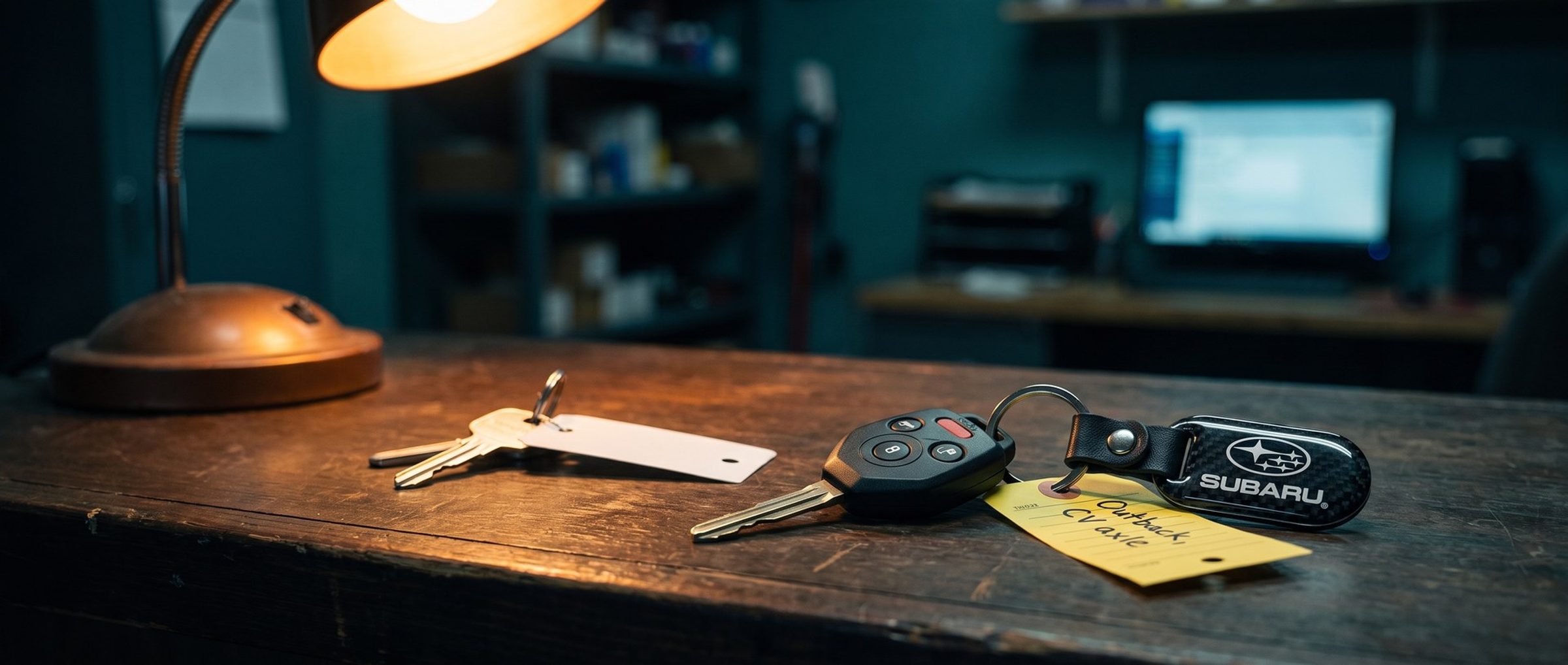
A driver with a 2014 Outback and a clunk in the front end searches "subaru repair near me." An ad comes up: Subaru specialists, honest pricing, book online. She taps it and lands on the shop's home page, which lists oil changes, brakes, tires, alignments, AC, diagnostics and "all makes and models." The word Subaru never appears again.
She'll probably back out and tap the next ad. But Google had already judged that page before it sold the click. The match between what she typed, what the ad promised and what the page delivered is part of how Google decides where an ad shows and what it costs. A shop that breaks the match pays for it twice: once in the auction and again when the driver leaves.
This chapter is about winning that match. Chapter 3 set a ceiling on what a shop can pay to bring one car in. This one is about winning the click for less.
The Repair Shop With the Highest Bid Can Still Lose the Top Spot. Google Weighs Five Other Things Too.
Behind every "subaru repair near me" there's a split-second auction among the shops bidding on it. Google scores each shop's ad, and that score, Ad Rank, settles who appears and in what order. By Google's own account, six inputs feed that rank:
- The bid. Your ceiling for the click. The real charge often comes in under it.
- Quality. Google holds the ad, and the page it opens, up against the search itself.
- Ad Rank thresholds, a floor: below it, an ad doesn't get that spot no matter what it bid.
- How tight the race is. When two shops' ads score close together, they trade the spot back and forth.
- The context of the search. A driver typing "brake repair" on a phone two miles away at 7 PM is a different auction from a laptop search across town at noon.
- What the ad's extras should add: a call button, links to your brake and Subaru pages, your address.
The bid is one line out of six. Google doesn't publish a formula, and the old multiply-the-bid-by-the-score shortcut you'll still find online isn't how Google describes it today. What Google does say plainly is that "higher quality ads can often lead to lower CPCs." In a repair account, the cheapest way to raise quality is relevance: an ad and a page that say exactly what the driver searched.
Quality Score Is a Dashboard Light, Not the Engine
Google Ads also shows a Quality Score for each keyword, from 1 to 10. Shops sometimes treat it as the thing to optimize. It isn't. Google calls it "a diagnostic tool," and its help page puts it bluntly: "Quality Score is not an input in the ad auction."
Think of it the way you'd think of a check engine light. It tells you where to look; it doesn't run the car. Google builds the score from three readings:
- Expected click-through rate: Google's estimate of how often drivers tap this ad when it appears for that keyword.
- Ad relevance: does the ad speak to the search? Subaru for a Subaru search, brakes for a brake search.
- Landing page experience: Google's read on the page itself. A Subaru ad that opens a Subaru page keeps its promise; one that opens the home page breaks it.
Google grades each part "Above average," "Average" or "Below average" next to the keyword. Read those labels, not the single number. If "subaru mechanic" shows a strong ad but a weak page, rewriting the ad won't help. The Subaru page is the repair.
Relevance is the reading a shop can shift fastest of the three. Shrink the ad group until one ad can honestly echo every keyword in it, and the relevance reading follows. That's where most repair accounts go wrong: one ad group called "Auto Repair" with eighty keywords, from "brake repair" to "subaru mechanic" to "check engine light," all sharing one ad that can't speak to any of them.
"BMW Repair Near Me" Draws 9,900 Searches a Month. Drivers Search the Car Before the Service.
Repair shops tend to think in services. Drivers often think in cars. Google's Keyword Planner shows how much of the demand starts with the make or where the car came from. Searches a month across the US:
- "bmw repair near me": 9,900
- "mercedes repair near me": 8,100
- "european auto repair near me": 8,100
- "japanese auto repair": 8,100
- "subaru mechanic": 5,400
- "audi repair near me": 5,400, with top-of-page bids reaching $25.39
Those drivers aren't asking for any mechanic. They're asking for one who knows their car. Some local ads answer that head-on; two Portland-area shops ran "The Same Expertise As The Dealer, At A Better Price."
The shops advertising in our example market already sell this way. In our example market, Portland, Oregon, we read 229 Search ads from 30 local shops whose ads we found in Google's Ads Transparency Center. 87 of them named a car make, an origin like "German" or "Japanese," or a vehicle type like the Sprinter van. It was the second most common thing in those ads, behind star ratings. Your market's makes will differ. In a Subaru town it's Subaru; somewhere else it's trucks or German imports.
Make searches can also cost more. In Portland, Keyword Planner shows top-of-page bids for "subaru repair" reaching $20.79 and for "bmw repair" $23.38, against $10.00 for "auto repair near me." That's one more reason to make sure a make click lands somewhere that earns it.
A Subaru Ad That Lands on a Home Page Throws Away the Match Ad Rank Rewards
The fix lives in how the account is built. Isolation, the opening campaign in our build and a name we use rather than a Google setting, sorts its exact match keywords into one ad group per make, every bid typed by a person. Each make or origin you actually service gets its own ad group, five or six close keywords, nothing else in it:
- "subaru repair near me," "subaru mechanic near me," "subaru repair shop," "subaru service near me," "independent subaru repair"
Start with the makes your shop software says you already service most. Those are the ad groups with the jobs, the parts knowledge and the reviews to back the ad up. Add makes later as the shop's mix changes.
The ad in that group says Subaru in the headline. The final URL goes to a page about Subaru: the models you see most, the jobs you do on them, the technicians who know them. The searcher's word shows up three times in a row, in the search, the ad and the page. That's ad relevance and landing page experience, the two parts of quality a shop can most directly change. Google allows a car make as a keyword, and in the ad when the page is about servicing that make, as long as the ad doesn't suggest the shop is the dealer. Chapter 16 covers those rules.
Four of the twelve example sites we profiled already have the pages for it. Two have make pages by the dozen (23 and 25 of them). One has six pages for the German makes it works on. One splits its pages by origin: Asian, domestic and European.
Having the page isn't enough if the ad doesn't use it. One Portland shop's Audi ads printed "/audi" in the green address line, yet its Audi page sits at "/vehicles/audi." Shops fill that path in by hand, and it doesn't need to match a live page, so it proves nothing on its own. It's still the nudge to open each make ad's settings and confirm the click really lands on that make's page.
Last, test the page itself. Google's PageSpeed Insights tool shows how fast the page loads on a phone, and a driver standing next to a car with a warning light is likely holding one. A slow page loses the click you already paid for.
"Brake Repair Near Me" Belongs on a Brake Page. 10 of 12 Shops We Checked Already Have One.
Services work the same way as makes, and a shop already has more of these pages than it thinks. "Brake repair near me" gets an ad group of close brake searches, an ad about brakes and a final URL on the brake page. Ten of the twelve example sites had a page just for brakes; the two without one were a transmission specialist and a shop that lists every service on a single page. Transmission, AC, check engine light diagnosis and alignment each get the same treatment wherever the shop has the page.
No page yet? Write it first. The ad group can wait a week; an ad pointed at the home page shouldn't run at all. A page that answers one search, with your prices or price policy, your warranty and a way to book, will earn its keep for years. The home page has one job in a Google Ads account: catching the drivers who search your shop's name.
The payoff shows up in the same Quality Score labels from earlier. Give a new make or service group a few weeks of clicks, then check its ad relevance and landing page experience. Below average on either one points straight at the ad or the page that needs the work.
Shops that want help mapping their makes and services to ad groups and pages can see how our Google Ads management sets up an account.
Next: Keyword Planner Mixes Home AC Searches Into Car AC Lists. "AC Repair Near Me" Bids Up to $100 a Click.
With the structure in place, it's time to fill the ad groups. Chapter 5 seeds Google's Keyword Planner from competitors' sites and shows what has to come out before anything goes live, starting with the home air conditioning searches that land in a car AC list and carry home AC prices.
This chapter is part of Google Ads for Auto Repair, a sixteen-chapter guide for independent repair shops in every state.