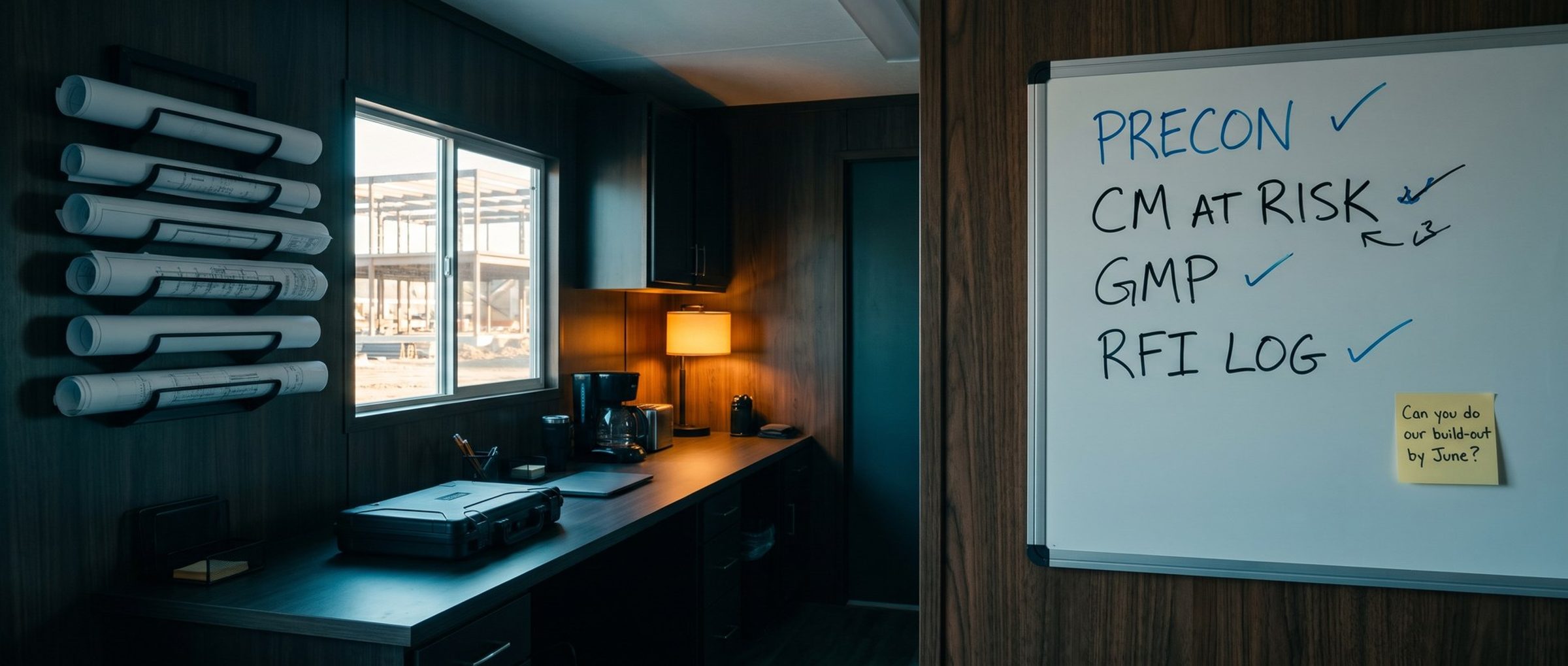
A builder spends weeks getting its ad headlines right: "Tenant Build-Outs Around Your Lease," "Dental Office Build-Outs," "Finished 6 Weeks Ahead." Then it switches on AI Max, and Google starts writing more headlines of its own. Where does Google get the words? From the builder's website.
If that website talks about "preconstruction services" and "construction management," so can the new ads.
This chapter covers what AI Max writes and where it gets the words, what the example market's builder websites actually say, the controls Google gives you, and why AI Max is the last thing a builder turns on. It follows Chapter 12, which covered reviews and the map.
Google Writes Extra Ad Text From a Builder's Own Pages When AI Max Is On
AI Max is a set of automated features for Search campaigns. Chapter 9 introduced all three and switched them off at launch. This chapter is about the one that writes.
Google calls it text customization. The raw material is whatever the builder already put in front of Google. A service page headed "Preconstruction Services," the project gallery an ad links to, last year's ads, the keywords from Chapter 6: Google's AI Max page names all four kinds of source. That same page shows the setting arriving already ticked the moment a builder opts a campaign into AI Max. Final URL expansion, the Chapter 10 feature that can land an owner on a page the builder didn't pick, comes ticked too, and it can't run on its own: untick text customization and Google unticks the page-swapping along with it.
Google adds its own headlines and descriptions to the ad. A builder who wrote careful headlines in the owner's words, the way Chapter 8 recommended, can end up with ads that also carry lines Google wrote from the website.
That's fine if the website speaks the owner's language. In our example market, most didn't.
Text customization is the AI Max feature most likely to change what an owner actually reads. The other two change which searches and which pages a click lands on; this one changes the words in the ad itself, the words Chapter 8 argued are a builder's best chance to stand out.
"Build Out" Showed Up in 33 Posts on Owners' Reddit Threads. Builder Sites Said "Preconstruction" Instead.
Chapter 4 compared the words owners use with the words builders use. In 309 posts and replies on owners' forum threads about commercial space, "build out" turned up in 33. "Design-build" and "construction management" turned up in none.
For this chapter we went back to the pages we'd saved from the 12 example builders' websites, the homepage and about 10 other pages each, and counted the same words:
- 11 of the 12 sites used "design-build," "construction management" or "preconstruction" at least once. The only one that didn't was an asphalt paving contractor.
- 5 of the 12 sites used "build out" at least once. Three used it often; for the other two it appeared once.
- One site used "preconstruction" 61 times across its saved pages. Another used it 27 times alongside "design-build" 31 times.
Those counts come from the pages we saved, not every page on every site, so read them as a pattern rather than a census. The pattern is clear enough: most of these builder websites are written for other people in the industry, and the industry says "preconstruction."
That's not a mistake on a website. A firm that chases public work and large negotiated projects may be writing for the facilities directors and architects who evaluate it, and those readers expect the terms. Architects and owner's reps read those pages too, and the terms mean something to them. It becomes a problem only when the same words go into ads aimed at a dentist searching "dental office build out." Chapter 4 showed why: Google grades how well an ad matches the search, and an ad that answers "build out" with "preconstruction services" reads like the wrong answer.
Text Guidelines Let a Builder Block Words AI Max Should Never Use
Google gives advertisers a control for this. Its AI Max page says that when text customization is on, you can use text guidelines "by establishing specific term exclusions, such as restricted words or phrases, and messaging restrictions to dictate tone and guidelines for the AI-generated text."
For a commercial builder, the list writes itself from earlier chapters:
- Words that pull the wrong people. Residential words such as home, house, kitchen and remodel (Chapter 6). "Bid" and "bidding," which in construction searches usually come from subcontractors looking for work (Chapter 14).
- Claims that need proof. "Licensed," "bonded," "LEED" and certification claims, which can carry legal weight in construction ads (Chapter 15). Let a person write those, or leave them out.
- Promises a builder can't keep. Prices, guaranteed finish dates, "lowest cost." Chapter 8 showed how a specific, true schedule claim beats a vague one; AI-written text has no way to know which of your projects actually finished early.
A messaging restriction can also set the tone, which matters for a builder whose clients are business owners, not consumers: tell Google the ads speak to business owners and property managers, not homeowners, and use plain words over industry terms.
The page controls from Chapter 10 still apply. Final URL expansion comes on by default with text customization, so the URL exclusions for careers pages, subcontractor forms and supplier portals need to be in place before AI Max goes on.
AI Max Works Best on Conversion Bidding, Which Needs Real Project Inquiries First
On the same AI Max page, Google warns that its three features lean on Smart Bidding that targets conversions, and won't do their job well on a builder's hand-set bids. For a builder, the conversion is a project inquiry, so AI Max waits until the account has enough of them for Google to aim at.
That puts AI Max at the end of a builder's rollout:
- Isolation (Chapter 6): exact match keywords, bids set by hand. AI Max off, as Chapter 9 set it at build.
- Exploration (Chapters 6 and 7): broad match with a target cost per inquiry, once the account logs about 30 good project inquiries a month.
- Performance Max and Demand Gen (Chapters 10 and 11): at the same threshold, with brand exclusions and the right segments.
- AI Max: last, one campaign at a time, with text guidelines and URL exclusions set first.
Some single-market commercial builders never reach that point, and that's fine. A builder winning work from exact match keywords and a well-written set of headlines isn't missing much. When a builder does turn AI Max on, it should do so in one campaign first and read the new headlines Google writes, the way it would read a new employee's first proposal.
Reading them is a weekly job for the first month. Look for three things, and keep a running list of what you found so the exclusions grow with the account. Industry terms that slipped in from the website: add them to the term exclusions, then fix the page they came from. Claims nobody on the team would sign: exclude the words, and check whether the website makes the same claim. Residential or job-seeker language: that usually means a careers or residential page is feeding the text, so exclude that page from Final URL expansion too. After a month, compare the campaign's cost per project inquiry with the month before. If AI Max brought more searches but no more inquiries, switch it back off; the account was doing fine without it. If it brought more inquiries at a similar cost, keep it, and keep reading what it writes.
A Service Page Written in the Owner's Words Gives AI Max the Owner's Words to Repeat
The best control over what AI Max writes isn't a setting. It's the website.
Chapter 4 recommended a page for each kind of work a builder wants to win, written in the words owners use: tenant build-outs, offices, dental and medical offices, warehouses. Those pages do double duty once AI Max is on. They're the landing pages for the ads, and they're the text Google reads when it writes new headlines. A tenant build-out page that says "build-out" and "TI" in its headings and first paragraph gives AI Max those words to work with. So does a dental office page that names the things a dentist worries about: operatories, plumbing for chairs, X-ray shielding, opening before the lease's rent starts. Google can't write a headline about a schedule the page never mentions, or a building type the builder never names. A page that opens with "comprehensive preconstruction services" gives it those instead.
So before AI Max goes on, read the service pages the way Google will. Do the headings name the work the way an owner would search for it? Does the first paragraph mention the building type, the schedule and the kind of owner the builder serves? Is "preconstruction" explained, or just used? A few hours rewriting those pages improves the ads AI Max writes, the landing page grades from Chapter 4, and the pages architects and owners read on their own.
If you'd like a builder's service pages and ad text checked before AI Max goes on, our Google Ads agency does this with commercial builders.
Next: The Only Construction Ad We Found Using "Bid" Targeted Subcontractors
Chapter 14 looks at the word "bid": who searches it, why the one construction ad we found using it was aimed at subcontractors, and how public owners actually buy construction. The full chapter list is on the Google Ads for Construction Companies guide home.