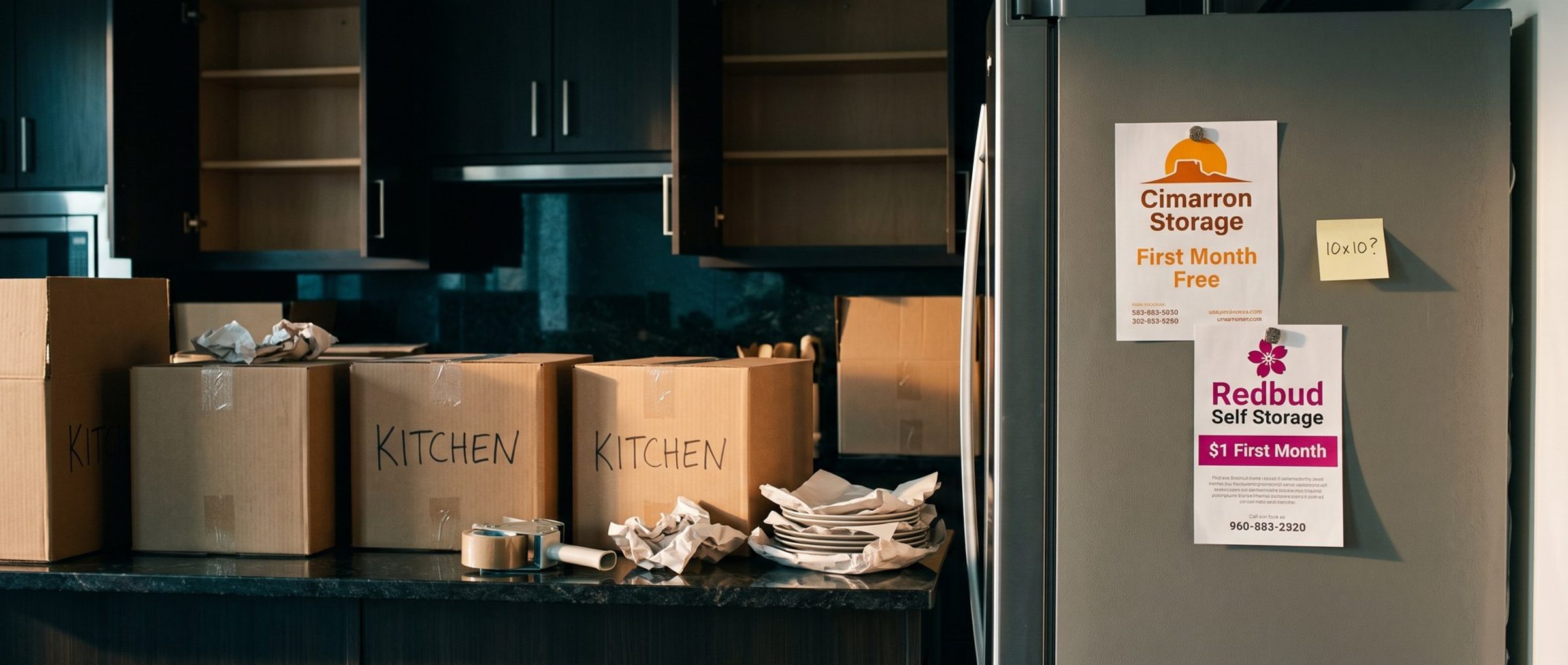
A storage renter who types "storage units first month free" is telling you two things: they're ready to rent, and they're shopping on price. Advertisers know it. Across the US, the top-of-page bids Keyword Planner reports for promotion searches run well above the bids for the plain unit searches, and some of the bidders are national chains with marketing budgets of $20 million to more than $100 million a year.
A new storage account doesn't have to join every one of those auctions at whatever price they reach. In the first campaign, the Isolation campaign from Chapter 6, you set every bid yourself. This chapter covers how to pick those bids from what a move-in is worth, which Google Ads columns tell you whether they're working, when to walk away from an auction, and when Google's automated bidding is ready to take over. The national figures come from Keyword Planner; the local ones from our example market, Oklahoma City.
Clicks on Storage Deal Searches Cost More Than "Near Me." Manual Bids Let You Decide How Much More.
Keyword Planner attaches two numbers to each storage search, a low and a high estimate for a spot above the free results, both built from past auctions. The high one is a bid that would have topped about four in five past top-of-page auctions. Nationally, here's how the deal searches compare with the plain one:
- "storage units near me": high end about $21.81
- "cheap storage units": about $26.59
- "storage units first month free": about $34.24
- "$1 storage units": about $50.00
The pattern makes sense. A renter shopping a promotion is close to signing, and the operators who advertise those promotions are willing to pay for them. But the pattern doesn't hold everywhere. In our example market, "storage units first month free" came in at $14.84 at the high end, below "storage units near me" at $17.40. Local auctions have their own mix of bidders, which is why your own market's numbers matter more than any national average.
Manual bidding puts a ceiling on each storage ad group's clicks: you type in the most a click is worth, and that's the most it can cost, before any bid adjustments you set. You can bid hard on the searches that produce move-ins and stay modest on the ones that don't, regardless of what the chains are doing.
A Storage Bid Should Start From What You'll Pay per Move-In, Not From Keyword Planner.
Keyword Planner tells you what others have paid. Your bid should come from what you can afford. Chapter 3 worked out the chain: about $120 per lead and roughly half of leads moving in, for about $240 per move-in, which is what you've decided to pay to win a tenant worth about $2,000 in rent. Your own numbers will replace these benchmarks.
A storage bid ceiling comes from two of those numbers: the lead price you'll accept, times the fraction of your clicks that reserve, call or fill in a form. With a $120 lead and a 4.65% conversion rate (the storage benchmark from LocaliQ, a vendor), the average click you can afford is about $5.60. The same benchmark puts the typical storage click at $7.46, already above that ceiling, so treat $5.60 as a cautious starting point and replace it with your own conversion rate as soon as you have one. Either way, the ceiling tells you which auctions your economics can carry.
For a storage facility's first Isolation campaign, the routine looks like this:
- Price each unit-type group separately, so climate, drive-up and each size carry their own bid.
- Start near the bottom of the Keyword Planner range for each group, then raise bids where the clicks turn into reservations and calls.
- Give your best groups more room. If climate-controlled searches turn into higher-rent move-ins, they can carry a higher bid than the drive-up group.
- Recalculate as data arrives. After a month, your own cost per lead and conversion rate replace the benchmarks, and the ceiling moves with them.
Impression Share Shows How Many Storage Searches Ran Without Your Ad. Low Rank or a Small Budget Is Usually Why.
Once the campaign runs, three columns in Google Ads tell you whether your bids are high enough. Add them to the keyword or ad group view:
- Search impression share: the share of searches you were eligible for where your ad actually appeared. Google defines it as impressions divided by the impressions you could have received.
- Top and absolute top impression share: the first counts storage searches where your ad ran above the free search results; the second counts the ones where it was the first ad of all.
- Lost impression share, by rank and by budget: the storage searches that ran without your ad, which Google Ads splits into those your ad ranked too low to show on and those after the day's budget was spent.
For the searches that matter most, the six from Chapter 6 and your town names, aim for a top impression share of about 75% to 90%. Below that, renters are seeing someone else first. If you're losing share to rank, raise the bid on that group or improve the ad and page behind it (Chapter 4). If the money runs out before the searches do, fund the campaign further or trim it back to the unit-type groups that actually rent units. For the weaker groups, a lower share is fine; you don't need to win every search.
Watch the calendar too. Storage demand moves with the moving season: Extra Space's annual report notes that occupancy usually runs higher in the summer months, when more people move, and in Keyword Planner the near-me searches dip to their lows in November and December. With manual bids, that means checking impression share at the start of each season instead of leaving one set of bids in place all year. Public Storage notes in its annual report that the cost of paid search varies with demand and with "the number and aggressiveness of bidding competitors," so the price of a top spot can rise in the moving season and ease when it ends. Adjust group by group, not across the board, so the climate and size groups that rent in every season keep their footing.
Keep the Quality Score column in view too. A keyword with a low score is costing more per click than it should, and the fix is usually the ad group or the landing page, not the bid.
Auction Insights Names the Facilities Bidding Against You. Some Fights Cost More Than They Return.
Google's auction insights report shows who else is bidding on the same searches and how you compare. Each rival storage advertiser gets a row with six numbers. Two show reach: their impression share and how often they and you appeared on the same search. Three show who's winning: how often you outranked them, how often their ad sat higher, and which of you landed above the free results more often. The sixth is how often each ad ran first.
In our example market, the report would read like a who's who of national chains and regional operators. That's useful in two ways.
First, it shows where you're fighting chains on price. In our example market, the chains and national brands included a price or promotion in 48 of their 134 readable ads, against 4 of 17 from local independents. If a chain sits above you most of the time on a deal search and your cost per move-in on that search climbs past your ceiling, that's an auction to leave: lower the bid until it's affordable, or pause the keyword and put the money into searches where your facility competes on location, climate control or service.
Second, it shows where you're winning cheaply. A search where you outrank most competitors at a modest bid is one to protect and, if the budget allows, to raise.
Target CPA Works Best After About 30 Conversions a Month. Below That, Hand-Set Bids Do the Job Better.
Manual bidding is the right start, and in Isolation it stays the setting; what changes is that a second campaign adds automated bidding beside it. Automated bidding needs something to learn from, and for a storage account that means roughly 30 quality conversions a month: reservations, online rentals and qualified calls added together. At that point the storage account adds Chapter 6's Exploration campaign, the broad-match twin of Isolation, bidding with Maximize Conversions plus a cost-per-conversion goal (labeled simply "Target CPA" in newer versions of Google Ads). For most storage accounts that happens around months two or three; busier accounts get there sooner.
Where to set that goal at first is spelled out in Google's help pages: start from what conversions cost over the past 30 days, and read the results over a stretch that holds 30 or more of them. Use the cost per conversion Isolation has actually produced, not a wish. Google cautions that an unrealistically low goal can cost you conversions, because the system then skips clicks it judges too pricey, real renters among them. Start at your real number and lower it gradually if the results hold.
Before you hand bidding to Google, check what it will learn from. If calls count as conversions, listen to a sample of them, or read Google's call reports if recording is on (Chapter 1). A 30-second call asking about gate hours from an existing tenant isn't a lead, and if too many of those count, target CPA will chase more of them. Clean conversions in, sensible bidding out.
Next: Storage Renters Praise "Clean," "Secure" and "Easy." Self Storage Ads Should Say What Renters Say.
Chapter 8 turns from what you pay to what your ads say, using the words renters use in their own reviews. Every chapter is listed on the Google Ads for Self Storage guide home, and Chapter 3 covers the move-in value these bids start from. Our Google Ads agency team manages bids for storage operators who'd rather not watch auction insights every week.