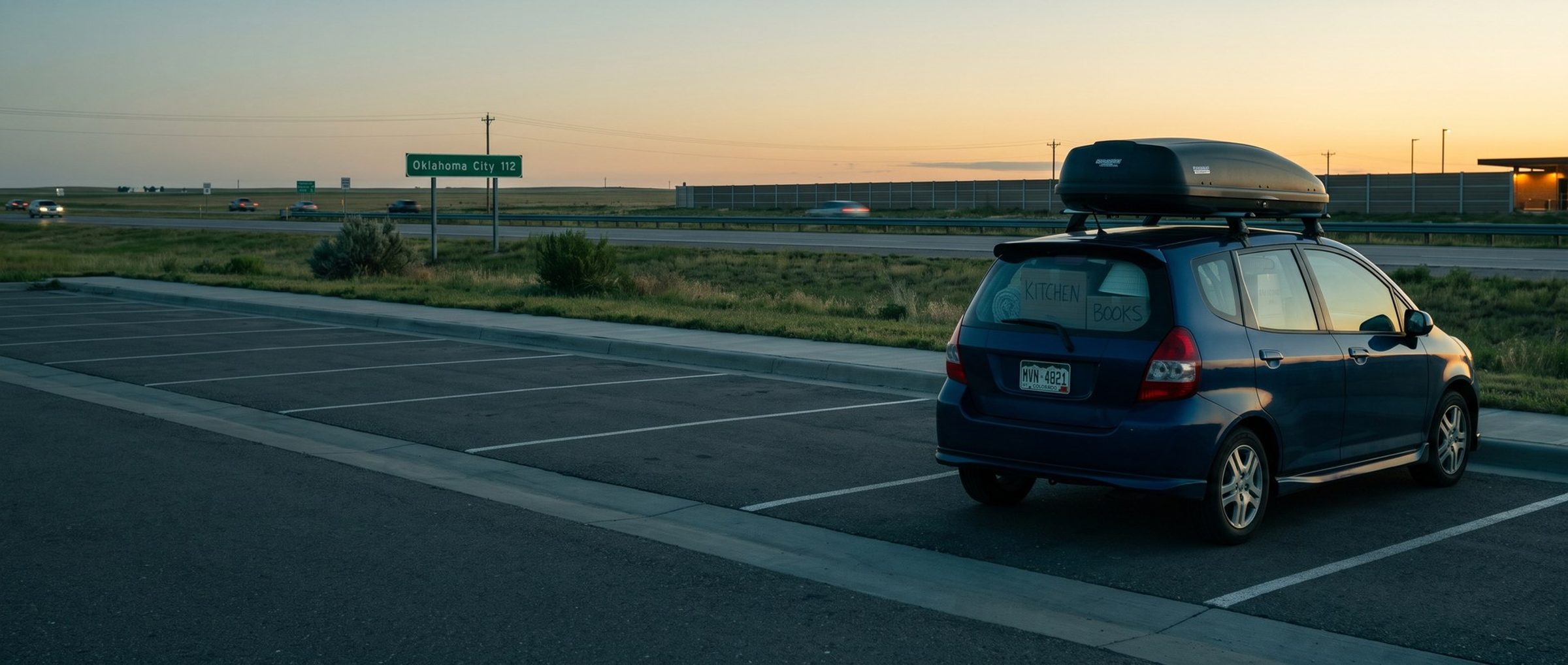
Someone in Dallas who just accepted a job in Oklahoma City has a moving date, a closing date that doesn't line up with it, and a truck full of furniture with nowhere to go for six weeks. They search "storage units oklahoma city" from a desk in Texas. That renter is real, ready, and invisible to a storage campaign that only shows ads to people already in the metro.
A new storage campaign opens with a page of settings. Together they decide which renters see the ad, which corners of the web it runs in, how much freedom Google gets to rewrite and rematch it, and whether a move-in can later be traced to the search that produced it. Most of them take a minute to set. Getting them wrong costs months of muddy data. This chapter walks through each one, starting with the setting that matters most for storage: where the searcher is.
Plenty of People Searching for Storage in Your City Don't Live There Yet. Keyword Planner Shows You How Many.
Keyword Planner reports search volume for any area you choose, so you can compare a search's volume across the whole US with its volume inside one market. The gap is the share of people searching from somewhere else. For our example market, we pulled the town-named storage searches for the US and for Google's Oklahoma City market area, which reaches well past the metro and takes in towns like Shawnee:
- "storage units oklahoma city": about 3,600 searches a month across the US, about 1,900 from inside the Oklahoma City area, so 47.2% from outside it
- "storage units shawnee ok": 45.8% from outside
- "storage units edmond ok": 44.6%
- "storage units yukon ok": 33.9%
- "storage units norman ok": 32.3%
- "storage units moore ok": 18.6%
"self storage oklahoma city" and "storage oklahoma city" share the same 3,600-search group as the first line, so the three phrasings aren't added together. The city's own name draws the biggest outside share, and smaller towns like Shawnee aren't far behind. Moore, surrounded by the metro, draws mostly locals.
Keyword Planner's figures by location are Google's estimates, so treat these as close, not a census. Some of the outside searchers live elsewhere in Oklahoma, in Tulsa or just past the area's edge. Others are likely people planning a move from another city or state.
Location Targeting Set to "Presence" Keeps a Storage Campaign Local. Renters Moving From Another State Need a Second Campaign.
Google Ads gives two location choices. "Presence" shows ads to people located in the area you target. "Presence or interest" also shows them to people elsewhere who have shown interest in that area. Google's help page calls the broader option a best practice on Search. It reserves Presence for advertisers who want their ads seen only by people inside the places they picked.
For a storage facility's main campaigns, Presence is the right call. Those campaigns hold searches like "storage units near me" and "climate controlled storage near me." When someone in Dallas types "storage units near me," they want a unit in Dallas, and with the broader setting your ad can still reach people outside your area based on the interest Google detects. Presence keeps the main campaigns' clicks local, which also keeps the data clean: a reservation came from someone who can drive to your gate. For the area itself, most single facilities do well targeting the metro or the towns their renters actually drive from. A tight circle drawn around the gate looks precise, yet Google's location help page cautions that tiny targets may get ads that appear intermittently, if they appear.
The movers get a campaign of their own, built so it can only show for searches that name your area:
- Target the US and exclude the area your main campaigns cover. Those campaigns reach the people inside it; this one reaches everyone else.
- Use only keywords that name your city or towns, in exact match: "storage units oklahoma city," "storage units norman ok," "storage units edmond ok." No near-me searches, no bare "storage units." Without a place name, a search from another state isn't about you.
- Write ads for someone arriving, with headlines like "Moving to Norman?" and "Reserve Before You Arrive." Online rental and reservation hold policies matter more here than anywhere else, because this renter can't visit first.
- Send the click to the same unit pages from Chapter 4, with sizes and prices up front.
- Keep the budget small to start. It's a slice of searches, not a second business. Watch whether these renters actually move in before raising it.
Judge this campaign on move-ins, not reservations. An out-of-town renter may reserve weeks ahead, and plans change between a job offer and a moving truck. Chapter 1's move-in import is what tells you whether the reservations from Dallas and Denver turn into tenants. If they do, the campaign earns more budget. If they mostly don't, ask whether your reservation hold and online rental flow give a renter enough confidence to commit from far away.
Search Partners and the Display Network Put Storage Ads Beyond Google Search. The First Campaign Leaves Both Off.
A Search campaign can reach further than Google's own results page. Search partners are other sites and apps that show Google ads next to their own search results and directory pages. Google's own help page cautions that some of those partner clicks won't come from people closely matched to what you sell, and a storage renter is a narrow match.
Display Expansion goes further still, sending a Search campaign's ads onto the Google Display Network, which Google describes as more than 3 million websites, videos and apps. It's also in transition: from October 2026, advertisers can set a priority tier and an optional budget cap for Display inside a Search campaign, and in February 2027 Google moves Search campaigns with Display Expansion onto that new setup automatically.
For a storage facility's first campaign, leave both off. The point of the Isolation campaign (Chapter 6) is to learn which exact searches on Google turn into reservations and move-ins. Clicks from a partner site or a banner on a news page blur that answer and spend money on people who never typed a storage search into Google. If the account later needs more reach, those networks can be tested as their own experiment, with their own numbers.
AI Max Comes Switched On in a New Search Campaign. A Storage Account's First Campaign Doesn't Need It Yet.
When you build a Search campaign today, Google checks the AI Max box for you. Under that one box sit three features. One lets a storage ad show on searches your keyword list never named. One writes extra headlines from your site, the text customization from Chapter 8. The third, final URL expansion, lets Google send a storage click to another of your pages it judges more relevant, even when you picked the climate page yourself.
Each of those undercuts what the first storage campaign is for. Exact match keeps the ad on known searches. Your own headlines carry the renters' words. Your own landing page choice sends a climate search to the climate page. So when you build Isolation, uncheck AI Max during setup and confirm every keyword is set to exact match. Google also notes that these AI Max features need conversion-based bidding to work well, and a manual-bid campaign with no conversion history doesn't have it.
That isn't a judgment on AI Max. It belongs in a storage account at the end, once there's a record of what rents units. Chapter 13 sets out the right moment for a storage account to switch it on, and the guardrails it needs, starting with the chain names it would otherwise bid on.
Auto-Tagging and Call Reporting Tie Each Storage Rental to a Search. Without Them, Move-Ins Can't Be Traced Back.
The last settings decide whether you can measure anything at all.
Auto-tagging stamps each storage ad click with an ID, a GCLID, tacked onto the end of the page address. New accounts get it switched on automatically, and Google lists it as a requirement for offline conversion imports, the route Chapter 1's move-ins take back into Google Ads. Check it anyway, in the account settings, and click one of your own ads in a test to make sure your site and rental software keep the ID in the address. Some redirects strip it.
Call reporting swaps your number in call ads, call assets and location assets for a Google forwarding number. Calls still ring at your office, but Google logs each one, and the ones that meet your rules count as conversions. Qualified calls are one of the conversions this guide bids on at the start, alongside reservations and online rentals, so without this setting a big part of the picture is missing. Set the conversion on calls long enough to be real conversations, and remember Chapter 3: a call nobody answers is a paid click that went to voicemail.
A few more settings round out the launch:
- Ad schedule: you can set up to six schedules a day per campaign. Run call-heavy ads when someone is in the office, and lean on online rental after hours.
- Language: since September 2026, a Search ad's own wording decides which language speakers it reaches; the old campaign language box is gone for Search. If your staff rents in Spanish, a Spanish ad group with a Spanish unit page does the job.
- Your facility's name: give it a separate small campaign, as Chapter 2 set out, so its cheap, high-converting clicks don't flatter the Isolation numbers.
Next: Performance Max Can Land a New Storage Renter on Your Bill-Pay or Auction Page. Exclude Those Pages First.
Chapter 10 takes the next step for an account that has the conversions to support it: Performance Max, and the pages on a storage site it should never send a renter to. The full chapter list sits on the Google Ads for Self Storage guide home, and Chapter 8 covers the ad copy these settings carry. If you'd rather have someone check the settings before launch, our Google Ads agency team builds storage campaigns this way from day one.