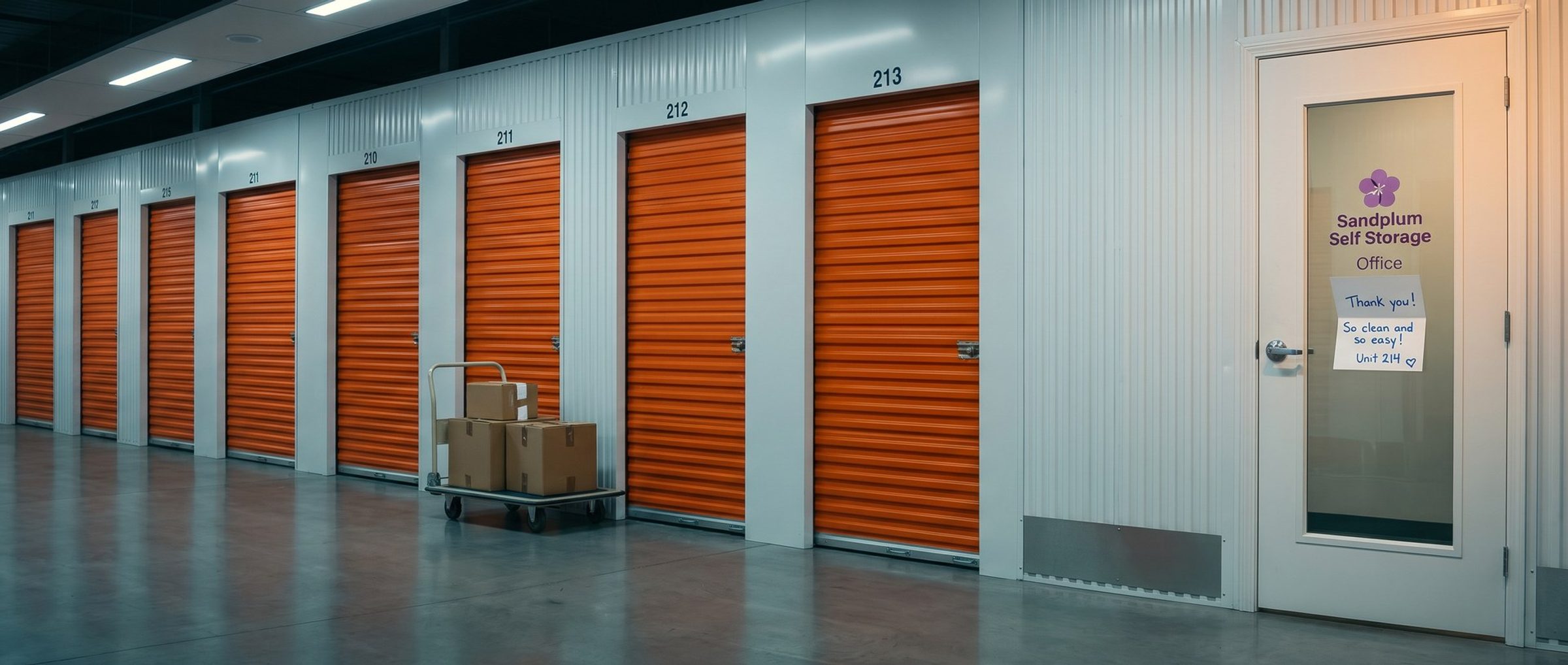
Read a few hundred five-star reviews of storage facilities and the same handful of words keeps coming back. Renters write that the place was clean, that the staff was helpful, that renting was easy, that their things felt secure. They rarely write "state-of-the-art," "solutions" or "peace of mind." Then read the replies owners post under those reviews, and the storage ads running nearby, and the vocabulary flips.
That gap is the opening for an independent facility. The words a renter uses to praise a storage facility are the words the next renter is scanning for in an ad. This chapter shows where to find those words, how to turn them into a responsive search ad with fifteen headlines, which claims your one-star reviews say to handle with care, and when to let Google's AI write copy for you. The review counts come from our example market, Oklahoma City; the method works anywhere renters leave reviews.
Happy Storage Renters Write "Clean" and "Easy." Almost None Write "Peace of Mind."
We pulled 1,895 Google reviews with text from 56 storage listings in our example market, then counted how many of the 1,447 four- and five-star reviews used each word at least once:
- "helpful": 320 reviews
- "clean": 296
- "friendly": 235
- "easy": 202
- "secure": 110
- "safe": 81
Then we ran the same count on the 1,389 owner replies posted under those reviews. Owners write in their own language. "Peace of mind" appears in 25 owner replies and 3 renter reviews. "Amenities" shows up in 30 replies and 2 reviews. "Solution" or "solutions" in 34 replies and 2 reviews. "Drive-up" in 29 replies and no reviews at all. Renters who loved a facility described it in plain, physical terms: the hallway was clean, the manager helped, the gate code worked.
"Drive-up" deserves a note: it's a real unit type and a real search, so it belongs in the drive-up ad group's headlines (Chapter 4). What the count shows is that renters praise the result of drive-up access, an easy move-in, more than the label.
A storage ad has thirty characters per headline to earn a click. Spend them on the words renters already use when a facility gets it right.
Storage Websites Already Say "Clean." Most Local Storage Ads Leave It Out.
The good news is that most facilities don't have to invent anything. We checked the saved pages of twelve independent and small-portfolio storage websites in our example market. Every one of the twelve uses "secure." Eleven say "easy" and ten say "clean." Eight also say "peace of mind," which is fine on a page; it just isn't the phrase renters reach for.
The ads are a different story. We read every recent Search ad we could find in Google's Ads Transparency Center for the local independents that advertise: 17 readable ads from 7 facilities. "Clean" appeared in 4 of them, all from the same facility. Security words such as gated, cameras or secure appeared in 9, from 4 facilities. A star rating or review count appeared in 1. Among the national chains' readable ads, ratings and review counts appeared in 52 of 138.
So the first draft of a storage ad starts on your own unit page. Take the words renters use that the page can prove:
- Cleanliness you can show: clean, well-lit hallways, pest control on a schedule
- Security in specifics: a gated entrance, cameras, individual door alarms, a manager on site
- Ease in steps: rent online, move in the same day, month-to-month terms
- The unit itself: climate range, sizes, drive-up access for the drive-up group
While you're in the Transparency Center, scan what the facilities near you already say. Chapter 5 used it to find keywords; here it shows which claims are crowded. If every rival leads with a percent-off deal and none mentions a clean, climate-controlled hallway, that headline is yours.
Fifteen Headlines Let Google Test a Storage Ad. Pinning Them on Day One Takes That Away.
A storage text ad on Google, which Google calls a responsive search ad, is built from parts. You supply as many as 15 short headlines, each capped at 30 characters, and as many as 4 longer lines of 90 characters; Google needs at least 3 and 2 to run the ad. For each renter's search it picks a few, arranges them, and over the weeks learns which pairings work best for which searches. Google recommends at least two of these ads per ad group, each rated "Good" or "Excellent" on Ad Strength.
Google also lets you pin a headline, locking it into one spot in every version of the ad. Google's help page steers most advertisers away from that. Every locked line leaves Google fewer pairings to try on each storage search, and the ad's Ad Strength rating can slip as well. For a new storage account, launch with nothing pinned. The exception is text that legally has to show in every ad, which would go in headline position 1 or 2 or description position 1, the only spots guaranteed to appear.
Because any headline can land next to any other, each has to make sense on its own. Here's a complete set for a climate-controlled ad group at a facility near Edmond, built from the review words and a unit page. Every line marked "if true" goes in only when it's true at your facility today:
- Climate-Controlled Storage
- Climate Storage in Edmond
- Clean Climate-Controlled Units
- Gated Access and HD Cameras (if true)
- Easy Online Rental
- Rent Online in Minutes
- Kept Between 55 and 80 Degrees (if you publish a range)
- 5x10 to 10x20 Climate Units (the sizes you have open)
- Manager on Site Every Weekday (if true)
- Friendly, Helpful Local Staff
- Month-to-Month Rentals (if true)
- Locally Owned Since 1998 (if true, with your year)
- Well-Lit Indoor Hallways
- See Sizes and Prices Online
- Rated 4.9 Stars by Renters (only while your rating says so)
And four descriptions:
- "Clean climate-controlled units kept between 55 and 80 degrees. Sizes and prices online."
- "Gated access, HD cameras and a manager on site. Rent online or call during office hours."
- "Renters tell us the place is clean, safe and easy. Read the reviews, then pick your unit."
- "Month-to-month climate units in Edmond. Reserve online and move in when you're ready."
Three of the headlines carry the ad group's keywords, which Google's guidance asks for, and the rest each add one reason to pick this facility. Your drive-up, size and town ad groups get their own sets built the same way. The Ad Strength rating shown beside the ad helps while you write, but it's a writing aid; Google says it isn't used in Ad Rank or Quality Score.
One-Star Storage Reviews Show Which Promises an Ad Can't Keep.
Five-star reviews tell you what to say. One-star reviews tell you what to be careful saying. We read all 394 one- and two-star reviews in the sample and coded each by its main complaint. Four of the biggest groups, plus one that tests an ad claim directly:
- Rent raised after move-in: 88
- Break-in or theft: 48
- Rude or dishonest staff: 47
- Nobody in the office or answering the phone: 32
- Reservation or online rental not honored: 13
Each one maps to a claim that needs proof behind it. "Secure" is the word renters praise and the one they feel most betrayed by, so name the specifics instead: the gate, the cameras, the lighting. "Call now" in an ad that runs at 9 p.m. sends a renter to voicemail, so give office hours or schedule call ads for the hours someone answers. "Reserve online" only works if the unit is there when the renter arrives. And "low rates" invites the complaint at the top of the list. Chapter 15 covers how to advertise a move-in price honestly.
"Locally owned" is worth a separate look. Wording like locally owned, family owned or local business shows up in only 5 of the 1,895 reviews, but on Reddit, storage renters raised it in 16 posts and comments across 10 threads, usually as their answer to rent increases. If your facility is locally owned and you don't raise rents the way the chains do, that's a headline that speaks to a fear renters already have. If you're not, leave it out.
If you quote a review word for word in an ad or on a page, the Federal Trade Commission's endorsement guides apply. Quotation marks tell the reader they're seeing the renter's exact words, and the endorsement can't be cut or reworded in a way that changes what the renter meant. A short line in the renter's own words, accurate and current, is both the most convincing copy you have and the easiest to defend.
Google's AI Writes Storage Headlines From Your Pages and Ads. Weak Ones Teach It Weak Copy.
Google Ads can write headlines and descriptions for you through a setting called text customization. It builds them from your landing page, your own ads and the searches people run, reviews them at least every 48 hours and refreshes them as needed, and serves them only when it predicts they'll beat the ones you wrote. You can preview up to 10 examples before switching it on, and, where your account has the beta, set text guidelines that block words you never want in an ad, such as a promotion you don't run.
It sounds like a shortcut. For a new storage account, it works better as a later step. The system learns from what it's given: if your unit page says "storage solutions for every need" and your own ads haven't shown which headlines rent units, that's the material it writes from. Write the first ads by hand from your reviews and unit pages, let them run long enough to show which headlines turn into reservations and move-ins, and turn on the AI copy after that. Text customization is part of AI Max for Search, which works with conversion-based bidding; Chapter 13 covers it as the last step in the account.
Next: Many People Searching for Storage in Your City Haven't Moved There Yet. Local Targeting Shuts Them Out.
Chapter 9 covers where your ads show: the renters searching from your town and the ones planning a move from somewhere else. Every chapter is on the Google Ads for Self Storage guide home, and Chapter 4 covers the unit pages these ads point to. Our Google Ads agency team writes storage ads from a facility's own reviews, if you'd like a set built for yours.