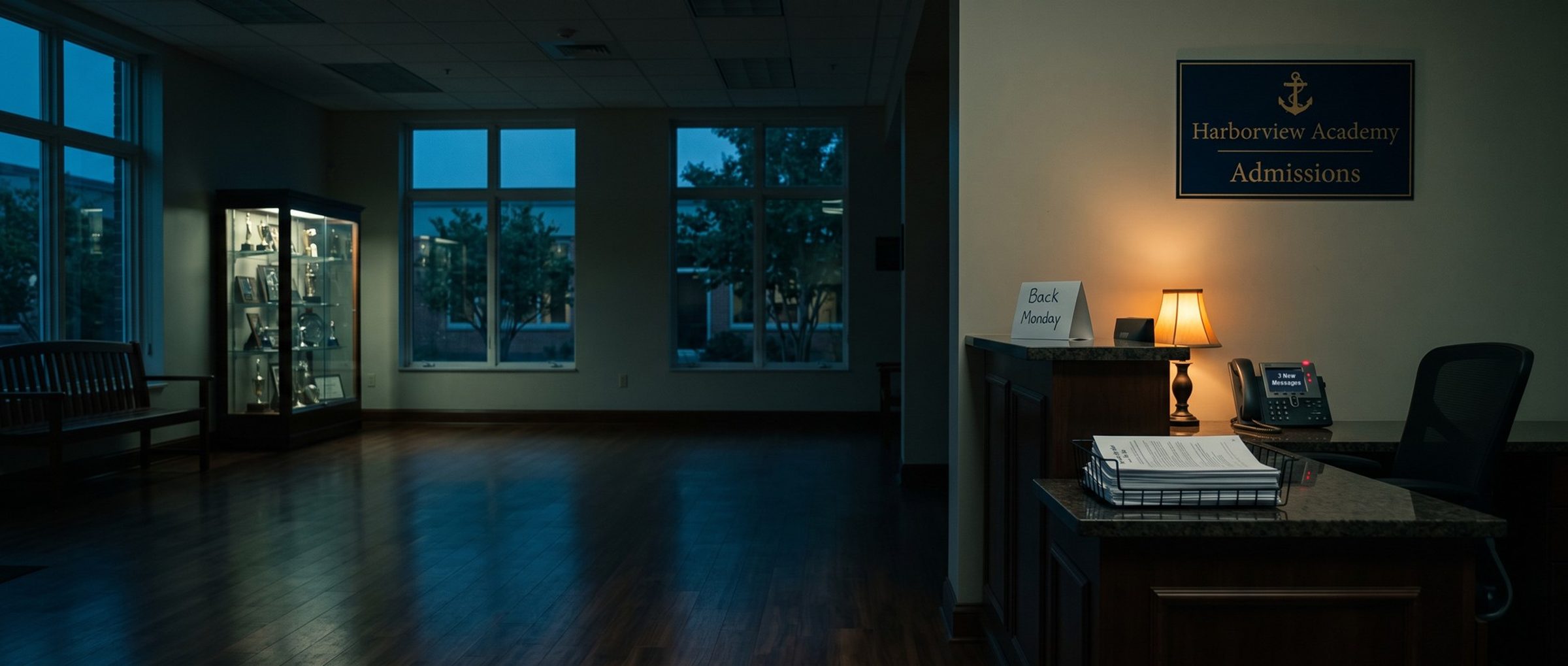
By the time an inquiry reaches admissions, the school has already paid for it. Google charged for the click, the program page did its job, and a family typed in a name and a phone number. What happens next decides whether that money buys a student, and at many schools, nothing happens fast enough.
This chapter covers what secret-shopper tests have found about how schools answer, what families say about it, what a slow answer does to the cost of each enrolled student, and the consent rules for calling and texting the families who asked.
Secret Shoppers Sent Inquiries to 432 Colleges. 38% of the Colleges Never Wrote Back.
Liaison, a company that sells enrollment software to colleges, runs a recurring test. Its 2024 Undergraduate Inquiry Response Project sent secret shoppers, acting as high school seniors looking at fall 2025, to fill out inquiry forms at 432 colleges, then tracked every response for four weeks. Because Liaison sells response tools, read its framing with that in mind; the counts themselves are what the shoppers saw.
What they saw:
- 38% of colleges never responded to the inquiry at all, up from 25% in Liaison's 2021 round.
- 25% either had no inquiry form or had one that was hard to find, up from 16% in 2021.
- Only 17% sent a personalized response tied to the student's interests. Over half, 55%, replied with a generic message.
- Only 36% used both digital and traditional channels, such as email plus a call or a mailed piece.
Liaison notes the drop coincides with volume: students now express interest in more schools at once, six to eight on average by the figure it cites, so each college gets more inquiries and each family hears from more colleges. A slow school is competing with faster ones for the same family.
Liaison recommends a first response within 10 minutes. It also reports that 52% of students "ultimately enrolled at the institution that contacted them first," down from 61% in 2021, though the report doesn't identify the study behind that figure, so treat it as Liaison's claim.
Other tests point the same way. An online program management company, AllCampus, cites a UPCEA secret-shopper study of 1,000 inquiries in which 44% got no response and the median response time among the rest was 3 hours and 18 minutes. We haven't read that study directly. And outside education entirely, InsideSales' research across 5.7 million inbound leads found conversion rates eight times higher when a lead was contacted in the first five minutes than when they were contacted between five minutes and 24 hours later. It's not school data, but the direction matches everything the education tests found.
Families Remember a Slow Admissions Office. In the 826 Reviews We Read, It Drew More Complaints Than Cost Did.
When we read 826 reviews of our twelve example schools in the Salt Lake City market, admissions and enrollment communication drew more complaints than any other theme: 136, against 122 about cost, tuition and debt. Our Google sample leaned toward negative reviews on purpose, so these are counts, not rates. The complaints were about calls and emails that went unreturned, conflicting answers, classes full or enrollment windows closed, and staff who were attentive until the money arrived. One reviewer at an online nursing college put it bluntly:
"you'll meet with all kinds of support staff and once your loans come through or you pay, it's crickets- everyone disappears"
The opposite failure shows up too. A reviewer at an online career training school wrote: "I repeatedly told her that I wanted time to think about enrolling before making a decision, but I felt pressured to sign up immediately." Fast and pushy is not the goal. A family wants to hear back quickly, get a straight answer and be allowed to decide.
Schools that get it right hear about it. A student at an online university wrote that the "entire process from applying to enrollment is fantastic." The praise in our reading looked like that: a named advisor and a fast, clear enrollment.
Every Inquiry From Google Has Already Been Paid For. An Unanswered One Raises the Cost of Every Student.
Chapter 3 worked through a private school example: a $7 click, one inquiry in ten clicks, about $70 per inquiry. Now suppose that school answered inquiries the way 38% of Liaison's colleges did, which is to say not at all for a share of them. Our arithmetic: if 38 of every 100 inquiries go unanswered, the school still paid $7,000 for the 100, but only 62 families ever heard back. The real cost per answered inquiry is about $113, not $70, before a single family has toured.
Nothing in the Google Ads account shows this. The account reports $70 per inquiry, Smart Bidding keeps buying inquiries at $70, and the leak happens after the conversion fires. It's the same blind spot Chapter 1 described for tracking: Google can count the inquiry, but only admissions can turn it into a student.
So the answer process belongs in the advertising plan:
- A response target. Practitioners we read set targets from two minutes to an hour; Liaison recommends 10 minutes. Pick one admissions can actually meet during office hours, and say what happens after hours.
- Calls from ads go to a person. The call extension and the phone number on the program page should ring someone who answers during the hours ads run, not a general switchboard. If the ad schedule runs at night (Chapter 9), a voicemail that's returned first thing the next morning still counts. Chapter 1 set the 30-second call threshold partly because a parent leaving a voicemail is a real inquiry.
- Forms trigger a person, not just an email. An inquiry form should alert admissions immediately and send the family a confirmation that says when to expect a call and from whom.
- One owner per inquiry. The family should hear from one named person, not three offices.
- Close the loop. Chapter 7 covered sending applications and enrollments back to Google. That only works if admissions records what happened to each inquiry.
The first call itself matters as much as its timing. A good one is short and useful: the caller says who they are and why they're calling, answers the question the family asked on the form, offers the next step that fits (a tour, a shadow day, an information session, a call with financial aid) and books it on the spot if the family wants it. It doesn't push for an application. Chapter 8 found that families praise schools for being known; the first call is where that starts.
After hours, a text or email that arrives within minutes and names the person who'll call in the morning does most of the work a call would. Families mostly want to know the inquiry landed with a person.
Measure it. Whatever system admissions uses should record when each inquiry arrived and when someone first reached out. Review the gap weekly, by source, so the inquiries from Google don't sit behind referrals and walk-ins. A school that tracks its own response time usually finds the slow spots fast: Friday afternoons, holiday weeks, the week before a deadline.
Calling a Family That Asked Is the Job. The FTC Went After Schools for Calling Families Who Never Asked.
Calling and texting fast raises a fair question: what consent does a school need? The rules changed recently.
In 2023, the Federal Communications Commission adopted a "one-to-one" consent rule that would have limited how consent collected on comparison and lead-generation sites could be used. In January 2025, the US Court of Appeals for the Eleventh Circuit vacated that rule, holding that the FCC had exceeded its authority, and the FCC formally removed it in July 2025. Under the court's reading, the baseline for prior express consent to automated calls is that a person "clearly and unmistakably" state, before the call, that they're willing to receive it. For automated calls and texts that market something, FCC rules still require the person's written consent, which a clearly worded checkbox or signature on the form can provide. In September 2026, the FCC also adopted rules that let callers name a single way for people to revoke consent.
The federal cases involving schools in recent years have been about something else. In 2019, the FTC settled with the for-profit college operator Career Education over leads bought from more than 70 lead generators, some of which acquired them through deception or illegal calls; the FTC said the company should have known. In 2023 it sued Grand Canyon Education over advertising claims and over calls to numbers bought from lead generators, a case the FTC dropped in August 2025. The common thread in those cases was contact with people who hadn't asked the school to call.
Our reading, which isn't legal advice: a family that fills out the school's own inquiry form and asks to be called or texted has given the school a clear basis to contact them about that inquiry. Make the consent explicit on the form, in plain words next to the phone number, and keep a record of it. Honor any request to stop, by whatever reasonable means the family uses, which is stricter than the new FCC rules require and simpler for families. And treat purchased lead lists, especially from sites that collect one form for many schools, with far more caution than the school's own inquiries. If your school uses a lead vendor or a texting platform, ask counsel to review the consent language before scaling up.
None of this argues for slowing down. The families who filled out the form asked to hear from the school. The risk in the cases above came from calling people who never asked, not from answering people who did.
Next: Placement and Salary Claims in School Ads
Chapter 16 covers the claims trade schools and online programs most want to put in ads, job placement and salaries, and what it takes to back them up. If your school has an affiliated foundation, Chapter 14 covers Ad Grants. All sixteen chapters are listed on the Google Ads for Education guide home. If you'd like a hand connecting your ads to your admissions follow-up, here is how our Google Ads management runs for schools.