
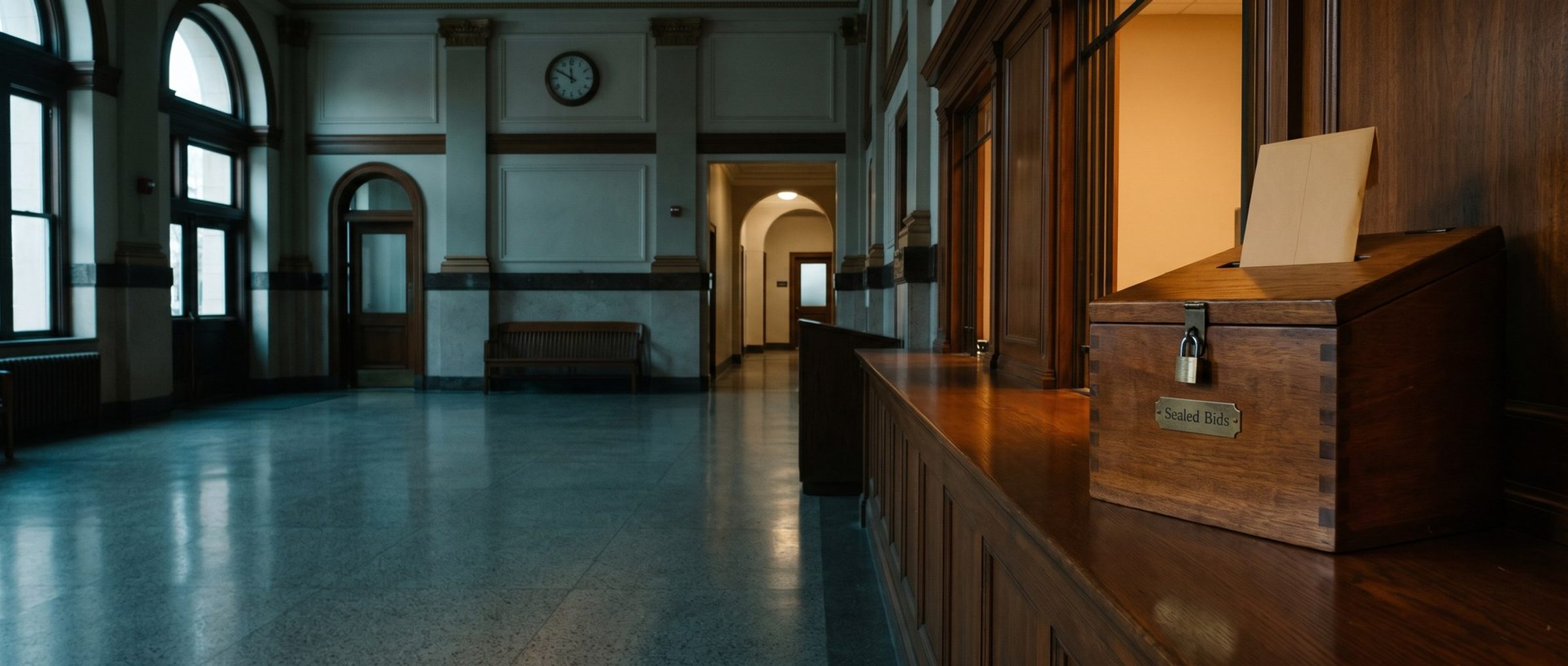
Construction runs on bids. Builders bid jobs, subcontractors bid scopes, public agencies open sealed bids on a set day. So it's natural for a builder setting up Google Ads to think about the word: should the ads say "request a bid," should the keywords include "construction bids"?
In our example market, no builder's ads used the word at all. The only advertiser that did was selling something else entirely.
This bonus chapter covers who uses "bid" in ads and searches, how public owners actually buy construction, how much construction is bought on low bid in the first place, and what that means for a builder's Search campaigns. It follows Chapter 13, which covered AI Max.
"Bid" Appeared in a Directory's Ads Aimed at Contractors, and in No Builder's Ads at All
Chapter 7 collected the Search ads that construction websites in the example market, Cincinnati, ran between August 1 and October 30, 2026, using Google's Ads Transparency Center. Chapter 8 read the 116 readable ads from 19 builders, specialty trades and remodelers. None of them used the word "bid." Not in a headline, not in a description, not as a call to action. Builders asked owners to call, to contact them, to request a consultation or a quote. Nobody asked an owner to request a bid.
The word did show up in one place: the ads collected under the website of The Blue Book, a construction directory that sells project leads and visibility to contractors. Its parent company, Dodge, ran all 15 of them, and 9 used "bid" or "bidding." A few examples of what they said:
- "Access Projects that are Bidding Right Now."
- "Subcontractor Bidding Site."
- "Largest Construction Bidding Website," in ads aimed at roofing and drywall firms.
Those ads aren't aimed at owners, and a builder bidding against them for the same clicks would be paying to reach its own competitors and subcontractors. They're aimed at roofers, drywall firms, tile setters and other contractors looking for projects to bid on. The directory's ads read as if it knows its audience: contractors on the selling side of a bid.
"Construction Bids" Gets About 1,000 Searches a Month, in Phrases That Read Like Contractors Looking for Work
Keyword Planner tells the same story from the search side. Across the US:
- "Construction bids" (with "construction bidding," which Google groups with it): about 1,000 searches a month.
- "Construction bid sites": about 590.
- "Bid opportunities": about 590.
- "Government construction bids" and "commercial construction bids": about 90 each.
- "Public works bids" and "construction bid opportunities": about 40 each.
Keyword Planner doesn't say who types a search, so read those phrases as an owner would type them. They don't fit. An owner planning a dental office doesn't search "bid opportunities" or "construction bid sites." A contractor looking for its next project does. These are the same people the directory's ads were chasing.
For a commercial builder, that makes "bid" a negative keyword, not a keyword. Add it to the account-wide negative list from Chapter 5, along with its relatives: bids, bidding, bid board, bid list, out for bid, RFP, invitation to bid. When broad match starts (Chapter 7), watch the search terms report for more: "projects to bid on near me," "subcontractor bid," "plan room." Each is a contractor, not a client.
It's worth being precise about the list, because "bid" also shows up in phrases an owner might use about their own project, such as "how many bids should I get." Those searches don't name a builder or a building type, and they come from people early in the process, often before an architect is involved. They're not worth a click at a commercial builder's cost per click, but they're also not the same audience as "construction bid sites." Watch them in the search terms report and decide case by case.
There's one exception worth keeping in mind. An owner who has already chosen a few builders may type a builder's name with "bid" or "proposal" after it, looking for how to send drawings. Those searches belong in the brand campaign (Chapter 5), where an exact match keyword on your name catches them anyway.
Public Owners Post Their Projects on Portals and Can Forbid Bidders From Making Contact
Public construction works differently from private. A city, county, school district or state agency typically posts a solicitation, takes sealed bids or proposals, and awards the work under its procurement rules. New York's procurement law, for instance, defines a "restricted period" that runs from the earliest posting of a solicitation to the final contract award. The owner isn't searching Google for a builder; it's posting a solicitation and waiting for bidders to find it.
Bidders find it through portals and plan rooms. BidNet Direct describes itself with "Find government bids matching your business," and Dodge offers to "See every project before bid day." Builders then use tools such as BuildingConnected's "Bid Board" and PlanHub, where subcontractors "Bid on the best fit projects," to price the job with their trades. In our reading, that's where public work is found and priced, and a Google ad isn't part of the chain.
Some public owners go further and restrict contact once a project is out for bid. Miami-Dade's procurement page says its "Cone of Silence prohibits any communication regarding a particular RFP, RFQ or bid solicitation after they have been advertised," while noting that "Written communications, copied to the Clerk of the Board, are permitted at all times." New York State's procurement lobbying law, State Finance Law 139-j, restricts contacts between bidders and the agency during a "restricted period," and a related section requires every contact in that period to be recorded.
Neither source says whether a public online ad counts as a contact. Our reading: an ad aimed at the general public isn't a communication with the agency. But a builder should never run an ad that names a live solicitation, or aim ads at a list built from an agency's staff while a bid is open. Check the solicitation's own rules, and when in doubt, ask the procurement office in writing. Miami-Dade's own page allows written questions copied to the clerk, which is the safe channel when an answer matters.
Design-Bid-Build Was 19% of Construction Spending in One Industry Study, and It's Shrinking
If low-bid public work were most of construction, this chapter would be bad news for Google Ads. It isn't.
FMI, a construction consulting firm, studied delivery methods for the Design-Build Institute of America. It looked at the building and infrastructure segments where these methods apply, about half of all US construction spending. In those segments, design-bid-build, the classic low-bid method, was 19% of construction put in place from 2019 to 2023, and FMI's forecast for 2024 to 2028 puts it at 11%. Design-build was 44% and is forecast at 47%. Other alternative methods, such as construction management at risk, were 37% and are forecast at 42%.
That's one study, and it measures dollars, not projects; a few huge projects can move the shares. But the direction matters for a builder deciding where advertising fits. In the segments FMI studied, most construction dollars go through methods where an owner chooses a builder, or a short list of builders, based on qualifications, experience and fit, not only on price. That's the decision a Search ad, a strong landing page and a set of good reviews can influence.
Search Ads Reach the Private Owner Picking a Builder, Not the Agency Opening Sealed Bids
Put together, the picture is clear enough to plan around:
- Private, negotiated and design-build work is where Google Ads earns its keep. The owner is choosing, often from a short list, often after an architect's recommendation (Chapter 11). The searches from Chapters 2, 4, 5 and 6, the landing pages from Chapter 4 and the reviews from Chapter 12 all serve that owner.
- Public low-bid work runs through portals, prequalification and the solicitation's own rules. A builder who wants it registers on the portals, gets prequalified with the agencies it wants to work for, and reads every solicitation's contact rules. None of that is a Google Ads job.
- Bid searches, in our reading, are mostly other contractors. They're negatives, not keywords, unless the builder is also looking to hire subcontractors, in which case they belong in their own campaign with their own goal, like the hiring campaigns in Chapter 16.
A builder that does a lot of public work can still use Google Ads for the private side of its business, and for the brand campaign that catches owners who search its name after seeing it on a public project. A finished school, library or fire station with the builder's name on the fence for a year is free advertising to every private owner who drives past, and some of them will search the name. The brand campaign is there to answer them. It just shouldn't expect a Search ad to win a sealed bid.
If you'd like help sorting which of a builder's work Google Ads can reach and setting up the negatives that keep bid-hunters out, our Google Ads agency does this with commercial builders.
Next: Five States Require a License Number in Contractor Ads
Chapter 15 covers the claims in construction ads that carry legal weight: license numbers, "bonded," and certifications such as LEED and small-business designations. The full chapter list is on the Google Ads for Construction Companies guide home.