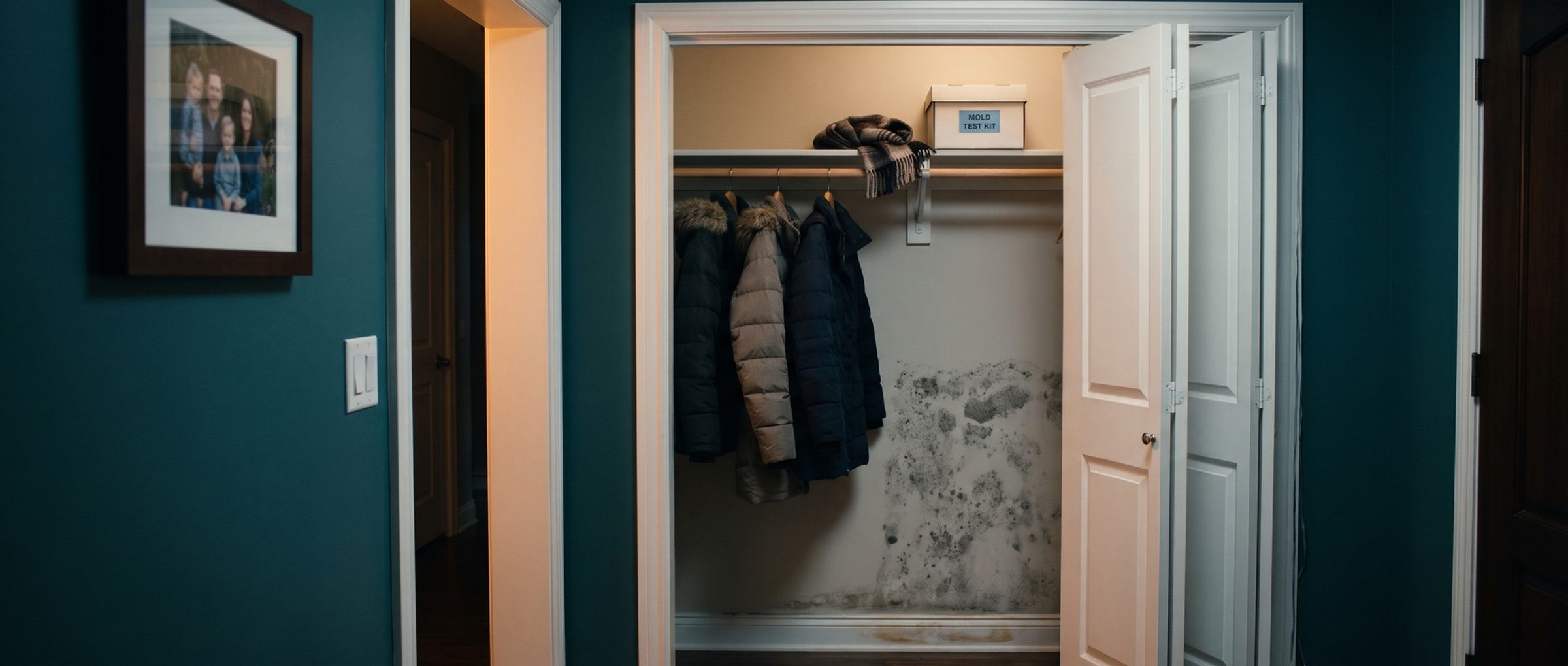
Most of this guide treats mold as one of three services, next to water and fire. In search data, it's bigger than that. Homeowners search for mold work about as often as they search for water damage restoration, and they search differently: more research, more testing, less emergency.
Mold also comes with rules water damage mostly doesn't. Several states license the work itself, a few make advertising it without a license unlawful, and several forbid the same company from testing for mold and then removing it. A mold ad that's fine in one state can be a problem in the next.
This chapter covers why mold gets a campaign of its own, which searches belong in it, and where the state lines sit. As in Chapter 14, it describes laws as we read them in 2026. It isn't legal advice. Have counsel in your state review mold ads before they run.
Homeowners Search "Mold Remediation" as Often as "Water Damage Restoration." Each Draws 90,000 or More US Searches a Month.
Keyword Planner has put "mold remediation" at about 90,500 to 110,000 US searches a month across our pulls, level with or ahead of "water damage restoration" at about 90,500. "Mold removal" draws tens of thousands more. In one example market, Sacramento, the gap was wider: about 720 a month for "mold remediation" against 390 for "water damage restoration."
Chapter 5 saw the same thing from the other direction: when we seeded Keyword Planner with restoration websites, mold searches floated to the top of most lists. Volume isn't value, though; Chapter 5 cited a trade survey in which far more restorers named water damage, not mold, as their most profitable work. Mold is a large, real source of jobs. It just isn't the same kind of job, and the account should treat it differently.
Mold Searches Need a Campaign of Their Own. Across the US, a Mold Click Usually Costs Less Than a Water Damage Click.
Chapter 4 put mold in its own ad group with its own page. At scale, it deserves its own campaign too, and the bids are the first reason. Keyword Planner's US top-of-page range for "mold remediation" runs about $6 to $40, against about $15 to $88 for "water damage restoration." Share one campaign and one budget between them, and you can't set or see what each service is costing you on its own.
Local markets don't always follow the national pattern. In the example market, "mold remediation near me" topped out near $136, higher than the main water damage searches there, such as "water damage restoration" at about $96. That's another reason to give mold its own budget: you can only see and manage its real price when it isn't blended into water's.
The other reasons are rules. Google's Local Services Ads put mold inside the single water damage category (Chapter 12), so Search is where mold gets ads written for it. Searchers behave differently too. A burst pipe is an emergency; a musty closet usually isn't. Mold searchers read about testing and ask what removal costs, so the mold page needs more explanation than the water damage page: what containment looks like, how long the work takes, how the company confirms it's done. A separate campaign lets the mold ads point to that page and be judged on their own booked jobs.
Licensing is the third reason. A restorer whose service area crosses a state line may be licensed for mold on one side only. With mold in its own campaign, its targeted areas can stop at that line, while the water damage campaign keeps serving both sides.
"Mold Testing Near Me" Draws 33,100 Searches a Month. In Several States, the Company That Tests Can't Fix the Same Job.
A big share of mold searching is about testing. Nationally, "mold testing near me" and "mold inspection near me" each show about 33,100 searches a month in Keyword Planner. Identical counts and identical bid ranges suggest Keyword Planner is counting one pool of searchers under both phrasings (Chapter 5). People want to know whether they have a problem before they pay to fix it.
Here's the catch for a restoration company. Several states bar one company from both assessing mold and remediating it on the same job:
- Texas. Occupations Code 1958.155: a license holder "may not perform both mold assessment and mold remediation on the same project," and no one may own an interest in both companies on the same project.
- New York. Labor Law 936: no licensee "shall perform both mold assessment and mold remediation on the same property."
- Louisiana. R.S. 37:2187(B) has the same same-property rule.
- Florida. Statute 468.8419 bars a company from both assessing and remediating the same structure within 12 months, in either order, except for Division I certified contractors.
- Oklahoma. 15 O.S. 765.4 bars the same company from inspecting and removing mold unless the total is $200 or less and the homeowner agrees.
So "free mold test with every remediation" is the offer to be most careful with. In those states, a remediation company may want testing searches as negatives in its mold campaign, or a page that explains plainly that an independent assessor does the testing. Have counsel review any combined test-and-fix offer.
Four States License Mold Work. In New York and Louisiana, Even Advertising It Without a License Is Unlawful.
Texas, Florida, Louisiana and New York each license mold work, and the District of Columbia does too. The details differ:
- Texas licenses mold assessment and remediation through its Department of Licensing and Regulation. A license isn't required for remediation of less than 25 contiguous square feet.
- Florida licenses mold assessors and remediators for jobs over 10 square feet, and protects titles like "mold remediator" and "certified mold remediator."
- Louisiana requires a mold remediation license, and R.S. 37:2185 says no one may "advertise or hold himself out" as doing mold remediation without one.
- New York licenses mold work on areas over 10 square feet, and Labor Law 931 makes it unlawful "to advertise or hold themselves out as a mold remediation contractor" without a license.
Many of the states we checked have no mold license. Two require certification instead: Virginia makes offering residential mold remediation without a recognized certification a prohibited practice, and Connecticut requires home improvement registration plus a certification such as IICRC. California's health department says there's no legal requirement for licensing mold remediators there, Washington's says the same, Maryland's mold licensing law ended in 2019, and Illinois has passed a registration law whose rules aren't yet in effect.
For ads, the practical rule is short: run mold ads only in places where the company is licensed or no license is required. For an unlicensed company in New York or Louisiana, running "mold removal" ads is a problem before any work happens: the ad itself breaks the rule.
The EPA Sets No Standard for Airborne Mold. A "Mold-Free" Guarantee Promises Something No One Can Measure.
Mold ads are tempted by fear and by guarantees: "100% mold removal," "mold-free guaranteed." The trouble is what "mold-free" would even mean.
The EPA says plainly that "there are no EPA regulations or standards for airborne mold contaminants," and that sampling can't be used to check compliance with federal mold standards because none exist. New York's Department of Labor makes the same point. A guarantee measured against no standard is a promise nobody can check.
Some states put that into their rules. Texas's code of ethics for mold licensees bars claims "not readily subject to verification" in advertising, along with representations designed to take advantage of the public's fears or emotions. DC's rules say much the same, and Florida's mold law bars false, deceptive or misleading advertising.
Write the process instead. What the crew does, how the work is contained, what standard it follows. Chapter 6 covered Google's own rule against leaning on a bad life event to scare people, and a messaging restriction like the price one in Chapter 13 can tell AI Max not to generate "mold-free" or health claims.
A Certified Technician Doesn't Make a Restoration Company a Certified Firm. The IICRC Publicly Lists Companies Misusing Its Logo.
The IICRC's standard for mold work is ANSI/IICRC S520, now in its fourth edition, from 2024. Citing it is a fair way to describe how a company works. Using the IICRC's logo is a different matter.
The IICRC distinguishes certified technicians from Certified Firms. A firm needs current liability insurance, at least one active certified technician on file and a completed firm application, and each location that should appear in the IICRC's locator has to be certified separately. The IICRC also publishes a list of companies that violated its logo usage policy, firms it says aren't registered and aren't permitted to show the logo on their websites, communications or vehicles.
So check the registration before the logo goes on a mold landing page or an ad image. "Our technicians are IICRC certified" and "IICRC Certified Firm" are two different claims, and only one of them may be true for your company.
Next: Some "Local" Water Damage Sites List Out-of-State Phone Numbers.
Mold searchers are often careful researchers. The last chapter is about the companies that take advantage of homeowners who aren't: lead sellers and call networks that look local, sell the call to whoever pays, and compete in the same auctions. Chapter 16 covers how to spot them and how your ads can show you're actually nearby.
Want the whole plan first? The guide home lists all sixteen chapters. Chapter 14 covers the insurance rules that sit alongside these.
When a restoration company hands us its account for Google Ads management, mold runs in its own campaign, only in the places the company is licensed to do the work.